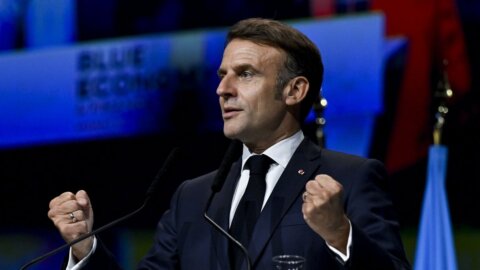
Emmanuel Macron sends a strong signal to Europe: it's time to shake things up. In an interview with Le Monde and to six other European newspapers, the French president outlines his for successful corporate training for a more ambitious Union, made up of Eurobonds, market unique strengthened and strategic investments in defense, intelligence artificial e transition greenThe move comes at a delicate time: theunderstanding between Giorgia Meloni and Friedrich Merz It risks isolating the French line, while Brussels seems ready to redraw the political and economic balance.
Despite the firmness demonstrated at Davos and his activism on the ground—from his visit to ArcelorMittal in Dunkirk to the industrial summit in Antwerp—Macron faces his final year as head of state amidst domestic challenges and European skepticism. Amid political instability in Paris and doubts about his partners, his vision of strategic autonomy appears to be struggling with a more pragmatic Europe, less inclined to follow the pace dictated by the Elysée.
Europe must choose its future
In the interview, Macron relaunches his appeal: a common EU debt to finance defense, artificial intelligence, quantum technologies, and the ecological transition. "If we want it to preserve the internal market, to prevent it from fragmenting even further, we mustn't push it back onto the nations. It must be a joint investment," he says, emphasizing the need for collective and coordinated action.
"Europe is, in fact, the adjusting factor for the rest of the world. The question is whether we are capable of becoming a power, economically, financially, militarily, and even democratically. The EU must decide whether to become a power or it will be swept away," adds the head of the Elysée, highlighting how China has accelerated enormously, with a surplus of 1.000 billion euros with the rest of the world, and warns that if Europe it remains a market open to the four winds risks being surpassed.
Three strategic battles
For Macron, Europe must concentrate its energies on three main fronts. of your digital ecosystem. , defense remain priorities in order not to fall behind China and the United States. technologies of transition ecologica require immediate investments to ensure sustainability and industrial competitiveness. Finally, intelligence artificial and quantum technologies represent the third crucial front: if the EU does not act in the next 3-5 years it risks being "swept away" by these sectors.
The annual requirement estimated by Macron to support these priorities is approximately 1.200 billion euros between public and private investments, calculated starting from the numbers indicated by Mario Draghi: "Mario Draghi estimated the need for public and private investment in green and digital technologies at 800 billion euros per year. If we add defense and security, we arrive at approximately 1.200 trillion euros per year."
Single market and industrial autonomy
On the economic front, Macron calls on Europe to "become an adult." His vision includes simplification and reinforcement of the market internal use, the union of capital markets and the integration of electricity networks, creating a native market of 450 million consumers instead of the current 27 separate markets.
At the same time, Macron is aiming for new trade partnerships, such as the one just signed with India, to reduce strategic dependencies and stimulate growth. It also proposes a brand “Made in Europe” and public procurement rules to support European industry and increase strategic autonomy from America.
Defense and joint military projects
On the industrial and defense front, Macron defends the Franco-German fighter aircraft project (FCAS), at risk according to rumours, linking it to the common tank"It's a good project. If Germany were to question the common aircraft, we would be forced to reevaluate the tank as well. When industrialists try to forgo synergies, that's one thing, but it's not up to us to defend it. We'll discuss it again with Chancellor Friedrich Merz," explains the French president, reiterating the need for coordination and protection of European industrial synergies.
A two-speed Europe ahead of the summit in Belgium
While Macron insists on European preference, Meloni e Merz, together with the Belgian Bart DeWever, they called a pre-summit Thursday, February 12 in Alden Biesen, with over a dozen EU leaders, including many Nordic and Eastern European countries. The aim is to define a common line on deregulation, the single market and the centrality of trade, in continuity with the Draghi's report e Read on competitiveness. The two former Italian prime ministers will join the 27 after Mario Draghi had invited the Union to work as a true community and to adopt a “pragmatic” federalist approach for common projects, from energy to security.
The Nordic and Baltic countries warn: a generalized European preference "risks driving away investments." The German minister Katherine Reiche He warns: "Isolation is not the answer," advocating an open approach to global partners. Belgium will therefore discuss not only competitiveness, but the future of the EU.
Two days after the informal summit, theEurope appears divided Between Macron's federalist vision and the more pragmatic approach of Rome and Berlin. For the French president, the time to decide is now: "Leaving the state of minority" is his warning to the Union.