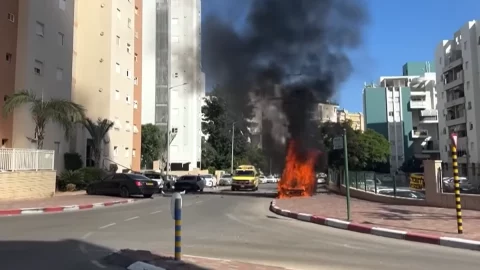
Nothing ever happens "by chance". And it is no coincidence that the massive attack launched by the Islamic fundamentalists of Hamas in the Gaza Strip into the Jewish State occurs just as the negotiations for a agreement between Israel and Saudi Arabia, in which the Palestinian National Authority participates, the entity that has governed the autonomous Palestinian territories in the West Bank since 1993. And in history we have seen that every time we glimpse the possibility of peace in the Israeli-Palestinian conflict someone relights the fuse. But what exactly is Hamas, who are the terrorists who belong to it, who finances them, what are its objectives and why has it attacked Israel now?
The political and military power of Hamas
Acronym for Harakat al-Muqawama al-Islamiyya (Islamic Resistance Movement), Hamas is a Palestinian, Islamist, Sunni and fundamentalist political and paramilitary organization founded in 1987. Politically Hamas rules Gaza since in 2006 won the elections legislative elections (the last ones to have been made), becoming the first party in the strip of land delimited between Egypt, Israel and the Mediterranean where approximately 2 million Palestinians live.
In Gaza, Hamas runs schools and hospitals and has implemented many principles of Islamic law. He established a “moral police”, banned the consumption of alcohol and imposed several limitations on women, for example relating to clothing or such as the ban on going around accompanied by men other than one's closest relatives or one's husband.
Hamas is internally divided into various currents, with strong influences from foreign countries and financiers. One of the main currents, less radical in its opposition to Israel, is that which refers to the Qatar, while the faction of the so-called “iraniani” is more faithful to the founding statute, which included the “destruction of Israel” among the objectives.
Hamas also has a more narrow soul military: check the Ezzedin al-Qassamal Brigades, who have been fighting Israel and its army for years, especially with rocket launches. Its main rival is Fatah, the party that came second in the 2006 elections and which until then had expressed the president of the Palestinian National Authority, who officially renounced the use of violence and armed struggle.
Both the political wing and the military wing are considered a terrorist organization from numerous Western countries or allies of the West, including the United States, the European Union, Canada, Japan and Israel; while the United Kingdom, Australia and New Zealand consider only the military wing a terrorist organization.
In the founding statute of Hamas there is the destruction of Israel
Hamas was founded in 1987 on the initiative of Sheikh Ahmad Yassin, who was then killed in 2004 by an Israeli air attack. But the first activities of what would become Hamas under Yassin's leadership date back to the XNUMXs. Yassin becomes the religious leader, assisted by Abd al-Aziz al Rantisi and Mahmud al-Zahar, political-military leaders, against the backdrop of the first Intifada, the "revolt of stones" triggered by young Palestinians against the Israeli forces in the Occupied Territories.
In essence, Hamas is the Palestinian arm of the Muslim Brothers, an Arab fundamentalist organization present in various countries, which aims to fight Israel with terrorist attacks.
Il founding statute of Hamas established a series of very precise principles including the statement that "there is no solution to the Palestinian question except in Holy war” with the goal of returning all of Palestine to its 1948 borders, including the state of Israel today. In 2017 that statute was replaced by a new version, which however does not radically change the objectives.
In 2009, Khaled Meshal, head of the political wing of Hamas, declared himself in favor of a solution that included a Palestinian state with East Jerusalem as its capital "on the 1967 borders", that is, in practice only in the West Bank and Gaza, the territories that Israel conquered that year in the Six Day War and which it has occupied ever since.
In 2017, without recognizing Israel, the Hamas leadership reiterated its acceptance of a Palestinian state within the 67 borders. Some commentators do not exclude that Hamas could be involved in a peace negotiation, as did another group long considered a terrorist organisation, Yasser Arafat's PLO, later awarded the Nobel Peace Prize together with the Israeli prime minister. Yitzhak Rabin and Israeli Foreign Minister Shimon Peres. The last major wave of high-intensity clashes between Hamas and the state of Israel occurred in May 2021: they lasted eleven days, before a temporary ceasefire. Since then, however, rocket launches by Hamas have been recurrent, as have responses with military operations by the state of Israel.
Funds to Hamas: direct and "indirect" ones
Initially the funds reaching Hamas come from Saudi Arabia and Syria. Subsequently, Hamas becomes the main financier Iran, which sends an average of 100 million dollars a year in money, humanitarian aid and weapons to the Gaza Strip: despite being a Shiite Islamic country, therefore not Sunni like the Palestinians, Tehran sees Hamas as one of the fundamentalist groups allied with fight his proxy war against Israel.
Le Iranian Revolutionary Guards they also send funds to Islamic Jihad, the other Palestinian terrorist organization that operates both in the Gaza Strip and in the West Bank. But Hamas also receives funding from Qatar and others Arab countries, according to a reconstruction by Repubblica. Furthermore, they reach Hamas indirectly the humanitarian donations sent to Gaza by the UN, byEuropean Union, from Norway, from Japan, from Australia and from other nations. Finally it should be remembered that a crucial source of financing for the strip is Israel, which transfers to Gaza the salaries of the thousands of Palestinians admitted to work as commuters in the Jewish State: an economic cooperation that is however suspended for long periods when the conflict reignites, as in recent days.
What convinced the people to prefer Hamas in the 2006 elections?
La Hamas victory in the Palestinian legislative elections of 2006 took me by surprise Mahmoud Abbas, the president of the Palestinian National Authority (PNA). Until then, like its predecessor Arafat, Abbas had extended his authority over both the West Bank and Gaza. But Hamas has gradually increased the consent in all Palestinian territories, particularly in those poorer of the strip. She succeeded for three reasons: one more ascetic style compared to that of Abbas' PNA, perceived as corrupt by the majority of the population (PNA leaders live in luxury homes and travel in Mercedes, Sheikh Yassin lived in a shack with an earthen floor and traveled around on foot) ; there fundamentalist preaching Islamic compared to the secularism of the PNA; and the military radicalism, against any concession to Israel.
The result is that for almost two decades the Palestinian leadership, united under Arafat, has found itself divided into two factions that fight each other politically and sometimes even militarily: the PNA, which governs the cities of the West Bank, although with increasing difficulty because even there favors for Hamas and Islamic Jihad are growing (this is why Abbas postpones new elections from year to year, fearing he will lose them even at home); and Hamas, which governs the Gaza Strip and is increasing support in the West Bank. A dualism with different positions on the conflict with Israel, which has therefore contributed to paralyzing the peace negotiations.
The actions of Hamas: from suicide bombers to rockets
In a first phase of its operations, Hamas attacked Israel only with terrorist attacks. The first were shares of kamikaze who blew themselves up at the bus stop or in nightclubs full of Israeli civilians. Among these, the attacks in Jerusalem in 1997 and in Rishon LeZion in 2002 (16 Israeli civilian victims each) and the one on a bus in Haifa in 2003 (17 victims, mostly children and adolescents) stand out. Suicide attacks multiplied during the Second Intifada, resulting in hundreds of Israeli victims in total.
Since 2001, Hamas has also begun to attack Israel with rockets, imported clandestinely through the tunnels on the border between Egypt and Gaza or made with rudimentary but equally effective means. Due to the frequency with which conflicts break out between Hamas and Israel, we are now talking about "Gaza wars".
Here are some of them: with a raid on the territory of the Jewish state, in 2006 Hamas captured Gilad Shalit, an Israeli soldier, provoking weeks of air raids and incursions to try to free him (he was released five years later in a prisoner exchange); in 2008 Hamas launches rockets on the Israeli city of Sderot, Israel responds with a military offensive that lasts 22 days in which 13 Israelis and 1400 Palestinians die; in 2014 the kidnapping of three Israeli teenagers by Hamas causes seven weeks of war with the death of 73 Israelis and 2100 Palestinians; in 2021 Hamas launches rockets on Jerusalem, Tel Aviv and other Israeli cities in response to clashes on the Jerusalem Mosque Mount between Palestinians and Israeli forces during Ramadan, Israel responds with aerial bombings, a total of 13 Israelis and 260 Palestinians die. Other similar flare-ups will break out in 2022. But there has never been an incursion by armed Hamas militants of the size of today's, accompanied by rocket fire: an action from which to expect one of the harshest Israeli responses ever.
The difference, in the wars in Gaza, is that Hamas attacks civilian populations by striking at random, be it suicide bombings or rocket launches into cities, while Israeli raids from the air and on the ground try to hit targeted targets, i.e. installations or military and political leaders of Hamas, even if these actions also cause "collateral damage", as Israel calls it, causing huge casualties among Palestinian civilians.
The reasons for the new attack
There are at least three possible reasons behind the sensational surprise incursion of these hours, according to the reconstruction of Repubblica. The first is the negotiation for a historic peace agreement between Israel and Saudi Arabia, which would be the definitive and most important piece of the Abraham Accords signed by Israel with three Arab countries (United Arab Emirates, Bahrain and Morocco) under President Trump. The Palestinian National Authority, represented by President Abbas' closest advisors, participates in the negotiation, mediated by the United States. Between the condizioni of the agreement requested by the Saudis are there Israel's concessions to the PA, agreed by Riyadh with the Palestinians, to restart the peace process, which has been blocked for years.
If the negotiations were successful, Abbas would achieve a significant political victory, capable of reviving him after a long period of stasis in which he increasingly lost favor among the Palestinians. Attacking Israel so blatantly, resulting in a predictable lethal outcome Israeli response, will likely put Abbas in difficulty in reaching an agreement with the Saudis and, indirectly, with the Israeli government of Benjamin Netanyahu. It's a tactic often seen in the Israeli-Palestinian conflict: radicals on both sides fan the flames to prevent moderates from finding a compromise agreement.
An second reason it is the historical precedent of the Yom Kippur war, when in 1973 Egypt, Syria and other Arab countries attacked Israel on the holiest date of the Jewish calendar, taking the Israeli forces by surprise and prevailing for a few days, before Israel managed to respond . In the end, it was the Jewish state that won, but that war remains the proudest moment for the Arab world in seventy years of conflict between Jews and Arabs in the Middle East. Recreating a similar moment can aim to arouse similar pride, demonstrating that the Palestinians, led by Hamas, can catch Israel unprepared, at least for a few days or a few hours: an unpreparedness which, incidentally, some will try to link to the protests also by Israeli military circles against the justice reform carried out by Netanyahu, dividing their country and raising alarm for national security.
Un third possible reason of the Hamas attack is the rivalry with other fundamentalist groups, first and foremost the Islamic Jihad, which in recent months has stolen the scene and taken away consensus from Hamas, especially in the West Bank, as seen in the attacks and clashes that they were found in the city of Jenin. Finally, we must not forget the divisions within Hamas itself between the political wing and the military wing, and within the two wings between radicals and moderates: this may also have influenced the decision to attack Israel in such a spectacular way.
Although such a large-scale attack requires planning that would be difficult to organize without broad consensus among the group's leadership, and not just in Hamas: an action that triggers war can only have been taken with the approval of the financiers of Hamas, mainly of Iran, with the aim of reshuffling the cards across the board, from the Israel-Saudi negotiations to the one on the Iranian nuclear power. The Great Middle Eastern Game passes once again through the Israeli-Palestinian conflict.