We are playing on the new challenges of competitiveness and simplification il new painting of referenceEuropean Union shaken by the rupture in traditional transatlantic politics and by the not only economic challenges imposed by China and from Global South.
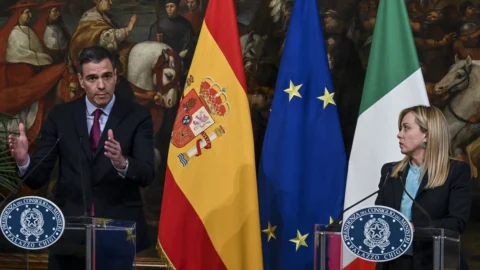
Le France's internal difficulties and the differences between Paris and Berlin on future projects in the defense industry and the creation of common debt to finance Ukraine have paved the way for the attempt by Italian Prime Minister Giorgia Meloni to strengthen the cooperation with Germany to the point of presenting theItaly as a valid substitute for France in the Union's leading carriage.
An operation attempted several times in the past, but with little success, now sees German Chancellor Friedrich Merz particularly available to reach agreements with Rome also with the aim of using a privileged dialogue lane with Washington of which Meloni appears to be the sole holder.
But a Italian-German lead car (based on a more intergovernmental than community-based Europe) is finding not a few obstacles. So, as soon as the news spread that Meloni, Merz and Belgian Prime Minister Bart The Weaver yes they would met before the "retreat" on competitiveness, that is, an extraordinary summit between the heads of state and government at the Alden Biesen castle in FlandersFirst French President Emmanuel Macron, and then a number of other countries, joined the initiative promoted by Friedrich Merz, Giorgia Meloni, and Bart. De Wever, effectively creating a pre-summit of around 20 participants, which will also see the presence of Commission President Ursula von der Leyen.
On the summit at Aiden Biesen Castle, which will be attended by the two former Italian prime ministers Enrico Letta e Mario Draghi (authors of the reports on the internal market and competitiveness) according to some sources, there are "excessive expectations" even though it is "an informal exchange of views between heads of state and government, more of a brainstorming session, without concrete decisions." Decisions should in fact only be made at the formal European Council on March 19, where "initiatives, mandates, and concrete deadlines" should be adopted.
Macron's proposal for a common debt of 1200 trillion euros has Germany sceptical.
Meantime Macron has proposed a common European debt from 1200 billion a year to support Ukraine and build a European army but Berlin The common European debt is not liked. The French president in an interview published yesterday by Le Monde and other European newspapers, he reminded that the EU must finance itself through debt, issuing joint bonds. Now that the dollar has become a relatively riskier asset, due to the policies of the current administration, there is a clear appetite among financial markets for a European safe asset, evidenced by the extremely high demand that constantly accompanies the rare issuance of Next Generation EU eurobonds. But for Germany, this remains a taboo, also because the AfD is rising in the polls, and for Chancellor Friedrich Merz, embracing the cause of eurobonds is not the best way to regain consensus.
Merz is also withdrawing from the project for a military plane A sixth-generation project he initiated with France and Spain, and a nod to the project being pursued by Italy, the United Kingdom, and Japan. Meanwhile, Macron is pursuing an attempt to initiate dialogue with Putin, while his European allies remain skeptical.
Ursula von der Leyen, in preparation for the conclave on Productivity and the European single market of tomorrow, reiterated yesterday Strasbourg that enhanced cooperation is the key to a Europe capable of facing the new world being created. This involves the possibility—envisaged by the European Treaties—that at least nine member states can move forward on certain initiatives, leaving the door open to other states.
On the other hand, not all 27 have joined the Euro or the Schengen Convention. Germany and Italy propose simplifications to internal European procedures, presumably with an even more relevant role than the European Council. In a letter sent to the other European leaders, Meloni and Merz recall that tomorrow's informal summit "will have to develop a specific agenda on competitiveness in all sectors, focusing on the integration of the single market, regulatory simplification, and the reduction of energy prices." Meloni and Merz's goal is to reach an agreement at the March summit on completing the single market, simplification and the fight against bureaucracy, and an ambitious and pragmatic trade policy.