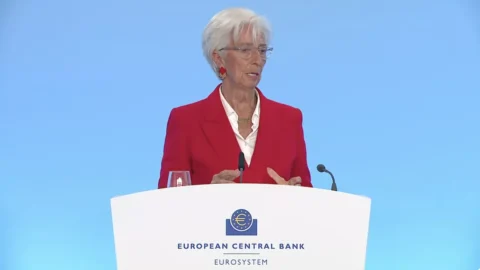
The ECB raised interest rates by 0,25%. The deposit rate at the central bank thus rises to 2,25 %, the one on the main refinancing operations at 2,40% and the one on the marginal lending facility at 2,65%. This is the first increase in almost three years – from September 2023 – and it may not be the only one, given that a second increase is expected by the end of the year. "The outlook remains uncertain, with upside risks to inflation and downside risks to economic growth," ECB President Christine Lagarde said at a press conference in Frankfurt.
Lagarde: "The unanimous decision sends a signal."
“The decision we have taken today to increase our three interest rates by 25 basis points was unanimously, without any reservationWe did not discuss or debate any alternative proposal, and the one based on the Eurosystem staff projections and the recommendations of our chief economist was approved unanimously. There was no discussion of other options,” he explained. Lagarde, emphasizing “it's not a drastic decision“: a 25 basis point increase in rates “is a decision that, clearly, send a signal and it is necessary given the economic situation we are in, the uncertainty we are facing, the inflation outlook and the projections developed by the Eurosystem", he said. the president of the ECB.
The rise comes following the inflationary spiral triggered by the war in Iran which has had a strong impact especially on energy prices. The aim is to prevent a surge like the one seen in 2022 from occurring, when the European economy, just emerging from the pandemic, faced a dramatic price increase triggered by Russia's invasion of Ukraine. At the time, it was said that the ECB had acted too late. Today, the Eurotower does not want to repeat the same mistake.
"The Governing Council is committed to setting monetary policy so as to ensure that inflation stabilizes at its medium-term objective of 2%," the central bank said in a statement. "In line with this commitment," the board "has decided today to raise the three key ECB interest rates by 25 basis points. The conflict in the Middle East is generating inflationary pressures and the decision to raise rates is robust against a range of scenarios that outline how the shock could evolve and impact the medium-term outlook for the euro area.”
New growth and inflation projections
The ECB also released the new growth and inflation projections. According to the new forecasts, in the baseline scenario, headline inflation will stand at 3% in 2026 (from 2,6% expected in March), 2,3% in 2027 (from 2%), and 2,0% in 2028 (unchanged). Core inflation, i.e. excluding energy and food, is estimated at 2,5% on average in 2026 and 2027 and 2,2% in 2028. upward adjustments are mainly due to the "higher energy price trajectory, which should to some extent be passed on to food, goods and services inflation,” explains the ECB.
Always taking a basic scenario as a reference, growth Eurozone GDP growth is expected to average 0,8% in 2026, 1,2% in 2027, and 1,5% in 2028. In March, staff projections were for growth of 0,9% in 2026, 1,3% in 2027, and 1,4% in 2028. “This is a downward revision for 2026 and 2027, reflecting the more pronounced impact of the war on commodity markets, real incomes, and confidence,” the Eurotower said.
Lagarde: "Inflation will remain well above targets until the first half of 2027."
"Rising energy prices will further push inflation up over the summer and keep it well above target until the first half of 2027. They will also impact food, goods, and services inflation," ECB President Christine Lagarde said at a press conference in Frankfurt. "Inflation should then return to target in the second half of 2027," she added, "supported by falling energy prices and more moderate increases in other prices. However, the war in the Middle East remains a major source of uncertaintyThe longer energy prices remain high, the more likely they will be to fuel a broader rise in inflation through indirect and second-round effects.” “We will therefore closely monitor the size and persistence of rising energy prices and how they are transmitted to price and wage formation, inflation expectations, and overall economic dynamics,” said the President of the European Central Bank.
Lagarde: "Growth is slowing, especially in services; risks are tilted to the downside."
Speaking instead of growth, "Excluding a temporary factor in Ireland, the euro area economy grew in the first quarter, supported by domestic demand and exports. However, the war in the Middle East is weighing on economic activity, and surveys point to a slowdown, particularly in services," Lagarde said. "The manufacturing sector has held up so far," she added. "This is partly due to companies building up inventories to cope with pressures on supply chains. This also reflects increased defense spending." Risks are tilted to the downside, as the war "has added to a global context already characterized by high economic policy volatility," the Eurotower chief explained, emphasizing that "prolonged supply disruptions Energy prices could further increase and keep them high for longer than currently expected. These factors would further erode real incomes and make businesses and households more reluctant to invest and spend.
“The negative impact on growth would be intensified if the closure of major shipping routes caused serious shortages of essential production factors, forcing euro area companies to reduce production. A worsening of sentiment in global financial markets or a more restrictive credit supply could weaken demand.” Furthermore, further frictions in international trade could exacerbate supply chain disruptions, reduce exports and weaken consumption and investment. Other geopolitical tensions, “in particular the Russia's unjustified war against Ukraine, continue to represent a significant source of uncertainty,” Lagarde clarified.
Economists expect another hike by the end of the year
"To determine the appropriate monetary policy stance, the ECB Governing Council will closely monitor the situation and adopt a data-driven approach, with decisions being taken on a case-by-case basis at each meeting," Lagarde said in Frankfurt. "In particular, the Governing Council's interest rate decisions will be based on an assessment of the inflation outlook and associated risks, taking into account incoming economic and financial data, as well as underlying inflation dynamics and the strength of monetary policy transmission, without being committed to a particular rate path."
Today's may not be the only increase. The economists of the panel heard from Bloomberg, in fact, they estimate another hike by the end of the year. Goldman Sachs expects a second hike in September, which would bring the ECB rate to 2,5%, because "the latest data points to significantly higher inflation and weaker growth" than the ECB forecast last March. This forecast is also shared by Barclays. ING takes a different view, arguing that the June hike could be seen as a purely one-off intervention.
(Last updated: 3:48 PM, Thursday, June 11)