
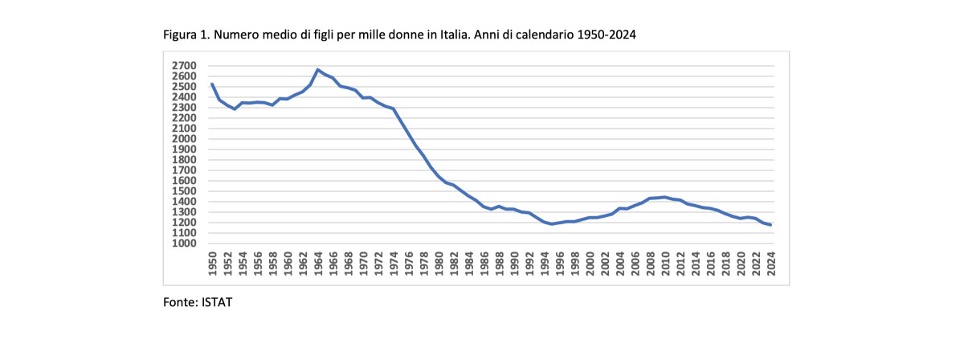
Poor Italy! Italians are bringing about ethnic substitution on their own. In 2025, births there were 355 thousand, with a decrease of 3,9% compared to 2024, when with 369.944 a negative record. The deaths there are 652 thousand, a decrease of 0,2%. The natural balance (i.e. the difference between births and deaths) was largely negative (approximately -296 thousand units), worsening compared to 2024, when it was equal to -283 thousand. immigrations from abroad, 440 thousand, although decreasing by 12 thousand units compared to 2024 (-2,6%), remain solid, confirming the notable level of attractiveness of the country. The emigrations for abroad: 144 thousand, a good 45 thousand fewer than the previous year (-23,7%). In this context, the migratory balance with foreign countries it remains not only very positive (+296 thousand) and enough to fully compensate – remigration theorists should take note – for the deficit due to natural dynamics, but it also grows by 33 thousand units compared to 2024. In essence, we are a country that exports Made in Italy, but we import the hands and minds that produce it.
An ignored emergency
When Istat communicates these data, they "make the news" for a couple of days, then they resignedly retreat into the oblivion of public opinion and politics, as if they were to be attributed to a cynical and unfair fate. Demographers launch the alarm, but they risk ending up like Laocoon and not being believed. In recent days, two publications dedicated to thedemographic winter which delve into these problems: the first is an extensive review – published on Neodemos – of an essay by Gianpiero Dalla Zuanna and Asher Colombo (Few children. Fifty years of very low Italian fertility, Il Mulino, 2026), which addresses the issue from the perspective of falling birth rate; the other is an article of Gian Carlo Blangiardo, former president of Istat, published on Lisander, which focuses in particular on the side ofagingNeodemos begins with an original perspective: the difference between desired and achieved fertility. Today, as twenty years ago, Italians achieve barely half the fertility they declare they desire (table 1). This is a much lower proportion than in countries such as France, Sweden, Germany, and the USA. The first protagonists of the very low Italian fertility It was the cohorts born between 1940 and 1960 that progressively and drastically decreased the proportion with three or more children. In the subsequent cohorts – born between 1960 and 1985 – third and fourth children remained few, but they were instead the number of people without children has increasedThis seems to be the main cause of the demographic imbalance.
This increase in childless people is, in fact, the real novelty in fertility in Italy and in all rich countries of the 21st century. The vast majority of these people are childless. by coercion (childless), rather than by choice (childfree). The number of young people who consciously do not want to have children is also increasing, but the greatest obstacle to parenthood is the difficulty in forming a stable cohabiting couple, often due to low income, job insecurity, and difficulty finding housing. Consistently, childless people are particularly numerous in Southern Italy.
The four causes of Italy's very low fertility rate
On average, today as yesterday, Italians would like to have two sonsThe causes that prevent this desire, which matures during childhood and adolescence, from transforming into effective fertility are of four types.
(1) Since the 1980s, Italy has shared with all the rich countries and with a growing number of poor countries a drastic decrease in fertility before the age of thirty, attributable to radical changes in the condition of women. Entering into a union, getting married and having children are considered an important reason for living for a vast majority of men and women, but for women this aspiration is hard to reconcile with other objectives which have become primary: studying, working, pursuing a career, finding time for themselves. And in Italy, this reconciliation is particularly complicated and translates into a particularly pronounced delay in leaving the parental home and entering a first union.
(2) Italy shares with other countries with very low fertility the'insufficient recovery of births over thirty. This is partly attributable to the anthropological structure of the family with strong ties, which characterizes Italy like many countries with very low fertility rates. The family with strong ties, on the one hand, overloads women with family and work commitments, while male involvement is still insufficient; on the other hand – also due to tax systems and welfare unfavorable to families with minor children – parents are overloaded with responsibility for the social success of their offspring. This is the paradox of familism in Southern Europe and Southeast Asia: lots of family, but only one child, Or to maximum two, to maximize their chances of upward social mobility, and very high material and psychological obstacles to the decision to have their first child. Today, in China, Taiwan, Singapore, South Korea, Japan, Thailand, Spain, Greece, Portugal... fewer than 1,3 children are born per woman, just like in Italy. This extremely low fertility rate is also prevailing in Latin America (for example, Chile, Puerto Rico, Uruguay, and southern Brazil), in other Asian countries (such as many Indian states), and in the wealthier classes of African countries.
(3) children are increasingly expensive, in terms of time and money. In Italy in the first quarter of the new century, it is the wealthiest, most educated people, living in the most economically dynamic areas, who have the means to form a stable union and have a greater number of children. Furthermore, first and second children are more frequently born within unions in which both partners work steadily, rather than in the "classic" twentieth-century family, with a working man and a stay-at-home wife. Upon closer inspection, this radical shift in fertility differences between social classes, reversing trends that have persisted for over a century, sheds light on the possibility of a future increase in Italian fertility. Indeed, if the link between fertility and economic welfare It has become positive, increases in the well-being of couples of childbearing age could translate into an increase in their fertility.
(4) It is not only economic constraints that depress fertility. Even a bleak vision of the future that awaits the new generations is keeping many people from having an additional child. It's no coincidence that over the last fifteen years, fertility has declined across the rich world, even in countries with particularly generous family welfare systems—like France and Sweden—which, however, are still far from the extremely low levels of Italian fertility.
What to do?
There is no automatic mechanism that will induce a recovery in fertility. It is likely that, without significant changes, fertility in Italy will remain very low in the coming years. However, even in Italy, the vast majority of young people would like to start new families and have more than one child, and these are especially the material obstacles to prevent this desire from becoming a reality. Therefore, low fertility is not a fate, but the ruling classes should put young people and families with children at the top of their agenda, taking action accordingly, with broad and ongoing policies, employment contracts that are more family-friendly, and housing policies worthy of the name. If this happens, the benefits of forming a union and having another child could be perceived as greater for the new generations than for the burdens associated with being parents: a leap into the light, rather than a leap into the dark.
In his essay, Blangiardo takes a few stones out of his shoes, recalling that the falling birth rate is a a story that comes from afar. Already in 1980, birth rates in Italy fell below the "Caporetto threshold," that is, the 1918 figure after the military catastrophe of the autumn of 1917, but the leap from understanding trends to taking consequent actions to direct them and manage their effects was far from stimulating adequate interventions in response to the problems linked to a demographic already in evident and growing difficulty. Indeed, the author would like to point out once again that the r1995 pension form (the so-called Dini, Treu, Cofferati law), in order to set the contribution rate at 32,5%, took significant resources away from the rate reserved for family allowances, a social security institution already downsized with the 1988 reform, which overcame the universalistic nature of the benefit and subjected it to requirements relating to the number of family members and income.
A society that looks less to the future
Blangiardo calls into question the concept and the comparison over time of the so-called "demographic heritage”. And he explains: if we were to calculate how many additional years of life would be granted to the total number of current residents in Italy, taking into account their numerical size and distribution by sex and age (as of January 1, 2025), we would obtain, based on the life expectancies of the most recent ISTAT table (year 2024), a total – precisely the "demographic heritage" – of 2 billion and 286 million life-years (38,8 per capita). But repeating the same calculation with data from five years earlier (January 1, 2020 and the 2019 ISTAT table) we would obtain 2 billion and 361 million life-years (39,6 per capita): in fact, in five years the "demographic heritage" of the country has lost 75 million years of future.
Furthermore, looking at the details by age group, we can also see how the percentage ratio between future years spent in retirement (setting the 67th birthday as the cut-off age) and the potentially productive years spent in working age has increased – from 78,5% in 2020 to 82,1% in 2025. If we then move the previous calculations forward thirty years – operating on the basis of the most up-to-date ISTAT forecasts and with unchanged 2024 survival rates – the demographic wealth of Italian residents as of January 1, 2055, drops to 877 billion life-years (-18%). This means counting 409 million years of future lost overall and, on a per capita level, a reduction of almost four years (from 38,8 in 2025 to 35,2 in 2055), with a ratio of years to be spent in retirement for every 100 people of working age also increasing by five percentage points (from 82,1% to 87,2%).
Is Italy still capable of investing?
And here come the questions of fate. Are we therefore inevitably destined to increasingly become a people suffering the erosion of our own future? As a we should do to maintain or restore the social and economic balances of the country system? How can we intervene, where possible, to encourage investment, thus keeping pace with progress and guaranteeing the population's quality of life?
The author invites you to reflect retracing some phases of our pastIn the post-World War II period, when the "economic miracle" was being built, the average lifespan of Italians was 32, and the future lifespan – still to be lived, on average, even under the less favorable survival conditions of the time – was a good 9 more (41 per capita). Therefore, if we can say, with justified satisfaction, that since then the average lifespan (lived plus expected) has increased by 13 years – from 73 in 1951 to 86 today – we must also acknowledge that today the gap between the path traveled and the path to be traveled has reversed: 47 years lived on average compared to 39 still expected (per capita).
We can therefore realistically think that a people already after more than half of the journey of life (even on average) has kept intact the stimuli to invest and innovateIs it fair to assume that we are still oriented or willing to look to the future and sacrifice, where necessary, the consumption and well-being of the present?
The Italian "investor" of the post-war period, ready to put energy and resources into the field in order to build the future (rebuilding a country) for himself and his loved ones, is perhaps destined to be supplanted by the comfortable figure of the Italian “maintenance worker”?
Live longer, invest better: Italy's new challenge
We must realize – argues Blangiardo – that the orientation to living in the present, or even just in the short term, represents an unacceptable surrender, both for the individual and for the entire community.
In addition to the relaunch of flows that produce the future (from births to well-governed and hopefully family-based immigration), a further effective response could come fromincreasing the “quality” of the remaining years, encouraging knowledge, social interaction, relationships, and commitment to productive and/or volunteer work. In this way, the comparison between the two totals of years—those lived and those to be lived—would not have the same value, and in the overall assessment, the gap between life spent and life to be spent could even disappear.
But the fundamental question in an aging society is: why on earth should a sixty-five-year-old today, with 21,3 years of life remaining – Istat 2024 table, without distinction of gender – and with, precisely, 65 years of life lived, invest time and energy in acquiring knowledge and training, for example in the field of new information technologies or AI?
It goes without saying that, if he were thirty, he might be looking at a return on benefits that would extend the remaining 54,1 years expected on average, but at his age, with an expectation of less than half of what he has already spent, would it really be worth it?
In these cases the answer can be positive – according to the author – only if the cost of the investment is considered to be lower than the discounted value of future benefits, also taking into account the residual life bonus that further extension of survival will likely bring.
In conclusion, it is reasonable to imagine that the Italians of today and of the next decades, having exhausted the youthful enthusiasm of the people of reconstruction, will be able to keep alive the idea of investing in your future – and contribute to innovation and development – only if we take care to provide a mature group with the arguments and opportunities to rationally judge the choice to remain active. This will only be possible if, through the tools of policy and crop, relations social, Italians will be encouraged to experience aging not as a season of disarmament, but as opportunity to discover new opportunities and new roles. Obviously—we add—these needs require an extension of active life beyond retirement.