
"On June 2, 1946, the vote of the Italian people marked – after twenty years of fascism, the tragedy of war, the struggle for Liberation – a turning point in the history of the country, laying the foundations for building, on the solid foundations of the Constitution, a new civil pact, inspired by the principles of freedom, equality and solidarity, driven by an intense thirst for peace.“. The words of the president Sergio Mattarella They restore the deepest meaning of a date that is not just an anniversary, an institutional rite or a page from a civil calendar. June 2nd is the moment when Italy, destroyed by war and fascism, he looked at himself in the mirror again and decided what kind of state he wanted to become.
Eighty years later, Republic Day is one of the great founding dates of Italian democracy. Next to April 25th, the 1946 referendum marks the decisive passage from the Liberation to the construction of a new institutional order. It was not an abstract exercise, nor a consultation disconnected from the real life of the country. On the contrary, it was the act with which sovereignty returned to the citizens, called to choose between monarchy and republic and, on the same day, to elect the Constituent Assembly.
June 2, 1946: a country in ruins called to choose
The Italy that went to polls on June 2 and 3, 1946 It was an exhausted country. Twenty years of fascist dictatorship, war alongside Nazi Germany, the bombings, defeat, surrender, cities wounded, families torn apart by the dead, the missing, the deportees, and the prisoners who had not yet returned. There was no bread, no shoes, schools were cold, the state seemed almost dissolved. Yet it was precisely those afflicted people who were asked to make an enormous act of civic maturity: decide the form of the stateThe Republic was born in this way, not as a concession from above, but as political and moral conquestItalians were called upon to rebuild the backbone of their institutions through voting, after having long been excluded from democratic practice.
The electoral machinery had to be rebuilt almost from scratch. Ballot boxes, ballots, registers, pencils, stamps, and voter lists were missing. But the decision to rely on the vote was also a gesture of faith in democracy. After dictatorship, war, and occupation, the country was once again in control of its own destiny, albeit in a context still marked by Allied surveillance and a complex international framework.
Farewell to the monarchy and a break with the past
The 1946 consultation was not only a choice between two institutional forms. It was also the historical judgment on the Savoy monarchy and on its relationship with fascism. At the heart of the rift was Vittorio Emanuele III, accused of not having stopped the march on Rome, of not having reacted to the crisis opened by the assassination of Giacomo Matteotti, of having signed the racial laws of 1938, of having supported the war alongside Nazi Germany and finally of having left Rome after the armistice of 8 September 1943, with the country in disarray and the Germans at the gates.
The referendum thus became the necessary step for to dissolve the link between the top of the State and the twenty years of fascismThe Republic represented a clear turning point. Not just a new order, but the possibility of rebuilding the homeland based on freedom, rights, participation, and the Constitution.
Approximately 25 million Italians voted, 89,1% of those eligible to vote. The Republic received 12,7 million votes, the monarchy 10,7 million. The results were announced on June 10, 1946; On June 18th the Court of Cassation sanctioned the birth of the Italian RepublicUmberto II left the country on June 13, going into exile in Portugal, to prevent tensions between monarchists and republicans from degenerating further.
Women's first time
June 2, 1946 was also the day when the Italian women entered the national political history as protagonistsAfter the first local elections of the same year, the referendum and the vote for the Constituent Assembly marked the debut of women in a national consultation with universal suffrage.
The President wanted to remember this very moment, underlining that the Republic was born from a "choral and sincere exercise of democracy“, with an extraordinary and composed participation at the polls. “The Italian people were the protagonists, flocking to the polls with extraordinary participation and composure to choose the constitution of the state and elect the Constituent Assembly. Women were particularly prominent, called to the polls for the first time in Italian history, for the local elections that year and for the June 2nd consultations.".
It was a huge turning point, even if it matured within a non-linear framework. women's suffrage had been established in January 1945 by the second Bonomi government, while a subsequent decree by the De Gasperi government, in March 1946, also made women eligible for election. This achievement changed the face of Italian democracy, expanding the electorate and transforming the Republic into an institutional home built from the outset on the participation of women.
Resistance, political parties and Catholics: a less simple story than it seems
La The Republic was born from the Resistance, but reducing that choice to an automatic transition would be a simplification. In the months leading up to the referendum, the country was experiencing profound political, social, and institutional tensions. The partisan struggle had had as its main objective liberation from Nazism; question on the form of the stateInstead, remained in the background for a long time And he didn't find the same response everywhere. Even within the Resistance and anti-fascist world, different sensibilities coexisted.
The parties went to the polls with different positions and strategies. Action Party he sided with the Republic from the very beginning, harking back to the Mazzinian tradition. socialists firmly supported the overthrow of the monarchy. PCI, after the "Salerno turning point" desired by Palmiro Togliatti, postponed the institutional question until the end of the war, even though he had already previously indicated the need to end the monarchic era. More prudent was the Christian democracyAlcide De Gasperi avoided rigidifying the party along too clear a line, aware of the need not to divide the moderate and Catholic electorate.
Not even the Catholic world moved as a compact bloc. On the eve of the referendum, reports circulated of a supposed Vatican bias in favor of the monarchy, fueled by the positions of some bishops and ecclesiastical circles. But the picture was more complex. Pius XII, the main concern was not only the confrontation between monarchy and republic, but above all the outcome of the vote for the Constituent Assembly and the risk of a strong socialist-communist victory capable of shaping Italy's political future. Ultimately, a decisive segment of the Catholic electorate also contributed to the birth of the Republic.
Curiosity: the face that became a symbol
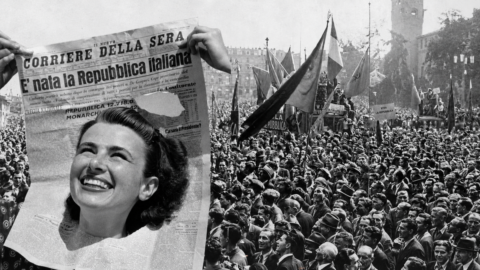
Among the most famous images linked to the birth of the Republic is that of a young woman smiling looking out from a copy of the New Corriere della Sera with the title "The Italian Republic was born“That photograph, which over time became one of the icons of 1946, was taken by Federico Patellani for the weekly Tempo as part of a feature dedicated to La Repubblica and the new role of women. For decades that face remained a collective, almost anonymous symbol, capable of representing the joy of a country emerging from darkness. Only in 2016 was the woman portrayed identified: her name was Anna Iberti, was born in 1922 and died in 1997. Her smile became one of the most recognizable images of the new republican Italy.
La history of Republic Day, after all, has undergone many transformations. The first celebration took place on June 2, 1947. In 1948, the first military parade arrived at the Imperial Forums. In 1949, June 2 was declared a national holiday. Then, in the 1970s, for reasons of austerity, the celebration was transformed into a movable feast and moved to the first Sunday in June. Only since 2001, at the urging of President Carlo Azeglio Ciampi, has June 2 become a permanent holiday again.
June 2, 2026: The Quirinale takes to the streets
For the eightieth anniversary of the Republic, June 2, 2026 takes on a special tone. Institutional appointments remain in Rome traditional: the homage to the Unknown Soldier at the Altar of the Fatherland, the parade along Via dei Fori Imperiali, the passage of the Frecce Tricolori, the official ceremonies in the territories and at Italian representations abroad.
But this year the Quirinale is changing pace. Instead of the traditional reception in the gardens, the celebrations are moving to the square with "The Faces of the Republic. 80 Years Since the Referendum", a grand institutional celebration broadcast live on Rai 1 from Piazza del Quirinale, attended by the highest officials of the State and personalities from the world of culture, art, sport, and institutions. Artists, actors, musicians, and champions will take to the stage: from Gianni Morandi to Cecilia Bartoli, from Annalisa to Luca Barbarossa, from Giuliano Sangiorgi to Paola Cortellesi, from Carlo Verdone to Luca Zingaretti, from Roberto Bolle to Paolo Fresu, as well as sports figures such as Alessandro Del Piero, Federica Brignone, Bebe Vio, Giuseppe Bergomi, and Arianna Fontana. The evening will be structured as a a choral account of Italian history from the 1946 referendum to today, with music, images, words and testimonies.
Taking the Republic out of the Palace means transform the celebration into a shared party and remember that Democracy is not something that is acquired once and for all.This is the warning that President Mattarella, as he did on April 25, wants to reiterate today: "Consolidating the architecture of trust between institutions and citizens, reviving in each the most authentic sense of democratic participation, is a persistent task in the life of the Republic.". It's still: "Supporting the fabric of society, understanding—together with schools and other educational agencies—the needs, questions, and expectations of younger generations, nurturing their talents and potential, is essential. Dialogue, listening, and proximity are essential canons for interpreting any civic responsibility aimed at social cohesion.".
Eighty years after that vote, the Republic lives not only in ceremonies, flags, and institutional buildings. It lives in the trust that must be rebuilt, the participation that must be defended, the rights that must be made concrete. Because June 2nd is not just the memory of a choice made but it is the promise, always open, of a A country that continues to choose itself.
Long live Italy, long live the Republic!.