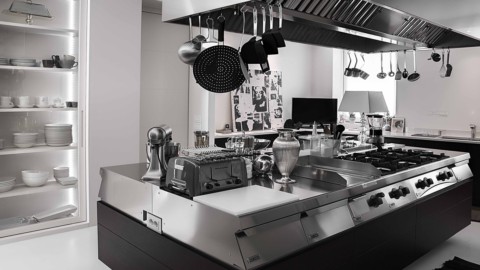
On the occasion of Eurocucina 2018, Gianni Meneghetti, president of the Meneghetti Group and of Fulgor Milano, one of the European protagonists of built-in appliances for cooking, had anticipated a sensational news: the opening in collaboration with the Chinese financial group Shanghai Yfaqiancheng Home Appliances Development, within three years, of 300 Fulgor Milano showrooms (the high-end brand of the Italian group). All confirmed punctually: by 2019 there will be 33 Fulgor Milano showrooms open throughout China, for a turnover of 20 million euros, given the great success of the first ones operating in Shanghai.
The news was and is sensational because the biggest producers and exporters of household appliances in Europe are the Chinese. But in just a few years, the gigantic Chinese market for the home is changing skin and attracts everyone, manufacturers, designers, trend catchers (on the streets of Shanghai and Shenzhen you can see an incredible world parading) and above all organizers of trade fairs.
The American KBIS-Kitchen and Bath Industrial Show, of Las Vegas, a world reference for kitchen and bathroom furnishings and equipment, has in fact become an Asian trade fair of great attraction, so much so that in China it takes place twice a year, in May in Shanghai and in December in Guangzhou. And Meneghetti is present at both fairs because the medium-high and high-end Chinese market is constantly developing, with a growing demand for design products and furnishings and in particular for Italian luxury and quality ones.
In the latest edition of Salone Internazionale del Mobile in Milan the Chinese furniture manufacturers were not present and will not be present in the future precisely because their production is increasingly absorbed by domestic demand. To get an idea of how colossal this market is, one figure will suffice: the sales turnover largely exceeded 2017 billion dollars in 36 with as many as 60 thousand producers.
Well, in China there is room for everyone, provided that some "pillars" are kept firmly in place and one of these is quality. Precisely this prerogative is considered a unique feature of the made in Italy of the house, which becomes a status symbol of the middle and upper middle class. Made in Italy in general had a further – exclusive – promotion and enhancement with the trip to our country in March by President Xi Jinping. “Real advantages arose from this historic event – confirms Meneghetti – because in China what the president decides and declares is very important, it directly affects the choices of families, it is perceived as an indication of great authority. And having chosen Italy as the first country for its strategic journey to Europe was a very clear, very strong opening of credit towards us that already influences and will influence the valorisation of Made in Italy”.
In simple words, more than oranges (which China does not need as it is the world's leading producer) and tangerines (which come from China), the Red Star giant will increasingly import the fabulous furnishings designed and built in Italy for luxury residences and hotels. Rigorously built in Italy, a provenance that must be guaranteed by certificates of origin to avoid – as has happened so many times – “original Brianza” furniture that is also manufactured in a tawdry way in Shenzhen or Canton. And that on the last trip to the gigantic Canton fair it was possible to see, since this is the typical fair for counterfeiting made in China, among enormous catafalques-beds in the Pompeian-Mandarin style, improbable thrones-armchairs of imaginative Renaissance inspiration, horrendous bathrooms that not even the dreaded Casamonica of Rome would have dared to put in their villas.