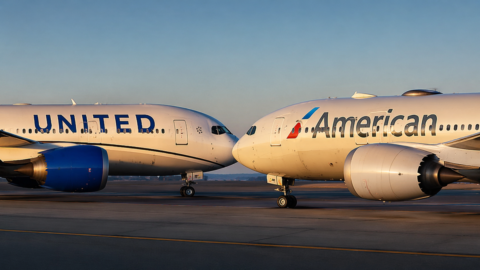
It was enough confidential interview, and above all his story filtered to the outside, to ignite the great risk of the American skies. At the center of the rumors there is Scott Kirby, CEO United airlineyes, which according to Reuters would suggested to Donald Trump, during a meeting at the White House in late February, thehypothesis of a merger with American Airlines. Bloomberg He adds that the suggestion has also been discussed with senior administration officials. For now, however, it remains a mere rumor. There's no confirmation of formal contacts, nor evidence that a concrete process has been initiated to evaluate a transaction.
Yet that was enough for shake up the market and put a scenario back into circulation capable of changing the balance of global air transport. In fact, we are not talking about a simple extraordinary operation, but of a merger between two giants already central to the global chessboard. United and American, considering also international traffic, were in 2025 the first two companies in the world for available capacity. Any integration would give life to an unprecedented group, with over a third of the US domestic market and a size that would immediately place it at the top of the industry.
United-American together? For now, just a suggestion.
The key passage, second Reuters, dates back to February 25, during a meeting at the White House on the future of Dulles Airport. It was there that Kirby raised the topic of a possible integration with American. The discussion was apparently built around a specific idea. A The combined company would have greater strength in international markets and greater ability to compete for traffic with foreign carriers, as the Trump administration continues to focus on global trade imbalances.
This is not a minor issue. Kirby had already observed in the past that a significant share of seats on long-haul flights to and from the United States are held by foreign airlines, despite their largely American passenger base. In this interpretation, a potential merger would not only be a gigantic internal consolidation operation, but also a attempt to strengthen international projection of U.S. air transportation.
However, the boundary between suggestion and reality remains clear for now. United and American declined to comment.No response has come from the White House. And the very lack of official confirmation contributes to keeping the entire affair in the gray area of rumors, where the industrial potential is enormous but the substance of the negotiations remains unproven.
The possible merger would give birth to a colossus of the skies
If this hypothesis were to materialize, it would be an impressive machine. Estimates reported by sources speak of a group with a turnover of over 100 billion dollars and a fleet of more than 2.800 aircraftA scale that would allow it to surpass Delta and wear the crown of the largest airline on the planet without hesitation.
Even from a stock market and financial perspective, the operation would have a precise physiognomy. United has a market capitalization of around 31 billion dollars, compared to approximately 7,4 billion for American. Both come from a difficult year on the stock market, with United down 15% and American down 27%. But behind the stocks' weakness lie very different corporate profiles. American is burdened by about $25 billion in debt in the long term and continues to trail rivals on profitability. United, on the contrary, presents itself with a more solid tone and ready to transform cost shocks into opportunities.
This is where the industrial puzzle becomes more legible. American is under pressure to improve performance and returns, while United appears in the position of consolidatorIt's no coincidence that Kirby, former president of American Airlines between 2013 and 2016, knows the company well, even inside, and that it could now become the cornerstone of a historic operation. And it's no small detail that, precisely at a time of rising costs, especially fuel, United's CEO has repeatedly argued that prolonged shocks tend to widen the gap between strong carriers and weaker ones.
The Antitrust Wall
If the industrial charm of the operation is evident, equally evident is theregulatory obstacle. And it is perhaps here that rumors risk being shatteredThe U.S. airline market is already highly concentrated. American, Delta, United, and Southwest control the bulk of domestic traffic, with shares around 17% each, according to Department of Transportation data cited by Reuters. Combining two of these four giants would mean further squeeze competition in a sector already dominated by a few players.
The objections, in this context, are easy to imagine. More concentration may mean less choice for passengers, greater pricing power, plus additional fees and reduced competitive pressure on the routes where the two groups compete today. Not surprisingly, he explains Reuters, the odds of a green light would be very limited due to the predictable opposition of unions, rival companies, parliamentarians, and airports, as well as the issue of network overlaps and the potential impact on employment.
Even politically, the idea is being held back. The Secretary of Transportation Sean Duffy he acknowledged that there could be room for further consolidation in the sector, but also warned that any operation would be examined closely for its effects on consumers. In other words, the point is not just to build a stronger national champion abroad. The point is How much it would cost American travelers, in terms of rates and available alternatives, the birth of such a champion.
For US air transport, however, the signal remains strongIn a period of high costs, pressure on profitability and the search for new competitive dimensions, consolidation once again becomes a real temptation. And meanwhile the market bets on the scenario. The stocks soar, with United up 2,92% in premarket trading at $97,98 and American Airlines up 10,15% at €10,36 on the reference price.