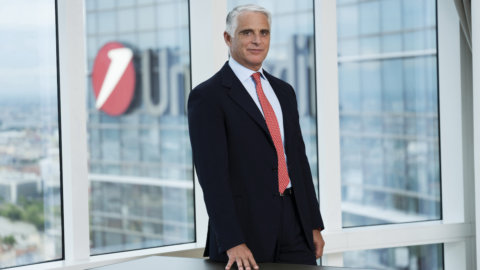
After almost two years of tensions, the confrontation between Unicredit and German Government marks a turning point. Andrea Orcel has found common ground with Berlin on the future of Commerzbank, obtaining a basic understanding which spells out in black and white the guarantees required by Germany to accompany the bank's potential transfer to the Italian group. The game isn't over yet, but one of the most significant political obstacles to the takeover has been overcome.
The agreement, formalized in a letter sent on November 18 to the Minister of Finance Lars Klingbeil, revolves around eight binding principles The Italian group has committed to complying with these commitments as part of a single package. Frankfurt will remain the German operating center, Commerz will maintain its listing and legal form, while employees and companies in the Mittelstand will be able to count on specific commitments. Investments in technology and artificial intelligence, German representation on governing bodies, and a significant role for operations in Germany are also planned.
“We look forward to the continuation of this constructive dialogue "We are committed to working closely with the minister and all other stakeholders involved, as we work to resolve the outstanding issues and, at the same time, fully leverage Commerzbank's significant potential within the UniCredit Group," Orcel said. He emphasized that the commitments undertaken will contribute to the long-term performance and prosperity of Germany, its citizens, and its businesses, with particular attention to the Mittelstand, considered one of the driving forces of the German economy.
Klingbeil confirmed that an agreement in principle had been reached, citing a common basis and clear commitments regarding Germany as a business location, employee rights, and continued dialogue with the works council. The government led by Friedrich Merz, which had previously opposed the deal, now supports a rapid and orderly transition of control.
In BagMeanwhile, the market welcomed the agreement positively: at the opening on the Milan Stock Exchange, Unicredit shares jumped by around 2%, while in Frankfurt Commerzbank shares were up over 1%.
UniCredit-Commerz, the eight commitments: Frankfurt, Mittelstand, and AI investments
The first point concerns the location. Frankfurt will remain the German headquarters even after the possible integration between Commerzbank and HypoVereinsbank (HVB), UniCredit's Bavarian subsidiary. The group also plans to maintain a significant presence in Munich, thus preserving the role of the two main German hubs.
Commerzbank and the future combined entity will retain the listing on the stock exchange , German legal form of Aktiengesellschaft. On the governance front, UniCredit is committed to ensuring adequate representation of both banks on the group's executive committee. Furthermore, at the ordinary renewal of its board of directors in 2027, it will propose the inclusion of German citizens with appropriate skills and reputation, subject to shareholder approval.
A central chapter is dedicated to the SME, the network of small and medium-sized enterprises that is one of the pillars of the German economy, and export-oriented companies. UniCredit intends to strengthen its services for these clients and expand their access to its international network, present in 14 markets. The goal is to offer German companies greater opportunities for growth and operations beyond national borders, leveraging the group's pan-European presence.
The commitments also concern the management of operations in Germany. UniCredit will ensure adequate capital allocation and maintain autonomy in decision-making in the country. This is complemented by significant investments in training, digital technologies, and artificial intelligence in Frankfurt, with the creation of a center of excellence serving the entire group.
The eighth principle concerns industrial relations. UniCredit is committed to: continue the dialogue with the workers' council and the trade unions, in compliance with existing agreements and employee protections. This is a particularly sensitive issue for Berlin, especially given the employment concerns surrounding major banking mergers.
Berlin gives up two seats on the supervisory board: what changes?
It is right on the ground of the governance This is one of Berlin's key concessions. The federal government, which holds a 13,27% stake in Commerzbank, has renounced the right to directly appoint two of its own representatives to the supervisory board, a provision envisaged in the agreements following the bank's public bailout in 2008-2009.
The renunciation does not mean, however, that Berlin will remain outside the debate on the new appointments. Unicredit has in fact agreed with the German government on nominations of two independent members, who will be included in the list of ten new shareholder representatives on Commerzbank's supervisory board. This commitment is separate from that of UniCredit's board of directors, where the group has committed to nominating German citizens for the upcoming renewal scheduled for 2027.
The agreement also opens the way to a possible state withdrawal from the shareholding. Orcel clarified that, if Berlin decides to yield his own ParticipationUniCredit would be willing to express its interest, in compliance with the regulations. However, the German government has not yet announced any intention to sell its stake or made any commitments to this effect.
UniCredit-Commerz: Authorizations and Next Steps
The authorization process has already passed three steps: the green light from the ECB upon the acquisition of control, which came on October 15, and those of the Federal Reserve and European Commission, both obtained on November 16. Brussels has ruled out challenges to competition in lending to medium-sized enterprises and trade finance, without imposing divestments.
The green light remains Polish surveillance, necessary for the involvement of mBank, controlled by Commerzbank with a stake of almost 69%. Orcel has indicated the end of November as a possible deadline. Once the process is completed, Unicredit will be able to request a meeting an extraordinary meeting of Commerzbank, expected in February 2027, to renew the shareholder representatives in the supervisory board and start the new business plan in the first trimester.
The transition of control will trigger the consolidation of Commerzbank's accounts into UniCredit's balance sheet. The subsequent reverse merger with HVB is a separate transaction, which Orcel believes is possible in 2028. The resulting group would exceed €1.300 trillion in assets.
UniCredit and Generali, testing their understanding: a €3 billion alliance on the table.
Unicredit e Generali they see in one industrial collaboration A potential value creation of between €2,5 and €3 billion, of which €1,5-€2 billion could be achieved even without a merger. The synergies would primarily concern the cross-distribution of banking and insurance products, in the life and property and casualty sectors, but also asset management, wealth management, and the integration of banking services into the Lion's offering. These opportunities would be complemented by operational, purchasing, and technology platform efficiencies. The project could begin in Central and Eastern Europe, where the two groups already operate, and then extend to other markets. This is what emerges from the analysis of MF, which reconstructs the possible areas of collaboration and the next steps of the negotiation.
Generali's willingness to explore new agreements was also confirmed by the deputy CEO Giulio Terzariol, who stated in the conference call on the September 30 results: "We are interested in any bancassurance agreement. A partnership with UniCredit or another financial institution of that standing would be something we welcome." Terzariol, however, specified that, before reaching an agreement, it will be necessary to "define all the financial aspects." Therefore, at this time, there are no definitive agreements or a roadmap.
Meanwhile, the industrial dialogue is developing in a delicate stock market scenario. Unicredit holds approximately 9% of Generali, while the Intesa-Mps operation could indirectly strengthen, through Mediobanca, the weight of Ca' de Sass in Leone. The CEO of Generali, Philippe Donnet He drew attention to antitrust restrictions, expressing his hope that any potential Intesa participation would remain exclusively financial in nature. Orcel, for his part, reiterated his preference for an independent Generali, with which to build an industrial partnership without seeking control. The issue could also have implications for governance, ahead of the renewal of the board of directors in 2028. Finally, Donnet ruled out any plans to sell Banca Generali.