Among the avenues of the Alden Biesen castle the delegations hurry to take their places in the room set up for the "retreat" conceived and desired by the President of the European Council, Antonio CostaThe leaders of the 27 come out into the open to take their place on the podium for the family photo. But seeing the body language of the Italian Prime Minister Giorgia Meloni It's hard not to think back to a famous line by Jep Gambardella in Sorrentino's film the great beauty. “I – Gambardella states – didn't just want to take part in the parties. I wanted to have the power to make them fail”. This is the “mantra” that the Italian Prime Minister seems to be following for a few months now with the dossier on migrants and now on to that of the competitiveness he is systematically obscuring with variable geometry formats the meetings prepared by President Costa's staff, who would not have hidden a certain disappointment from his most trusted collaborators.
The last act was the informal "retreat" to the castle of Alden Biesen preceded in the morning by a pre-summit in which 19 countries plus the President of the Commission took part, Ursula von der Leyen. Not without a polemical conclusion with Madrid and Dublin and they criticized Italy for not inviting them.
The Spanish Government of Pedro Sanchez in fact protested with the Italian Executive of Meloni for having organised a preliminary meeting with several European leaders before the informal European summit, deeming it "inappropriate and divisive." Spain wasn't so much asking to be invited, but rather believing that these types of initiatives "undermine the EU's fundamental principles and, instead of bringing solutions closer, push them further apart." El Pais reconstructs, citing government sources, that the negotiations to organize the pre-summit "took place at the sherpa level and, when preparations for the meeting began, Spain communicated that it did not consider it appropriate to hold preliminary meetings excluding some countries. At that point, Italy decided not to invite Spain, who was against the meeting.” Palazzo Chigi toned down the situation by recalling that Prime Ministers Sanchez and Meloni “had the opportunity to discuss matters on the sidelines of the informal meeting of EU leaders” and Sanchez “did not raise any issues.”
Also 'Ireland She criticized the fact that she had not been invited. "I don't understand the need for it," said the Irish Prime Minister. Michael Martin, also because "today's summit is a long and demanding one." Costa, Martin added, "was very eager to have a full day here to discuss competition and competitiveness in Europe. And I think that's a positive aspect."
The 27 have however concentrated on the best way to prepare the European summit in March which will have to set precise deadlines and mandates on the issues of competitiveness, energy prices and simplification according to a well-defined road map.
“What we need now is a clear path to complete the Single Market with rapid results and concrete results already in 2026-27-28". This is how the former Prime Minister would have remembered Enrico Letta to the 27 EU leaders. "We need an interinstitutional agreement that guarantees a fast track for the key measures needed to complete the Single Market," Letta continued, "approved at the highest political level. We can call it One Market Act, in the spirit of the early days of the Single Market. Now is the time to build a Single Market. A Single Europe. A Single Market”.
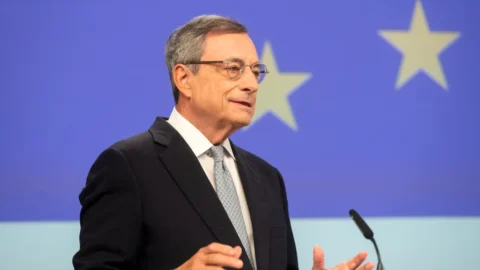
Even the former president of the ECB and former prime minister Mario Draghi, author in September 2024 of a Competitiveness Report, insisted on the need to accelerate investments. Draghi asked for a effort of courage Because the European Union's economic decline and decline in "power" can become a structural issue is happening faster than one might imagine. Compared to when his report was published, the economic situation "has worsened," said the former Prime Minister and former ECB President.
As for Giorgia Meloni, spoke bluntly of a Italian-German engine of the EU that does not want to "exclude anyone" and focused on energy prices. Responses are needed at the national level, says the Prime Minister, "such as the very detailed measure we will bring to the Council of Ministers next week. But we also need responses at the European level, because this is the most serious issue that threatens competitiveness."
But it is on the overall architecture of the European institutions that Meloni insists that they be given greater powers to the Council This would reduce the Commission's powers and its bureaucracy. An increasingly intergovernmental Europe would dash any hope for those who had until now fought and hoped for a federal Europe.