Everything is very fluid. The situation today is certainly better than it was two days ago, when Trump threatened to destroy everything unless Greenland was immediately handed over to him. However, the agreement in principle put forward by NATO Secretary General Mark Rutte is far from definitive, while the Europeans have so far remained outside the Gaza deal, and tripartite talks have begun on Ukraine, in which our continent has no say.
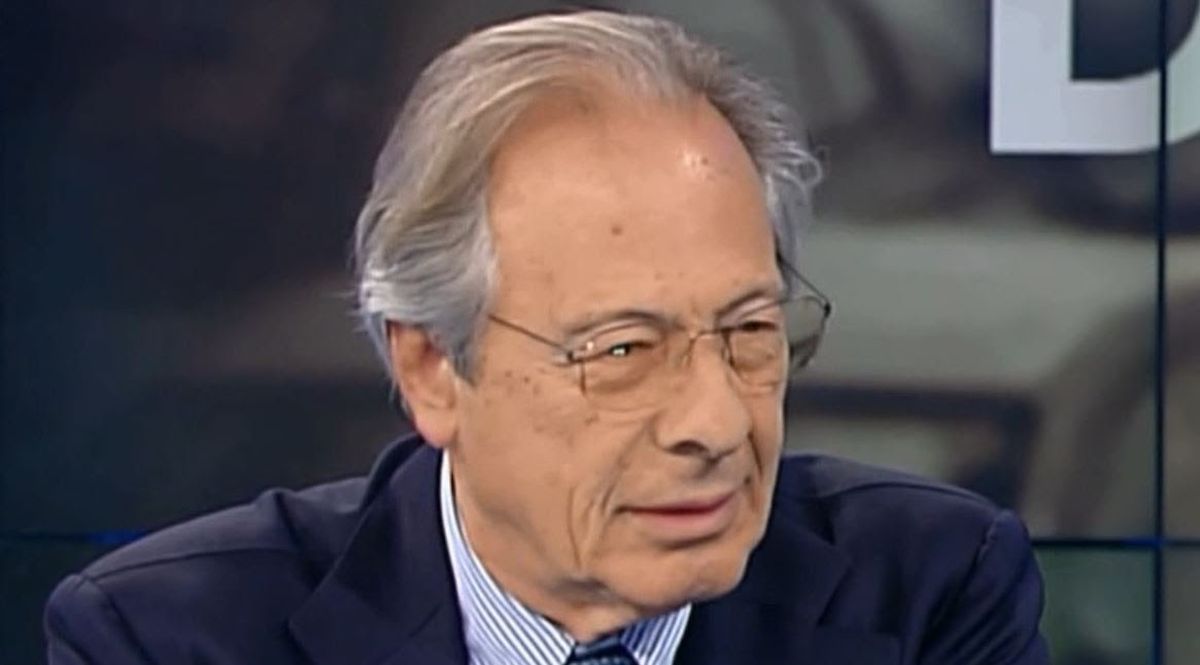
Marcellus Messori, professor emeritus at Luiss and an expert in monetary policy and international politics, especially European politics, is keen to point out that the situation is very unstable and that any day could bring a surprise, often negative, from Trump or from Europe itself.
Let's start with the turbulent markets, which saw a precipitous decline in stock prices at the start of the week, a surge in bond yields, particularly US Treasuries, and a strong resurgence in the rush to gold, considered the only remaining reliable safe haven. Could this be one of the main reasons that prompted Trump to tone down his bellicose tone and accept a possible basis for understanding by activating NATO as a tool for the security of Greenland, and thus of the United States and Europe itself?
"The exact same situation occurred last April when Trump announced the tariffs: a drop in stock prices, a rise in government bond yields, and a rush to seek other safe havens like gold. And the markets' signal is certainly Trump's most heeded because it affects a significant portion of his supporters. A stock market crash and increasing difficulty in selling US Treasury bonds would also undermine Trump's economic policy, which is pushing for lower interest rates and seeking to attract investment from around the world."
However, Trump felt compelled to send a strong message to Europeans telling them not to dare sell US Treasury bonds (of which Europeans are now the largest holders)..
It's important to remember that US Treasury bonds are still the only truly safe international asset, and investors around the world turn to them for a secure investment in their portfolios. Their attractiveness remains because they have a large market that facilitates transactions, and they offer an attractive yield of over 4,20% for the 10-year bond, compared to Italian Treasury bills, which yield around 3,60%. Last spring, it was thought that Trump's policies would damage the credibility of US bonds and that there would therefore be a partial shift of investors to European bonds. This hasn't happened to any significant extent, so US Treasury bonds have maintained their position as a safe asset and thus their attractiveness to investors.
Yet the American economy presents considerable margins of uncertainty. At Davos, Trump extolled the successes of his economic policies but overemphasized the positive aspects, while covering up, sometimes with lies or partial truths, the less stellar results of his policies.
I believe that market participants' expectations for the US economy are converging toward overheating, meaning rising inflation and a subsequent general slowdown in the economy. Tariffs on the one hand, the fiscal policies enacted with the BBB (Big Beautiful Bill), and anti-immigration policies that are creating a labor shortage, suggest that prices, already close to 3% today, are destined to rise. Trump is clearly banking on GDP growth, and indeed he has touted the last quarter's figure, which exceeded 4%, but if we look at the overall annual results, we see that the results are much less stellar.
So, Trump's tariff and budget deficit policies aren't working?
If you look closely at the growth data, you'll discover that most of the positive results are linked to the huge investments being made in the IT sector, particularly in artificial intelligence. There's little excitement in traditional sectors. It's now clear that tariff policy isn't designed to attract significant investment in traditional industries, because what matters is the international value chain, which is being disrupted by tariffs. In other words, for many companies, the gains they could make as a result of the reduced competition brought on by tariffs are more than offset by the higher costs these companies have to pay for imported components. In short, it was an illusion to think that tariffs would induce more investment in traditional sectors. Of course, IT growth could lead to healthy productivity growth, but we're certainly walking a tightrope. Furthermore, fiscal policy also presents several problems. For example, tax breaks for the wealthier classes will have to be partially financed by welfare cuts. But since Trump is focusing on the midterm elections, these cuts will take effect at the end of November!
So Biden, who lost the election due to inflation, actually had a better economy than Trump. Inflation had returned to low levels and was falling faster than it is now. And if the EU were to take a tougher stance on the American IT sector, the stock market bubble could burst, posing serious problems for the government. But speaking of the EU, we saw Zelensky goading Europe not only because of its hesitation in supporting Ukraine in its resistance to Putin's invasion, but above all to remind Europe that among great powers that use their power recklessly, uncertainty and division don't get you very far. Of course, Zelensky was likely forced into a corner by his previous meeting with Trump, who, always aligned with Putin, wants the entire Donbass to be ceded to Russia and organized an initial three-way meeting in Dubai, where Europe wasn't even invited. And this after Trump had said that Ukraine was a European issue and that he could wash his hands of it.
I think the EU has held up well in recent years in the face of Putin's aggression. Even now, it is replacing the US in full retreat. But I believe we can't stop here. We are not using our strengths, that of a fairly unified market of over 400 million consumers, so much so that we have a large trade surplus and invest our surplus in the US. We need to increase our decision-making capacity and the time we generally take to make decisions. These timeframes are incompatible with the speed with which other major international players move. We also have weaknesses due to absurd jealousies among EU bodies. The European Parliament's decision to delay the approval of Mercosur is foolish. Just as we were sending a signal of reaffirmation of multilateralism, we are sending a signal of confusion and unreliability. The EPP is playing a negative role with its two-oven policy, that is, remaining in the majority with the Socialists but then winking at the right. The Commission is weak, with its president losing credibility. Furthermore, the policies of various countries, including the ours, is uncertain and tries to juggle between America and Europe."
And what do you think of the Meloni-Merz agreement?
Now, the agreement with Merz signed just on Friday focuses on asking Brussels for new deregulation and a loosening of state aid rules to create national or European champions. This is unclear. This path would not lead to a strengthening of Europe's federalism, and thus to a unified government with greater powers in both foreign and economic policy than the current ones, but to a confederal EU, based on independent states with a small center and acting only upon direct delegation from the states. This is the wrong path.