The design of Europe could pass through mergers in two key sectors: banks on one side, cars on the other. While Unicredit moves towards the German Commerzbank, the French study the failure in the automotive field.
The idea is this: to create a all-European colossus to face the pitfalls of US and Chinese producers, to oust the Japanese Toyota from the top of the global manufacturers' podium and surpass Volkswagen from the top of the European ones. An idea that, already written in the notes of Sergio Marchionne, has returned with the hypothesis of a merger between Stellantis and Renault right in coincidence with the Stellantis profit warning of yesterday, with the blessing first of all of Emmanuel Macron who also sees a political advantage in it, but also of John Elkann who would prefer to disengage and move to other sectors.
The entire automotive sector in Europe, which also has to deal with the energy transition and the impact of the new emission limits, is suffering from Germany: Volkswagen is closing plants and laying off staff, Mercedes Benz, with two consecutive profit warnings behind it, is liquidating its Chinese subsidiary. Yesterday Stellantis announced the downward revision of guidance for adjusted operating margin and free cash flow. But it's not just the medium-high end car sector that's suffering: even the high-end English Aston Martin yesterday revised downwards its guidance for 2024 results.
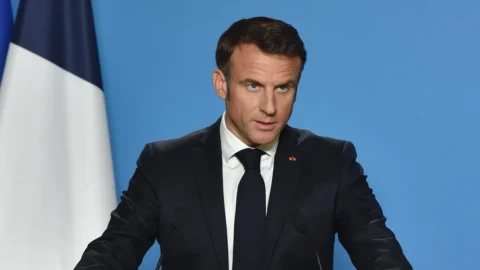
Macron is certainly the most interested in the merger
Al French president the wedding would be very nice. First of all because the France would have a prominent role in the operation and for him it would be a great move to secure the political consensus. Let's see how.
Il French government currently owns the 15% of shares in Renault and 6,1% in Stellantis, but France was already in the capital of Peugeot when Fiat, Chrysler, Renault and Citroen were merged, keeping a member on the board of directors (while Italy did not). It is clear that with a merger the presence of the French government would be even more substantial.
Macron, moreover, in search of a sensational piece of news to label “national sovereignty” would have one more political card that could even please Marine Le Pen. Among other things, Macron's idea would be to have the operation led by a true “Marchionnian”: the Italian Luca de meo, currently CEO of Renault, former Fiat manager, considering that Carlos Tavares will remain in office until 2026. Luca de Meo has already shown interest in cooperating and giving life to what he defined as a European “Airbus of the car”.
Already in 2019, before the Fiat-PSA operation, the Turin-based company was about to close the agreement with the first French group. But then everything fell through mainly due to the opposition of the Paris government and the Japanese Nissan (with which Renault has a very long-standing partnership).
The Outsider BMW and the Meeting of October 15
The idea of a Stellatis-Renault merger had already been circulating since last February. But now it has been enriched by a new player. According to some rumors, BMW could also be invited to the European wedding, which could bring as a gift its expertise in the field of high-end electric cars. Things could become clearer with a few more details on the strategies of European car manufacturers in the coming weeks: the 13th of October will begin Paris Salon, but above all we await the meeting, scheduled for 15 October, between Luca de Meo and Carlos Tavares, in which Oliver Zipse, CEO of BMW, should participate.
Antitrust, von der Leyen and Draghi
Of course, when we talk about a maxi-merger it could intervene the Antitrust to block it. But things are changing on this front too: Ursula von der Leyen, in accordance with the indications contained in the Draghi Report, after the interventionist period of Margrethe Vestager, is now inclined to favor the creation of "European giants". The Draghi report has explicitly indicated the need to create European industrial champions in various sectors.
Elkann faces a thousand headaches in Italy
The dossier also satisfies Stellantis shareholders, especially John Elkann, which however he denied Reuters merger hypothesis. Gianni Agnelli's nephew, dealing with the controversies of the sindacati Italians and the negotiations with Adolfo Urso, has demonstrated that prefer other sectors focused on investments and acquisitions in the luxury, healthcare, high-tech sectors, in other words: more Sam Altman, less Maurizio Landini. His most recent passion is precisely the medical sector: Exor, the Agnelli family's holding, bought 17,51% of Dutch Philips, which has shifted its business to medical equipment and devices, abandoning traditional consumer electronics. Some observers are even speculating that, once he leaves the auto sector, Elkann could think of abandon publishing too: Republic , Print.
In August Stellantis saw its shares drop registrations in Italy 32,4% on year, after -8,7% in July, doing worse than the rest of the market, which recorded a decline of 13,37%. Its share of the Italian market in August was 24,8% from 31,8% in August 2023.
Fiat cornered
A merger between Stellantis and Renault would encompass 18 brands: the fourth largest auto group in the world, created by the PSA-Fiat Chrysler alliance, already considered a giant, would bring 14 brands, including Fiat, Peugeot, Jeep and Citroën. There are fears that a Stellantis-Renault merger could disadvantage Italy and instead strengthen the French share in the auto sector.
Another month of suspension for the 500 Bev at Mirafiori
Just this morning Stellantis communicated to the unions that the production of the 500 Bev to the body shops of mirafiori will extend the suspension of activities until November 1st, justifying the decision with "the lack of orders linked to the trend of the electric market in Europe which is in deep difficulty, despite the fact that in the first 500 months of the year the 8e represents 40% of sales in the EV segment of city cars (segment A) in Europe".
Stellantis, adds a note, "is working with determination to ensure the continuity of all its plants and activities" and specifies that at the Mirafiori Body Shop "thanks to an investment of 100 million, the production of the Fiat 500e will soon be boosted with a new high-potential battery, integrating new technologies to make it more accessible and improve the customer experience, but at the beginning of 2026 the production of the New 500 Hybrid, which will be built on the basis of the current electric 500”. Stellantis therefore confirms its vision for Mirafiori “which includes a process of investments in the Turin area and in the Italian automotive industry, aimed at creating the Mirafiori Automotive Park 2030, which includes global excellence in the production of electrified dual clutch transmissions (eDct), the Circular Economy Plant and the Battery Technology Center, in addition to the creation of a green campus”.