No offense, INPS Annual Reports They are like the pig, that noble and generous animal from which nothing is discarded, not just for food. Those people who consider it an impure animal do not know what they are missing. The 25th Report, which we have already discussed in this column, has just been presented. Unlike the Pasquale Tridico era, when the Reports ventured to outline possible legislative interventions, Gabriele Fava's administration does not intend to overstep the bounds of a social security institution with respect to the duties of politics and institutions. This is a correct approach, but it risks avoiding the debate on pensions that will begin in a few weeks in the run-up to the budget session.
Pensions: The issue of adjusting to life expectancy
Yet, if we carefully read the text of the XXV Report, even the most severe commentators, those most concerned about the risks of an electoral avalanche, can find recommendations These indicate the path to follow to remain within the framework of the sustainability of the system, which—as President Fava stated in his report—"is not just a matter of balancing the accounts. It is a responsibility between generations."
We know well what awaits us when we will address the budget maneuver: as regards the pensions the debate will start again from where it ended the previous year, with the opening of a clash not only between the majority and the opposition, but within the majority itself on a crucial rule such as theautomatic biennial hookup from retirement requirements to increased life expectancy. This legislation will face a bipartisan ambush, not only in the long run, but also because of the measures agreed upon—through mediation that cost about a billion in revenue—for 2027 and 2028.
Indeed, it is likely that the artillery fire is concentrated on these measures (the installment plan for a three-month increase in the requirements) precisely because the election is in 2027. That year, the increase would be one month (two months' salary would be added in 2028). It's truly unfortunate that political forces would stoop so low as to seek consensus for the abolition of a few additional months of work. But that's what the convent gets away with.
The Report envisions a balanced reasoning From which useful suggestions could also be derived. Overall, the adjustment to life expectancy represents – it is written – an important tool for the financial sustainability of the pension system in the long term. This mechanism adapts the eligibility requirements to increases in longevity: as life expectancy increases, raising the requirements helps to limit the expected length of life in retirement and preserve the financial balance of the system. It is therefore a logic of intergenerational sustainability, based on the adjustment of pension requirements to changes in average survival. The mechanism was introduced with the Legislative Decree no. 78 of 2009, converted by Law n. 102 of 2009 and extended with the Law n. 122 of 2010, reinforced by the Law n. 214 of 2011 and operational since 2013. Then blocked in 2019 and reinstated in 2025.
Fragile careers and social gaps weigh on job exits
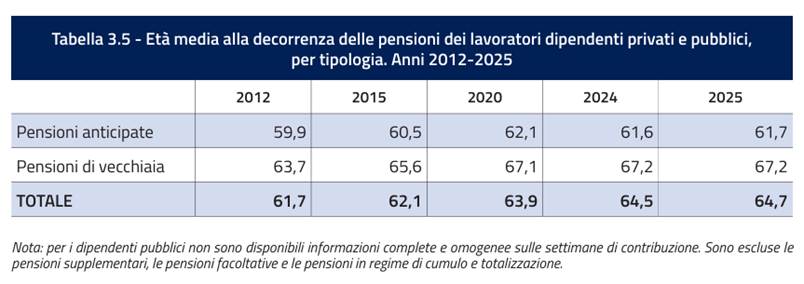
Historical series show how this mechanism is reflected in the actual exit behaviorsFor old age, the average starting age has stabilized at around 67 since 2019, closely following the evolution of legal requirements. For early pensions, however, the adjustment to life expectancy is primarily influenced by the required length of contributions, while the presence of temporary flexibility channels can alter the composition of the flows.
However, the logic of adjustment to life expectancy It operates on average values and can therefore mask significant differences between population groups. Life expectancy varies, in fact, depending on educational qualifications, socioeconomic status, profession, and place of residence. For those who have held more demanding jobs, have lower incomes, or live in contexts with less access to services, an age requirement based on average survival may result in a shorter expected retirement period compared to workers with skilled careers and more favorable living conditions.
I data on contributory seniority They add a further dimension. Early retirement currently selects workers with over 42 years of average contributions: these are largely people who entered the labor market early and have long, continuous careers. For those who have had discontinuous career paths, have alternated between work and inactivity, or who began contributing later, the early retirement channel remains more difficult to access; therefore, exit occurs more often—especially for women—through the old-age pension.
In this sense, theadjustment to life expectancy It does not produce uniform effects: it affects the retirement age for those accessing old age and the required contribution period for those aiming for early retirement, with different consequences depending on the continuity of working careers.
Sustainability and flexibility, the difficult mediation
That's why despite the importance of the operation of the indexing mechanismIts distributive implications, however, remain crucial: differences in life expectancy, unequal access to early retirement, and the persistence of gender contribution gaps can produce differential effects across worker groups. Therefore, the sustainability guaranteed by actuarial logic must be complemented by tools capable of protecting fragile careers, recognizing the varying burdens of career paths, and designing flexible exit options consistent with the heterogeneity of individual circumstances.
Agreed. There's always room for improvement. But the system has long taken these needs into account with measures that adapt requirements to specific working and living conditions, the results of which are documented in the Report. There are many ways out, to the point of requiring a treasure hunt map. But a mandatory retirement system must still outline general frameworks with common rules; it certainly cannot cater to specific individual circumstances. Especially since the average retirement age allows for retirement at a relatively young/old age.
La Table shows An increase in the average age at which pensions for employed private and public sector workers begin, rising overall from 61,7 years in 2012 to 64,7 years in 2025. The increase is particularly evident for old-age pensions, whose average age has remained stable at around 67 since 2020. Early pensions, on the other hand, are following a more uneven trend: after peaking in 2020 at 62,1 years, the average age will reach 61,7 years in 2025, more affected by flexible exit channels.