In recent days the sector of complementary pension has emerged from oblivion and, with difficulty in this troubled situation, has managed to put into circulation some proposals aimed at giving greater impetus to the various forms regulated by the law. The two key moments concerned the presentation of the Covip Report 2024 with the Considerations of the new President Mario Pepe and the approval – after a long consultation process – of a document by the Bicameral Supervisory Commission on social security institutions chaired by the senator Alberto Bagnai.
Professionals' pension funds under scrutiny
The Bicameral Commission, in the document, has dedicated much space and interest to the sector of Social security funds of the freelancers over whom Covip has control and monitoring tasks on the investments and assets called upon to guarantee performance over time.
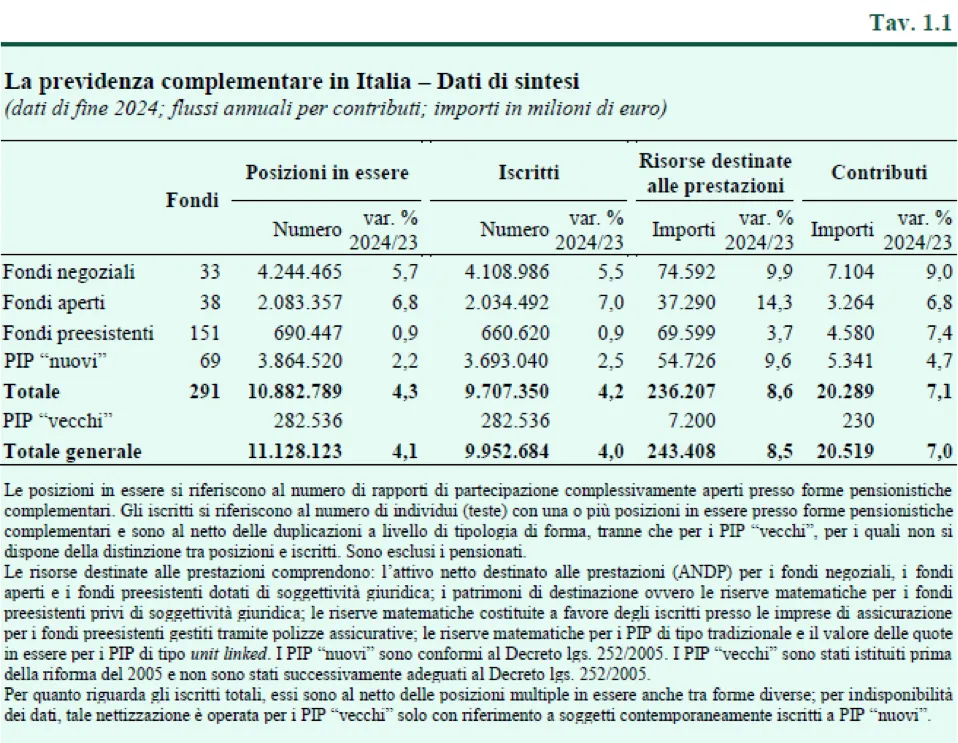
Covip's leitmotif can be summed up as follows: "The consolidation of the system continues". This consolidation is based on the following personal data: at the end of 2024, 291 supplementary pension schemes operate in the system, of which 33 negotiated funds, 38 open funds, 69 individual pension plans (PIP) and 151 pre-existing funds; since 1999, the number of schemes has more than halved, in particular that of pre-existing funds; the consequent increase in the average size of operators triggers economies of scale, with potential margins for cost reduction to the advantage of members.
Supplementary pension: more members, but growing alarm over non-payers and withdrawals
At the end of 2024 the enrolled in complementary forms there are almost 10 million, 4% more than in 2023. Among the various pension schemes, the trading funds and open funds, respectively 5,5 and 7%; less dynamic, equal to 2,5%, the growth for the Pip. But here the donkey falls for the first time. The members for whom contributions were paid in 2024 were 7 million, 72,3% of the total. The average contribution per capita is 2.890 euros; for men it is about a fifth higher than that of women.
- non-paying members, or for which no payments have been made, equal to approximately 2,7 million, are more present in the market pension schemes and among the self-employed. Due to the characteristics of the capitalization pension, these workers remain registered because, when the time comes, they will collect the pension on what they have paid. However, this is a phenomenon of associative dispersion worrying that in part may depend on organizational problems related to mobility on the labor market. The phenomenon is growing.
Advances and redemptions weaken the contribution amounts
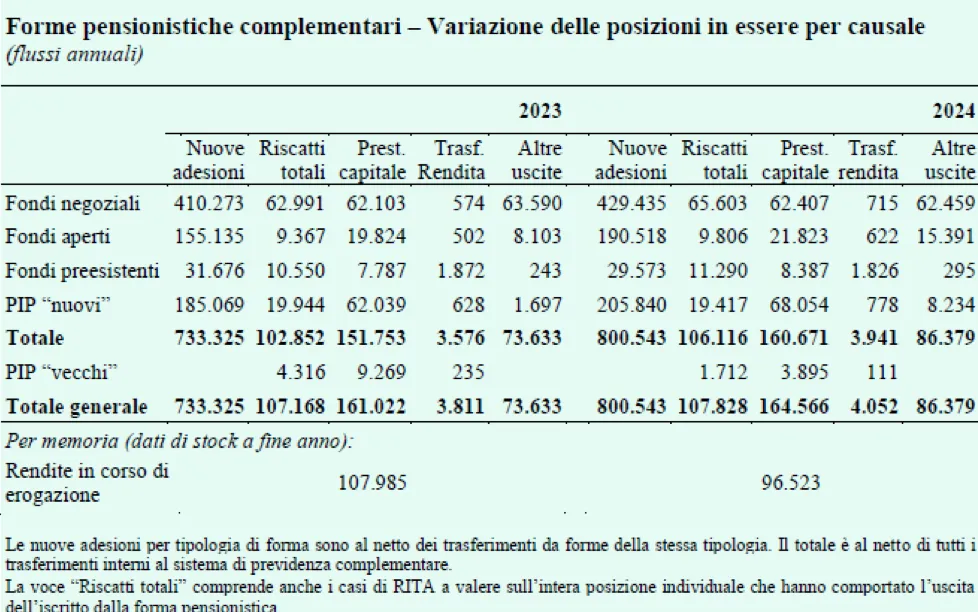
Other critical aspects are the advances and ransoms because they weaken the contribution amount. advances (which constitute a reason for competition with the TFR and which do not facilitate the role of social security finance) amounted to 2,3 billion, of which 939 million in the negotiated funds and 768 million in the pre-existing ones.
Among causal, stand out the purchase or renovation of first home housing, with disbursements of 1,1 billion euros and an average amount of 30 thousand euros, and that for reasons not attributable to a specific case, 1,1 billion in total for an average amount of 8,4 thousand euros.
Temporary supplementary pensions advanced (Rita): increasing numbers
For the ransoms, 2 billion euros in total, most of which was concentrated in trading funds with 850 million and in pre-existing funds with 677 million. The largest share of the redemptions is made up of the total ones: 1,6 billion euros for an average amount of 15.800 euros. The advance temporary supplementary pensions (Rita) increased: the overall disbursement was 1,6 billion euros (357 million more than in 2021), for an average amount of 57 thousand euros; the majority of disbursements, 1,4 billion euros (306 million more than in 2021), were concentrated in pre-existing funds. 28.800 positions were affected by Rita disbursements, up from 22.500 in the previous year; of these, 22.200 concerned the entire accumulated amount.
The previous year, redemptions amounted to 2 billion euros and advances to 2,5 billion euros. In the same year, approximately 1,9 billion euros of temporary supplementary annuities (Rita) were paid, mostly by pre-existing pension funds.
In 2024 the releases for the pension managementtotaled 13,2 billion euros, 1,6 billion more than in 2023. During the year, pension benefits in capital amounted to 5,2 billion euros and in annuities amounted to 361 million euros. The total resources accumulated in complementary forms amounted to 243,4 billion euros. The increase compared to the previous year, equal to 8,5%, derives for approximately two thirds from the result of investments and for one third from the balance between contributions and benefits.
Assets and contributions: supplementary pensions are growing
Le accumulated resources they are equal to 11,1% of GDP and 4% of the financial assets of Italian families.
In 2024 they were cashed in contributions for 20,5 billion euros, 7% more than the previous year. Among the various forms: 7,1 billion were collected from the negotiated funds; 3,3 billion from the open funds and 5,3 billion from the Pip; 4,6 billion euros flowed into the pre-existing funds.
Of the total contributions collected, the flow of Severance Pay (Tfr) paid to pension funds stood at 8,6 billion euros, approximately a quarter of the total Tfr generated in the production system.
Covip: a new model is needed to intercept vulnerable workers
The members for whom contributions were paid in 2024 are 7 million, 72,3% of the total. The average contribution per capita is 2.890 euros; for men it is about a fifth higher than that of women.
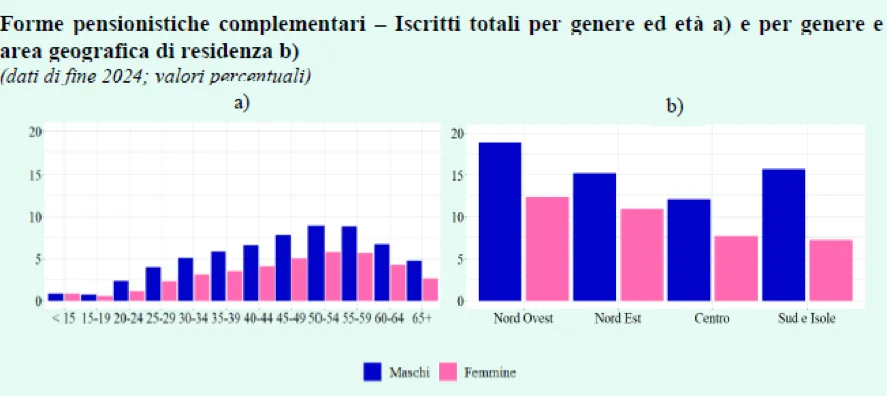
With regard to gender, the composition of the members remains unbalanced in favour of women, which make up 38,4% of the total. Compared to the workforce, women's participation is approximately 7 percentage points lower than that of men.
The middle age, 47 years old, does not show substantial differences between genders. The percentage of members under 35 is, however, on the rise: 19,9% of the total, 2,3 percentage points more than in 2019.
Participation in the workforce is growing as age increases. However, it is in the youngest age group, between 15 and 34, that the participation rate is growing the most, reaching 2024% at the end of 29,9, 8,4 percentage points more than five years earlier.
The majority of members, 57,2%, reside in the northern regions where the participation rate exceeds the national average. Lower values and decidedly lower than the average are recorded, however, in most of the southern regions.
Proposals for withdrawals and the decumulation phase
As for the proposals, Covip starts from an assumption that highlights the greater critical issues of the sector because it does not correspond to the strategic function assigned to the capitalization pension scheme in the framework of the pension system reform. Overall, participation in supplementary pension schemes is still characterized by a clear dualism. The membership continues to prevail among "strong" workers, employed in the northern or central regions, of male gender and of mature age. The entry of women remains difficult weaker groups of workers, younger, female and resident in the southern areas.
Is it then reasonable – asks Covip – to ask ourselves about how a supplementary pension model, initially conceived and built for a growing and continuously employed active population, can be improved to effectively intercept the most economically vulnerable people, as well as, in broader terms, a social reality that is changing in its structure, its choices, its priorities.
Tax interventions and the role of insurance
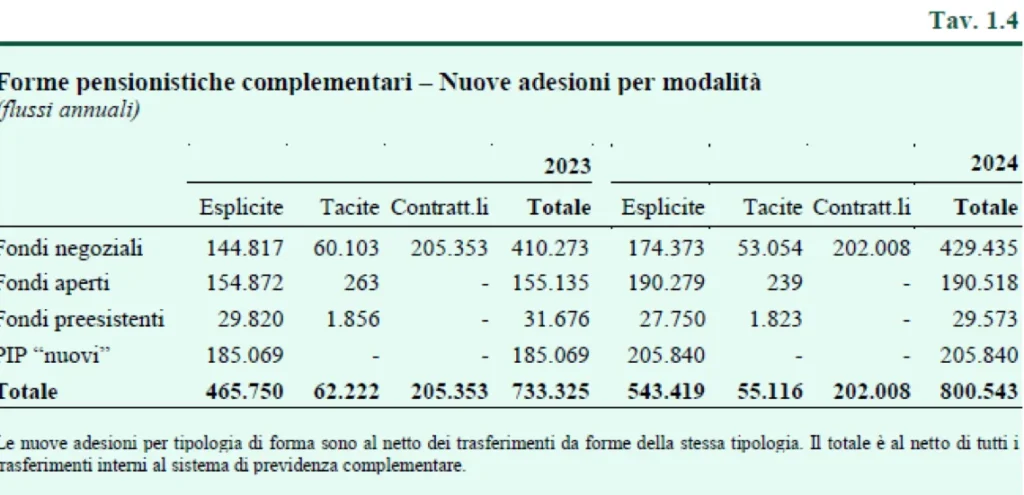
For relaunch of supplementary pension provision, it is first of all important to plan a broad and effective information campaign, which increases interest in the topic and with it curiosity and knowledge. It is also important to look at positively mechanisms that make participation more automatic, such as the silence-assent (currently only valid for first-time hires) or automatic registration with the possibility of reconsideration. In the automatic membership mechanisms, the methods used to guide the member towards participation solutions that are as appropriate as possible to his needs and characteristics are relevant. This is an architecture in which the identification of the choice of "default”, that is, the destination towards which they are silent subjects addressed.
Choosing the default line and life-cycle models
The choice made by the legislator in 2005, which identified the guaranteed line as the default for the transfer of TFR of silent workers – that is, supported by a guarantee comparable to the TFR revaluation rate – must be evaluated in relation to the effects produced. The management results observed in the last ten years show how the average annual returns the compounds of the lines with a higher equity content exceed, even significantly, those of the guaranteed lines over the same time horizon. This situation is confirmed by extending the observation period. The guaranteed line is characterized by a equity componentalmost nothing. The presence of a significant equity component in the pension portfolio is instead more appropriate for risk-return expectations of a medium-long term investment. The placement in a guaranteed line of the contribution flows of silent workers, especially younger ones, therefore determines a loss of opportunity in terms of profitability, also heavily mortgaging the result at maturity. The identification at a level normative of a default line can also be considered an element that implicitly directs the participation choices of non-silent subjects. It would therefore be more coherent to foresee as a default choice the line resulting from the use of a “life-cycle” model, replicating the best international practices and following the recommendations that the OECD has also been expressing for some time in this regard.
The model dynamically places the member in the different sectors from time to time, with the aim of optimising their risk-return profile following the stages of the life cycle.
Possible alternative options in the decumulation phase
Another evolutionary intervention, aimed at improving the system's ability to respond to people's needs, could concern the performance delivery phase. As is known, the system is required to convert into revenuelife annuity at least 50% of the individual position, with capital contributions playing a marginal role.
It is however evident that the choices of the members - also in light of the Costs and transformation coefficients of the capital applied by insurance companies – are moving in the other direction, showing a clear preference for the benefit in the form of capital.
Taking into account international experiences on this profile, in addition to the life annuity, it should therefore be possible to allow other payout options, better able to meet observed preferences.
Scheduled withdrawals and greater flexibility
Given this evidence, Covip sees the opportunity to directly allow the pension fund to pay the pension benefit in the form of scheduled withdrawals (without the involvement of insurance companies) in analogy with what happens for the Rita (Temporary Supplementary Anticipated Income), a measure introduced in 2017.
In particular, upon reaching the retirement requirements, it could, for example, be possible to provide an option that allows the member to make, in exchange for maintaining the accrued amount in the fund, subsequent partial withdrawals.
Limits, advantages and protection of supplementary pension provision
Withdrawable amounts may be in fixed amount, assuming the characteristics of a temporary annuity paid by the pension fund, or freely determinable. In both cases, withdrawals exceeding a maximum annual amount commensurate with the expected residual life, thus confirming the protective role of supplementary pension provision in old age.
The gradual nature of the withdrawals would also allow us to continue to benefit from the results of data management; with resources and, in fact, would increase the member's investment time horizon.
During the decumulation phase, in the event of premature death, the capital not yet withdrawn would remain for the benefit of the beneficiaries; this would increase the interest in participation. To date, in the event of choosing a pure life annuity, the same would be paid exclusively to the beneficiary and for the duration of the same's life.
Convergence towards European Pension Products (Pepp)
These innovations would allow the methods of providing services to be harmonised with those already foreseen for the Pan-European Individual Pension Products (Pepp), which, although not yet operating in Italy, can still be established and, once widespread, would in this respect likely have greater competitive strength.
Natural interventions fiscal they could then represent a further important lever to increase participation in the Italian supplementary pension system.
Mechanisms for recovering deductibility and encouraging participation
even the document of the bicameral commission explores these proposals. With a view to encouraging a further increase in participation in supplementary pension schemes, two aspects are highlighted, also by Covip. The first concerns the possibility of providing for a recovery mechanism of positive difference between the deductibility threshold of contribution to such pension schemes and theamount actually brought in deduction; this would be an incentive for those who, at the time of enrollment, do not have sufficient income to allocate beyond the expected threshold (5.164,57 euros) as pension savings, with the prospect of recovering these sums at later stages of their working career. Moreover, in the case of fiscally dependent persons (in particular children), this deduction limit should increase to take into account the number of persons enrolled in the supplementary pension scheme in order to encourage the creation of an adequate supplementary pension benefit. In fact, in perspective, the replacement rate of compulsory pension provision – that is, the ratio between the first annual pension installment and the last annual salary received – may reach values lower than 60%, especially in the case of more discontinuous careers. In this regard, it should be noted that the “Dini reform” set a replacement rate of 61,4% gross and 68% net of contributions with respect to the last salary, defined as “socially indispensable”.
Critical issues in the annuity disbursement phase and transparency of insurance conditions
The second concerns the annuity disbursement phase (at retirement), for which the system provides for the exclusive role of insurance and the obligation for the beneficiary to make a "dry" choice between the option of a life annuity, with the consequent application of appropriate tables for converting the accumulated capital into an annuity, and that of withdrawing the capital which, depending on the conditions, can be partial or total. The investigation also highlighted that the duration of the agreements of insurance is generally 3/5 years and therefore less than the duration of the contribution period (on average 25/30 years). This time gap makes it possible, to the detriment of the member, for the economic conditions to worsen after the act of joining the fund. It should be noted that situations have also emerged in which insurance companies apply transformation coefficients of the accumulated capital on the income side more "penalizing” compared to those used by INPS, as well as attention profiles regarding the transparency and completeness of the online applications, prepared by the various forms of supplementary pension, for the simulation of the pension benefits of the members. This is based on a "typical figure" of worker (62 years of age, 37 years of contributions, 2% annual growth in salary) who should be guaranteed a "degree of coverage" equal to that insured after 20 years of validity of the "Amato reform" in force (i.e. assuming a contribution rate of 33% and a GDP growth rate of 1,5% per year).