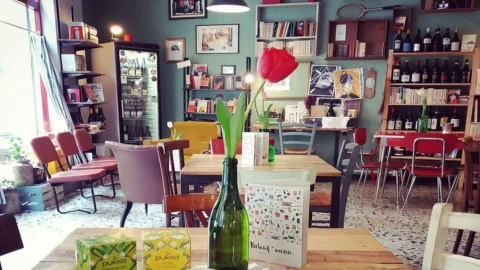
È Babeuf in Cagliari the Osteria of the Year for Slow Food. The guide to Italian taverns has placed this place at the top of the pyramid of good food in the country, which is “A perfect expression of an everyday place, which does not limit itself to “being” in the neighborhood – but makes the neighborhood, lives it and builds it by welcoming in a genuine way, with versatile dishes, always good and current, and with a contemporary, fresh and engaging approach to service”.
In bookstores from October 16, the thirty-fifth edition of the Slow Food guide to Osterie d'Italia reviews over 1900 venues reported for the local cuisine, selection of ingredients and genuine hospitality telling, as is now tradition, the most authentic and quality Italian catering through the visits and reviews of more than 250 collaborators spread throughout Italy.
Of the 1917 places listed in the guide, there are 324 venues have been awarded the highest recognition of the Chiocciola, assigned to establishments that stand out for their excellent offerings and for their environment, cuisine and hospitality in harmony with the values of Slow Food: next to the taverns, restaurants, wine bars with kitchens and agritourisms, there is something new. This year, in fact, we wanted inaugurate a section called Locali Quotidiani, which groups together all those alternative restaurant typologies such as pasta shops, pubs, wine bars and delicatessensand whose characteristics, first and foremost the attention and adherence to the territory, the selection of raw materials and a particular style of hospitality attentive to conviviality, fall in all respects into the idea of osteria as described by Osterie d'Italia. This new section, which is found at the end of the guide, has largely contributed to the number of new addresses included in the guide since Locali Quotidiani alone are 134, which when added to all the other new entries raises the number of new entries to 460, demonstrating a sector that continues to grow and renew itself.
Looking at regions, those with the most reported inns are Piedmont (178), followed closely by Campania (172) and Tuscany (164), with a fairly similar trend in the number of Snails which sees Campania with 39 snail-filled premises, Piedmont with 29 and Tuscany with 27.
The reporting of those unique regional gastronomic realities collected in the inserts also continues, which are easily identified in the Guide thanks to the pink pages in which they are collected, at the end of each regional section: alongside the piadinerie of Romagna, the fornelli of Puglia, the farinotti of Liguria and many others, the thirty-fifth edition also features the insert of the best pan pizzas in Turin.
“Osterias are authentic and welcoming places, they are places of peace different from all the others and we will do everything to protect them” said Carlo Bogliotti, CEO of Slow Food Editore.
"The future is also here, in the osteria, where innkeepers, chefs and the invaluable dining room staff express not only another idea of catering, but of the world," explains Barbara Nappini, president of Slow Food Italy. "An idea of the world in which change is governed in everyday life with choices about supplies, seasonality, short supply chains, non-affectionate research in the kitchen, the working conditions of collaborators, the way of welcoming and making guests feel at home. As well as adopting practices that reduce waste, reject disposable items, valorize scraps and so-called humble foods. Choices that educate at the table and in the kitchen. They proudly show us, every day, that conviviality is beauty. And where there is beauty, life is better."
Carlo Petrini, founder of Slow Food, invites us to reflect "on a fact that has characterized the past year in a very dramatic way: the lack of waiters and assistant cooks. The situation in some cases is so serious that many restaurants are forced to give up work shifts. The University of Gastronomic Sciences of Pollenzo intends to run a small school for migrant workers who want to enter the restaurant industry. The school will follow their training and also their integration. I ask everyone to be available to welcome these young people into this training process and to pass on their knowledge and the ability to welcome" and he concluded "we have the duty to pass on our knowledge to those who want and can be an extraordinary help".
The special awards of the Guide to the Osterie d'Italia 2025
Newcomer of the Year Award: Babeuf – Cagliari
A perfect expression of an everyday place, which does not limit itself to “being” in the neighborhood – but the neighborhood makes it, lives it and builds it by welcoming in a genuine way, with versatile dishes, always good and current, and with a contemporary, fresh and engaging approach to service.
Young Man of the Year Award “Vittorio Fusari” Franciacorta: La ciottolona – Boccheggiano (GR)
“A cuisine with character and identity, but strongly rooted: Duccio Frullani's is a courageous choice that starts from the land and the reality of a small mining village. With generosity and ingenuity, Duccio has put his wealth of skills, accumulated in various international professional experiences, at the service of the territory, to enhance its raw materials and the stories of its small producers”.
Courage Award: Osteria del Castello – Arquata del Tronto (AP)
“A vocation as a host so strong, clear and deep-rooted that it can face even the most impactful adversities, such as those caused by an earthquake but also, if not above all, by its consequences: the Osteria del Castello, with courage and obstinacy, continues to provide high-quality hospitality even in a context that has not been welcoming, for a long time, not even for its own inhabitants”.
Regional Cuisine Interpretation Award: Entrà – Finale Emilia (MO)
“Alongside contaminations with other cuisines or creative, characterful accents, there are faithful and authentic interpretations that assert themselves as the archetype of the local gastronomic culture. A precise Emilian cuisine, masterfully executed, that best expresses and represents the territory in which it is immersed”.
Pantry in the tavern award: La Stella – Meduno (PN)
Dish of the Year Award: Legume soup, told by its best expressions in Northern, Central and Southern Italy
Pasta and beans from the Antica trattoria Bellinazzo – Villa Bartolomea (VR)
Slow Bean Soup by Nonno Cianco – Cutigliano (PT)
Traditional bean and escarole soup with Acerra dente di morto bean from Taverna a Santa Chiara - Naples
Legume soup brings biodiversity and plant-based protein sources back to the center of the debate, but also the value of a reasoned recovery cuisine and slow and non-invasive cooking. To tell the story of legume soup, Osterie d'Italia rewards its best expressions in Northern, Central and Southern Italy.
Wine in the tavern award: Menabò wine and cuisine – Rome
Beer in the tavern award: Arrogant Pub – Reggio Emilia
Drink Well Award: The Michelaccio – Genoa
Innkeeper of the Year Award: Boivin – Levico Terme (TN)
Boivin's rhythm is marked by kindness, by the delicate and reassuring guidance of a host who welcomes with discretion, who becomes the narrator of the table and the territory with an authoritative but never protagonist voice, and invites you to a slowness that is nevertheless lively, cheerful and widespread throughout the room.
Special mention for Osteria Boccondivino in Bra, which will be celebrating its 40th anniversary and was founded together with Slow Food.