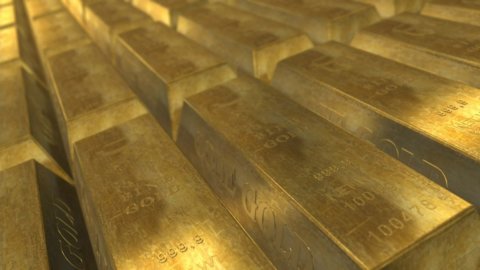
Every day the same headline appears on the financial pages of newspapers around the world. “New gold record”Yesterday, spot delivery was above $4.200 an ounce, supported by increased tensions between the US and China and bets on interest rate cuts by the Fed. And the precious metal is the focus of the latest episode of the podcast "On the 4th floor"of Alessandro Fugnoli, strategist at Kairos, who explains where this rally, which seems destined to continue over time, comes from.
The history of gold
“The first gold objects date back to 6600 years ago and were found in the necropolis of Varna, on the Black Sea. Since then, all over the planet, they have been 220 thousand tons of gold extracted. They seem like a lot, but since gold has a high specific weight, they could all fit into a cube with sides 22 meters long. Half of this cube is made up of jewels scattered around the world. 15 percent had industrial uses and the remaining 35 percent was distributed between the coffers of central banks and the safes of private individuals”, explains Fugnoli.
"There is not much gold left to extract. – he says –, at least with current technology. It's equal to a quarter of what has been mined in the past 7 millennia. At the current rate of extraction by 2050 there will be no more new gold and we will have to recycle what has already been extracted or go looking for it at the bottom of the oceans or in some asteroids that are rich in it."
“Until 1971 gold fulfilled the three functions of every currency, namely medium of exchange, unit of account, and store of valuee. In that year, America abandoned the gold standard and since then dollars and all other currencies are no longer convertible into gold", explains the strategist, then summarizing what happened in the following decades: "For thirty years, central banks and governments have tried to make people forget about gold and have sold off part of what they held. Inflation, until the middle of the last decade, continued to fall and gold, which does not yield interest, was considered a very unattractive alternative and intended for nostalgics. obsessed by the fear of new wars and catastrophes".
The two factors that triggered the gold rush
Now, two factors have radically changed the scenario: the first was the Covid, the second the emergence of a ever-increasing rivalry between China and America “and the latter's desire to begin creating the embryo of an alternative monetary system to that of the dollar, centered on a renminbi in turn backed by gold,” Fugnoli highlights.
“Laden with dollars from its exports, the China, at some point, stopped investing them in US government bonds and started accumulating gold, of which today, among other things, it is the largest producer in the world”. At that point, the other central banks also stopped selling their gold and began to accumulate it too, when they had availability. This was also contributed to by the seizure of Russian currency reserves held in the West. "Gold is better, some countries that might one day be subject to sanctions have thought, and it's better to keep it in our own country," the economist emphasizes.
Today's global economic environment sees inflation slightly above 2%, public deficits and total debt are higher than they should be in an ideal world, but they are still manageable. "The process of diversification away from the dollar and paper has begun and will continue, also because there is little gold in private wallets, "About one percent. A jump from one to two percent would be enough to see new price tensions," Fugnoli predicts.
"Today, gold mining costs an average of $1500 an ounce, and with a price of $4000, one might expect a rapid and imminent increase in production. However, supply is inelastic and unlikely to increase, even at these prices," he concludes.
A look at silver
The case is different withsilver, which is also in full swing. Silver is not bought by central banks but only by investors and theindustry and has a higher volatility than gold. “The demand for silver as a component for semiconductors, batteries and solar panels It is growing strongly, while investors are pushing it higher in sympathy with gold,” explains Fugnoli.
Returning to gold, gold company shares, despite their recent strong recovery, are still at a discount to the metal's price. Before purchasing them, however, it's important to carefully analyze all their complex variables. To name just one, some sell their production forward, others spot. For example, someone who pre-sold a year ago at that forward price now makes $2000. Someone who sells spot today makes $4000," observes the strategist.
In summary: those who buy silver today buy above all an industrial metal with a speculative component. Those who buy gold are betting on its gradual return to the function of money. “As long as there is demand from central banks, the price of gold, although subject to fluctuations, will maintain important support,” he concludes.