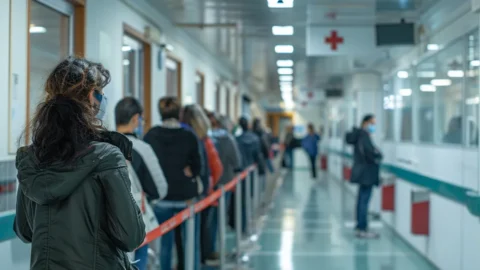
The shock treatment against the waiting lists it doesn't work as it should. This is demonstrated by the annual Civic Health Report presented by Cittadinanzattiva at the Ministry of Health, whose numbers photograph a disastrous situation: despite the Government's promises, waiting times are so long that Accessing healthcare is almost impossible for nearly one in three Italians.
The data shows in black and white that out of 24.043 reports from citizens in 2023 (an increase of 9.971 compared to the previous year), 32,4% (+2,8% compared to 2022 and +8,6 compared to 2021) refer specifically to the lack of access to services.
Waiting lists: increasingly longer times
According to the report, citizens continue to report the inability of the health service to respond promptly to health needs: for a first eye exam in class P (programmable, i.e. to be carried out within 120 days) you can wait 468 days; for a oncological check-up visit in an undetermined class you can wait 480 days; 300 days for a check-up eye examination in class B (short, to be provided within 10 days); 526 days for an ecodoppler of the supra-aortic trunks in class P; 437 days for a hip replacement in class D (within 12 months), 159 days for a prostate cancer operation in class B. Of course, these are the maximum times reported by citizens and not the average waiting times.
The phenomenon, the survey further emphasizes, has a decisive impact on the therapeutic path and even on the choice not to seek treatment. According to the report, in fact, in 2023, 7,6% of citizens have given up on treatment (+0,6% compared to 2022) and, of these, almost two out of three (4,5%) did so precisely because of the long waiting lists (it was 2,8% in 2022). The rate of withdrawal is equal to 9,0% among women and 6,2% among men. From a territorial perspective, withdrawals, moreover, increase more in the Center, where in one year it went from 7,0% to 8,8%, and in the South (from 6,2% to 7,3%). In the North the level of 7,1% remains stable.
The data on the decrease in services provided during 2023 also confirm the renunciation of care: the average decrease is 8% compared to the previous year. The gap is minimal in Lombardy and Tuscany (-2%), followed by Emilia Romagna (-3%), but in 14 Regions the percentages exceed the national average with peaks of -25% in Sardinia, -27% and -28% in Valle d'Aosta and in the province of Bolzano. It is above all on the front of first visits that the regional systems are struggling: these have decreased on average by 10%.
Difficulties even with family doctors and pediatricians
The document also shows how the relationship between citizens and the general practitioner - or the pediatrician of free choice – is increasingly suffering. Cittadinanzattiva, notes how reports of poor service by citizens in this area have tripled in 5 years (from 5,4% of reports received in 2018 to 14,2% in 2023) due to the little time available or a deficit in the information provided to citizens. There are reports of who does not receive an appointment within a time frame deemed "appropriate" or complains about visits that are too short and in which they are unable to report all their problems to the doctor. While the critical issues related to local healthcare (11,1% of the 24.043 total reports) mainly concern the facilities present in the territory that should take action to provide integrated care for patients”.
The situation is no better for other services in the area. In particular, the positive effects of the investments related to the PNRR and the reform of territorial assistance are slow to arrive, despite the fact that progress is being made in implementing the reform: in April 2024, 86% of the projects relating to the Community Houses have reached the point of signing the contract; percentages close to 100 for the contracts relating to the Territorial Operations Centers. The situation of the Community Hospitals is more varied, with values that oscillate between 70% and 100%, although some Regions are much further behind: Calabria is at 45%, the Autonomous Province of Trento at 33%, that of Bolzano at 0.