For now, it's just a prototype, an experiment, a first test for the clean mobility of the future. Solar panels covering electric cars to recharge their batteries is an idea as banal as it is difficult to implement. Today, but not tomorrow. Photovoltaic panels are rapidly increasing in efficiency, decreasing in weight, and decreasing in cost. In a few years, we'll see them circulating, embedded on the car's roof, in the hood, or in the tailgate. Colorful, perhaps. indistinguishable from the paint and color we like best. A zero-emission future, promises the Japanese giant. Or rather, a Franco-Japanese future, given the organic alliance with the Renault group.
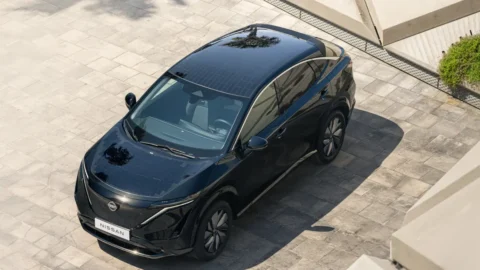
A few startups around the world are trying to apply for the potential business. But among the big brands, Nissan is going in advance scout Already now with the Ariya concept, which takes the form of the popular electric sedan already on the road. Covering it with glass-polymer panels, the most flexible and lightest available today, covering a not inconsiderable 3,8 square meters, they are integrated into all surfaces directly exposed to the sun. A bargain? Perhaps not today, considering the cost ratio, the additional weight of the device (not just the panels but also the control equipment), and the efficiency of the additional charging it can provide. But the signs of a future good deal are all there, if the cost-benefit-efficiency ratios improve even a little.
Nissan, which presented its creation on the occasion of the International Day of Clean Energy, claims that the prototype of the photovoltaic Ariya, created in collaboration with the Dutch specialized company Lightyear, guarantees aadditional autonomy Up to 23 kilometers on a sunny day. Already today, "it is possible to reduce charging frequency by 35-65% depending on usage," a note ventures, evidently referring to a short daily urban commute. Indeed, it immediately goes on to specify that "a two-hour, 80-km journey can produce 0,5 kWh (kilowatt-hours, ed.) of clean energy, adding up to 3 km of free, zero-emission range."
It must be said that the foreseeable developments are truly fascinating. Also because Nissan itself has earned a pioneering role in the so-called Vehicle to grid, that is, connecting the electric car to the grid, both the public and domestic one, not only to draw energy but also to exchange it and deliver it when needed, taking on the role of an element of a new public or private battery system.
It's still too early to talk about the system's net convenience, and decidedly too early to imagine a car that can fully recharge itself all the time thanks to its solar panels. But Nissan's commitment is definitely commendable. And it demonstrates a stubborn desire to pursue a double strategic line: cost containment, dictated by its delicate financial crisis and by the so far unsuccessful attempts at further corporate consolidation (a partnership with the giant Honda was even attempted), and maximum commitment to technological progress and quality and therefore the overall appeal of its cars.