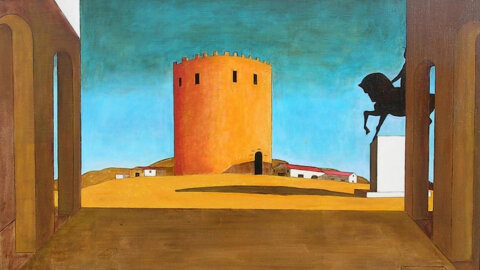
In this context, the work The Red Tower (1913) by Giorgio de Chirico offers significant food for thought on the need for change in the art market model. The tower, a symbol of stability and solitude, stands in a metaphysical landscape that challenges traditional perceptions of reality. Similarly, the art market is called to evolve, to open up to new models that respond to the challenges and opportunities of the XNUMXst century.
The metaphysical works, characterized by desolate urban landscapes, classical architecture and long shadows, invite the viewer to reflect on the hidden dimension of realityDe Chirico himself wrote: “Everything has two aspects: one current, the one we almost always see, and the other, the spectral or metaphysical one.”
The traditional art market: a static model
The traditional art market has developed around a model based on the rarity, authenticity and historical value of works.Galleries, auctions and private collections have represented the main channels of distribution and fruition. However, This model has shown clear limitations: access to art has often been reserved for a small elite, market dynamics have been influenced by economic speculation and the enjoyment of art has been predominantly passive. The Red Tower, with its solitary and suspended atmosphere, can be seen as a metaphor for this model: an isolated structure that does not interact with the surrounding context, but stands like a monolith in a motionless landscape.
The challenge of the future
Just as de Chirico's work challenges our perception of reality, the art market is called upon to challenge its own conventions and evolve toward more inclusive and dynamic models. The Red Tower, with its solid structure and dominant position, can be interpreted as a symbol of stability and innovation. The tower, despite being isolated, is visible and recognizable, just like new digital platforms that, despite being separate from the traditional market, are gaining visibility and influence.
Some examples of innovation illustrate how the art market is evolving
Digital platforms represent a paradigm shift for the art market. They enable not only greater accessibility and transparency, but also the creation of new experiences and economic models. Artists like Beeple They have sold digital works as NFTs for millions of dollars, demonstrating that digital art can have significant economic value and that new models of ownership and distribution are possible. Auction houses such as Christie's and Sotheby's They have launched online platforms that allow a global audience to participate in sales, expanding access to art and increasing transaction transparency. Finally, for example: exhibitions such as “Van Gogh Alive” and “Monet Experience” They use technology to create immersive sensory experiences that go beyond passive observation and invite audiences to actively participate. These examples demonstrate that art can adapt to today's challenges, maintaining its essence while expanding its modes of expression and enjoyment.
"The challenge today is to find a balance between preserving historical values and adopting innovations that allow art to continue to be a vehicle for expression, reflection, and dialogue in the 21st century.”