The name has ancient origins, deriving from the Medieval Latin carnem levare ("to remove the meat"), alluding to the final banquet on Shrove Tuesday, before the Lenten fast. This celebration marks the final period of revelry, debauchery, and disguise, with ancient origins linked to Bacchanalian rites, Saturnalia, and the concept of renewal. And the Neapolitan culinary tradition preserves the Carnival Lasagna as the ultimate expression of the gastronomic richness that precedes Lent. Because lasagna in Naples, unlike that made in Bologna, is a triumph of hearty ingredients with its mix of meat, cheese, and eggs, perfectly reflecting this tradition. A symbol of festive abundance, it combines pasta with Neapolitan ragù. A dish so deeply rooted in the history of Neapolitan cuisine that in the 800th century one of its greatest admirers was none other than Francis II of Bourbon, the last king of the Two Sicilies, who was so fond of this dish that he was nicknamed "King Lasagna".
But even before the arrival of the Bourbons in Naples, historical evidence relating to documents from two recipe books of the Angevin Court from 1238 and 1304 refers to an alternating sheet of pasta, although the sauce was not used until the 800th century.
Be that as it may, the concept of Neapolitan lasagna has evolved over time, enriched each time with new ingredients until reaching the triumph of gastronomic luxury we see today.
Meanwhile, the main ingredient, unlike lasagna bolognese, which is made with béchamel sauce, is the sauce, a thick tomato ragù with various pieces of meat, rigorously simmered over the stove for at least eight hours. Enriched with all sorts of goodies: fried meatballs made with ground beef, egg, and parmesan; ricotta, provola (or fiordilatte), and parmesan cheese (or pecorino). Hard-boiled eggs, sliced or chopped. Cured meats such as Neapolitan salami or cervellatine (a typical fresh sausage from Campania, known for being thinner (1-2 cm in diameter) and longer than traditional sausages. Made with pork, coarsely minced or ground with a knife (a ponta 'e curtiello), seasoned with black pepper, chili pepper, or fennel.
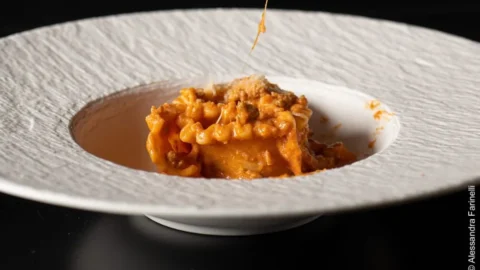
Peppe Guida, the great Michelin-starred chef from Vico Equense, creates an original Carnival Lasagna that is much faster and lighter, cooking it in a pan rather than in the oven and reducing the ingredients while maintaining its cultural significance and respect for its origins.
Peppe Guida's Pan-Fried Carnival Lasagna
Ingredients for 4-5 people
400 g of Mafaldone di Gragnano from Pastificio dei Campi, a type of pasta produced exclusively with durum wheat flour and water, once called Fettuccelle, later dedicated to Princess Mafalda of Savoy, which often enter into the composition of mixed pasta.
50g of fresh ricotta
50g of parmesan cheese
100g of fiordilatte
For the meatballs
500 grams of mixed minced meat (beef and pork)
2-3 slices of stale bread
2 eggs
100 grams of pecorino romano
salt and pepper
2 tablespoons flour
1/2 glass of white wine.
For the ragù
2 liters of tomato puree,
2 cloves of garlic
extra virgin olive oil
Method
In a large bowl, thoroughly mix the ground beef and pork, salt, pepper, pecorino cheese, eggs, and squeezed breadcrumbs. Then, with slightly damp hands, shape the mixture into small balls. Lightly flour the balls and brown them in a pan with a drizzle of oil and a splash of white wine.
Now it's time for the ragù, which is prepared by sautéing two cloves of garlic in extra virgin olive oil in a pan, then pouring in the tomato puree and simmering for about 20 minutes. Then add the meatballs and continue cooking for another 15 minutes, seasoning with salt to taste. Keep warm to accompany the lasagna. Chop the mozzarella.
Now, drop the mafaldone into lightly salted boiling water and cook until al dente. One minute before the pasta is cooked, stir the ragù into the pasta for just a few seconds. Remove the pan from the heat and add the ricotta, parmesan, chopped mozzarella, and a pinch of pepper. Stir well and serve.
If you have the patience to resist and wait until the next day the dish will be even more combined and will have an even more flavoursome taste.