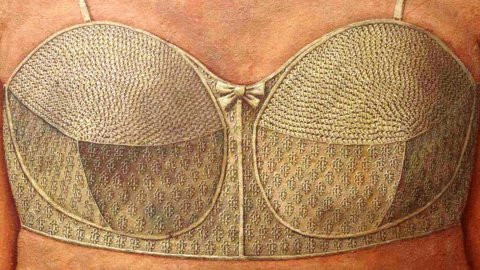
The exhibition intends to provide an articulated and innovative reading of the events that led to the birth and diffusion of an "Italian way" to Pop Art, fully in harmony with the similar experiences gained in the international arena and at the same time linguistically independent from the US models and Europeans of the period.
To highlight the specificity of the Italian declination of Pop, the exhibition opens with two exemplary works from the same collections of the Foundation, a 'Piazza d'Italia' by Giorgio de Chirico and a 'Sacco' by Alberto Burri, two primary, historical sources , of the Italian approach to contemporaneity, to figuration and to the object. On the other hand, it is no coincidence that initially the critics had spoken of a “neo-metaphysical” season in relation to the work of authors such as Mario Schifano or Tano Festa, and Schifano himself, as is well known, will explicitly pay homage to Giacomo Balla and Futurism in two central pictorial series in the development of his path.
The exhibition then proceeds with those who can be considered the precursors of the Pop language proper, a series of authors who, starting from the years immediately after the Second World War, have tackled the themes of the new visual landscape in a country that was emerging from the traumas of war and opening up to new, unprecedented lifestyles capable of naturally generating new images: Gianni Bertini, Enrico Baj, Mimmo Rotella, Fabio Mauri, were the first to grasp the new cultural climate, the new social climate that was maturing over the 1960s, and their works stand, stylistically and temporally, alongside those of the American neo-Dadaists such as Jasper Johns and Robert Rauschenberg or the contemporary exponents of the French "Nouveau Rèalisme". Together with them, in the late 1966s, authors such as Schifano, Renato Mambor, Gianfranco Baruchello reflected on the themes of the screen and the objectivity of painting, laying the foundations for the development of the real golden age of Italian Pop Art between XNUMX and XNUMX.
A moment of extraordinary artistic fervor that invests the entire peninsula, which has its nerve centers in the cities of Milan and Rome, but which also finds extremely significant places of diffusion in Turin and Tuscany, not to mention only the centers where the greatest is the impact of this trend on the art scene. In this section you will therefore see the masterpieces of Mimmo Rotella and Enrico Baj, of the Roman authors gathered under the label of "Scuola di Piazza del Popolo", the aforementioned Schifano, Festa, Mambor, Mauri and then Franco Angeli, Umberto Bignardi, Mario Ceroli, Giosetta Fioroni, Sergio Lombardo, Cesare Tacchi, Claudio Cintoli, the works of artists working in Milan such as Valerio Adami, Lucio Del Pezzo, Emilio Tadini, Antonio Fomez, the Turinese Piero Gilardi, Aldo Mondino, Michelangelo Pistoletto, the Tuscans Roberto Barni, Adolfo Natalini, Gianni Ruffi, Roberto Malquori.
A reading that concludes with the presentation of another crucial phenomenon in the evolution of the Pop language in Italy, namely that declination which, starting from 1966 and at least until the early XNUMXs, uses the images and styles of mass culture to create an explicitly political art, which reflects the new social climate spread all over the world at the end of the decade: in this section there are works by some authors present in the previous ones such as Schifano, Angeli, Bertini, but above all by the exponents of that "critical figuration" - such as Giangiacomo Spadari, Paolo Baratella, Fernando De Filippi, Sergio Sarri, Umberto Mariani, Bruno di Bello or Franco Sarnari - who are revealed today as a further, original Italian contribution to the diffusion of "popism" in the international arena .
What makes this exhibition truly unicum, unrepeatable in the exhibition panorama, not only nationally, is the possibility of seeing a series of sculptures in the extraordinary halls of the Villa dei Capolavori, the historic residence of Luigi Magnani, architect of the Magnani Rocca Foundation: the animals in methacrylate by Gino Marotta, the sculptures by Pino Pascali, the woods by Mario Ceroli, the "First color television" by Gianni Ruffi dialogue with the furnishings and paintings of the Foundation, in a surprising comparison between the classical world and the popular culture of the Sixty. Even a splendid and very rare painting by Domenico Gnoli, a great artist who died very young, from an important private collection, enters into dialogue with the foundation's masterpieces of ancient painting.
On display, the pictorial and sculptural works are accompanied by some significant design pieces of the time, as well as references to publishing and discography, which allow the viewer to fully immerse themselves in the cultural climate of the period, a crucial moment in the rejuvenation of Italian culture in terms of international, in direct comparison with the new mass culture, analyzed in those same years by great intellectuals active in our country such as Pier Paolo Pasolini or Umberto Eco.
The exhibition, curated by Stefano Roffi and Walter Guadagnini - former author of historical surveys on the subject such as "Pop Art UK 1956-1972", "Pop Art Italia 1958-1968", both at the Galleria Civica di Modena, "Pop Art 1956- 1968” at the Scuderie del Quirinale in Rome, as well as numerous solo exhibitions dedicated to the protagonists of the movement – is accompanied by a catalog published by Silvana Editoriale, containing essays by the curators and other scholars, as well as reproductions of all the works on display.