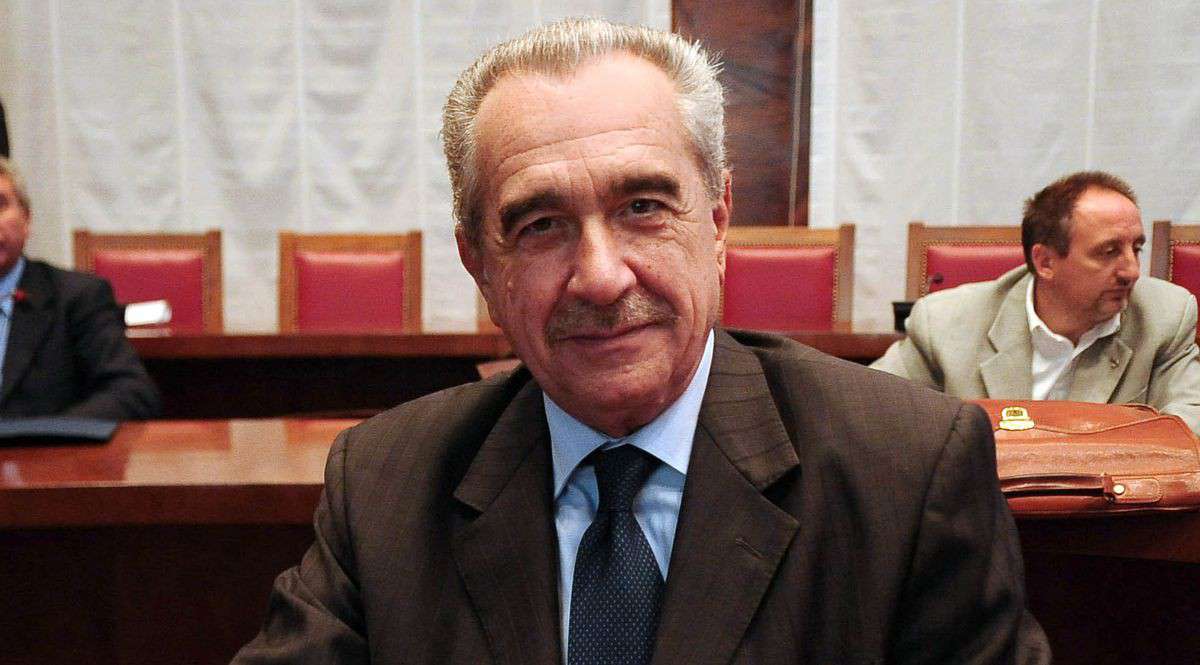
Il 10 April 1972 was found in a house on the outskirts of Buenos Aires the lifeless body of
Oberdan Sallustro, general manager of the Argentine Fiat Concord, kidnapped and murdered byERP (People's Revolutionary Army). The tribute of blood that other Fiat men, victims of Red Brigade terrorism, would shed in Italy in the following years began on the other side of the world. His father's family had emigrated to Argentina from Naples in the second half of the nineteenth century. Gaetano Sallustro, with his wife Anna D'Amato, moved to Asunción in Paraguay in 1899 where they started a jewelery production and sales business, and in 1915 their third child, Oberdan, was born, named after the irredentist patriot Guglielmo Oberdan , hanged in Trieste in 1882 by the Austro-Hungarians.
Oberdan Sallustro, who was he?
The Sallustro family, now in possession of a reasonable fortune, returned to Naples in the early twenties. And it was in Naples that their first-born Attila, betraying the expectations of his father who wanted him to be a lawyer, would be the first Paraguayan footballer in the Italian championship, playing as captain for 11 years with the Napoli shirt, and making, once naturalised, some appearances in the National university team of the time and in the senior national team. For many years Attila Sallustro played for Napoli for free because his father considered it unbecoming to be paid to play. Having finally turned professional, he married Lucy D'Albert, one of the most famous showgirls of those times, of Russian origin and later naturalized Italian.
Once he put his shoes on the nails, and after a brief period as coach of Napoli himself, he would be the director of the San Paolo stadium in Naples for over twenty years. Only fifty years later the Neapolitans will fall even more in love with another South American, Diego Armando Maradona, but Naples and its surroundings will be mindful of Attila Sallustro by dedicating a street to him in the Ponticelli district, a street in Pomigliano d'Arco and a square in Casavatore, as well as the municipal stadium of Carbonara di Nola.
Oberdan Sallustro, the meeting with Gianni Agnelli in Turin
Oberdan also, following in his older brother's footsteps, began a career as a football player. After finishing high school in Naples, he returned to Paraguay to play for Asunción's Nacional but with little luck. After a few years he returned to Italy and enrolled in the law faculty of Turin where he met Gianni Agnelli, the future Lawyer and owner of Fiat. A naturalized Italian for some time, at the outbreak of the Second World War Oberdan Sallustro was a reserve officer on the Greek front. After 8 September he will join the Justice and Freedom partisan brigades in Piedmont.
At the end of the war he returned to Turin where in 1946 he graduated in law and in the same
year he began his diplomatic career as a commercial attaché of the Italian embassy in Asunción in Paraguay. In 1949, at Valletta's request to the then Minister of Foreign Affairs Carlo Sforza, Oberdan Sallustro collaborated with the Fiat plenipotentiary for South America, the Turin Aurelio Peccei, for the resumption of trade relations with Argentina and the identification of a possible industrial area in which to establish its production, given the great potential that that country offered at the time.
Oberdan Sallustro and the rise of Fiat in Argentina
In Buenos Aires you will also have the opportunity to meet Susanna Agnelli and her husband the count Urbano Rattazzi, who had taken refuge in Argentina for a few years, after Rattazzi's time in the X Mas battalion of the social republic of Salò in 1944-1945. In the same year, thanks also to the work carried out by Sallustro, an agreement was reached between Fiat and the Argentine Fabricaciones Militares for the construction in Cordoba of a plant for the production of trucks, tractors and railway material.
Oberdan Sallustro is now a full-fledged part of Fiat and with Peccei continues to build relationships with the government authorities to create an automotive production center in the country, despite the competitive opposition of American companies that have already been there for some time, in particular the General Motors, concerned about the role that Fiat itself could have played in Argentina's industrial development.
Fiat, the turning point: yes to car production in Argentina
The country, after the fall in 1956 of Peron, a period of economic development passes, accompanied by the replacement of rail transport by mass automobile transport. Established the Fiat Concord, President Aurelio Peccei and general director Oberdan Sallustro, cars began to be imported directly from Italy, in particular the icon of the Italian miracle, the Fiat 600. Thanks to the work of Peccei and Sallustro, in 1959 the Argentine government definitively authorizes Fiat to produce cars in the country. In 1960, the first Fiat Concord 600, identical to that of the parent company, rolled off the assembly lines of the Caseros plant in the Buenos Aires area. Three years later, Peugeot also settled in El Palomar, still in the hinterland of Buenos Aires. Under the direction of Oberdan Sallustro, Fiat Concord will climb to the top of the Argentine car manufacturers with a production that will vary from 150.000 to 200.000 cars a year, having identified that segment of the middle class market that the American car manufacturers above all had neglected.
Argentina unstable between governments, military coups and kidnappings
Furthermore, in Argentina in the 21s and 1972s, high political and social instability reigned: regularly elected governments alternated with military coups, in the presence of a guerrilla war organized by left-wing groups such as the Montoneros of Peronist origin or the ERP (Ejército Revolucionario del Pueblo) of Marxist-Trotskyist inspiration. It was an ERP commando that kidnapped Oberdan Sallustro on 3 March XNUMX near his home while he was on his way to the office. The news also attracted great attention in Italy if only because three weeks earlier, on XNUMX March, a kidnapping by the Red Brigades had taken place for the first time, that of the manager of the Milan office of Sit-Siemens Idalgo Macchiarini.
The kidnapping lasted only about twenty minutes: the time to load him into a van, photograph him and leave him a few hundred meters from his home. The photograph was sent to newspapers with Macchiarini portrayed with a sign around his neck bearing what would become the infamous writing “Hit and run. Hit 1 to educate 100." The terrorists justified the kidnapping of Sallustro by accusing him, as such characters can do, of being an accomplice of the President of Argentina, General Alejandro Lanusse for the arrest of approximately 250 members of the same ERP present in the Fiat Concord factories.
Oberdan Sallustro: the kidnapping, the rejected negotiations and the ransom never paid
As stated later, their goal was to obtain an immediate ransom of approximately 2 million dollars and the release of all arrested Fiat employees. The General Lanusse he will refuse any negotiation despite pressure from Fiat, not only from Aurelio Peccei but also from Gianni Agnelli, a friend of Oberdan Sallustro since his University days, willing to pay the ransom. The pressure on Lanusse was equally useless Pope Paul VI, who in 1968 had awarded Oberdan Sallustro with the Pontifical Order of Saint Gregory the Great, and his appeals to terrorists. The eight thousand workers of Fiat Concord will also demonstrate on several occasions for his release. The only ones who will applaud the ERP's "revolutionary" initiative in France will be the usual left-wing intellectuals, such as Jean Paul Sartre and Julio Cortàzar.
Hunt for terrorists and murder of Sallustro
The hunt for terrorists lasts about twenty days. Every time the federal police arrest members
of the commando, the remaining ones move the hostage from one place to another, until dawn on April 10th
1972 the police raid a house on the outskirts of Buenos Aires. The three remaining jailers manage to escape, but not before having massacred, in the "people's cell", with several gunshots from
fire Oberdan Sallustro. They will be captured later, but it will never be known exactly who shot them, accusing each other and never going to trial due to the intervening amnesty.
Oberdan Sallustro and the letter to his wife
It will be found on Sallustro's body a letter addressed to his wife: “I am very calm, like Socrates too, because I will finally know the truth of Giorgio (the son died young, ed) and of God. Sincerely. Oberdan”. Gianni Agnelli will also participate in his funeral in Argentina and will arrange the arrangements 5 minutes of silence as a sign of mourning in all Fiat factories around the world. There will only be a second time in which Fiat factories around the world will stop for 5 minutes of silence as a sign of mourning for the death of the Lawyer.
Argentina, amnesty for all terrorists
In May 1973, the Peronist was elected President of Argentina Hector Campora which he will grant general amnesty for all terrorists, including the kidnappers of Oberdan Sallustro. Some of these will return to the armed struggle, others will enjoy a golden exile in France on the basis of the Mitterrand doctrine, others will become disappeared with the advent of the new military junta of General Videla in 1976. When Fiat Concord launches the Fiat 1977 in 133, a car designed directly in Argentina, the Argentines themselves will proudly nickname it “Sallustro”. In 1980, Fiat Concord will merge with PSA, which will form the "Argentine Sevel" in El Palomar. In Argentina, Fiat will remain with the Cordoba factory, which will be renamed Cor. Mec., with which he returned to producing cars in 1996, as a branch of the Fiat plant in Brazil. The El Palomar and Cordoba plants are now part of the Stellantis Group, born from the merger of FCA with PSA.