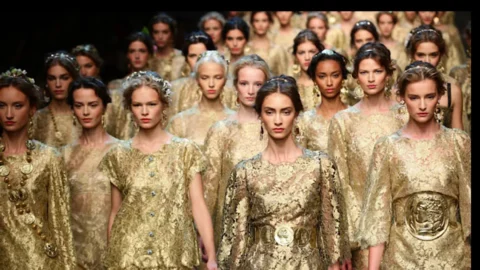
In this context, Stefano Gabbana's recent decision to step down as executive chairman of Dolce & Gabbana takes on a significance that goes beyond the individual company case, becoming an emblematic sign of a structural shift in the entire industry. Historically, major luxury fashion houses have developed around the figure of the founder, who embodied their identity, aesthetic, and cultural vision. A luxury product was not merely a material good, but the direct expression of a creative personality, often unique. This model ensured stylistic consistency and authenticity, key elements for building brand prestige. However, with the expansion of markets and increased global demand, this structure began to show its limits.
Today luxury is increasingly an industry
Major brands operate on an international scale, with widespread distribution networks, sophisticated financial strategies, and an increasing reliance on growth and performance strategies. In this context, the centrality of the founder tends to diminish, leaving room for more complex and managerial governance. Even historically independent companies are adopting models similar to those of large conglomerates, such as LVMH and Kering, where success is determined by a balance between creativity, marketing, and financial management. This shift involves a redefinition of the very concept of luxury. While in the past it was synonymous with rarity and distance, today it tends to become more accessible, widespread, and experience-oriented. New generations of consumers, less tied to traditional codes of status, seek authenticity, sustainability, and emotional engagement. As a result, brands are driven to innovate not only aesthetically, but also in terms of communication and values.
A difficult transition, here's why
The transition from a “creative vision of the founder” to a “global industrial management" represents one of the most delicate issues for the luxury sector, because it calls into question its identity balance. It is not just an organizational change, but a structural tension between symbolic uniqueness and economic replicability. On the one hand, the managerialization enables brands to address the complexity of contemporary markets. In a global system characterized by volatile demand, digitalization, and intense international competition, models like those adopted by large groups enable greater operational efficiency, more solid strategic planning, and an investment capacity that is difficult to sustain by purely creative or family-run structures. The standardization of certain processes, from supply chain to marketing, therefore, becomes a necessary condition for growing and maintaining market share. On the other hand, however, this very standardization risks contradicting the very nature of luxury. The symbolic value of brands has historically been based on elements that are difficult to replicate: the creator's touch, aesthetic consistency, the authentic narrative of a vision. When the creative process is integrated into an industrial logic, there is the risk of transforming the exceptional into mass-produced, and thus diminishing the perception of exclusivity. In other words, the more accessible and widespread luxury becomes, the more it loses the distance that justifies its prestige. This tension also manifests itself in the management of creativity. In contemporary organizations, the creative director is no longer necessarily the founder or owner, but a figure embedded in a complex corporate system, with performance objectives and financial constraints. This can lead to greater designer rotation and a certain aesthetic "homogenization" across brands, where creative choices are influenced not only by an artistic vision but also by market analysis and sales data.
A further critical element concerns the relationship with the consumer
Traditional luxury was based on a logic of distance and selectivity; today, however, brands are constantly present on social media, in collaborations, and in experiential marketing strategies. This convergence increases visibility and engagement, but it can also trivialize the product, making it less "exceptional." The risk is that luxury will transform into an aspirational mass good, losing part of its symbolic dimension. However, the tension between these two dimensions is not necessarily destructive. On the contrary, it can become a space for innovation. Brands that manage to maintain a strong core identity, often linked to their history or personalities, while adopting advanced managerial tools, can transform this contradiction into a competitive advantage. In this sense, the future of luxury will be neither completely artisanal nor entirely industrial, but will hinge on the ability to integrate creativity and system, authenticity and global scale. Ultimately, the tension between creative vision and industrial management cannot be eliminated, only managed. It is precisely in this unstable balance that the contemporary meaning of luxury is defined today.
To state that “luxury is no longer luxury” means to recognize that the sector is changing its paradigm
Value no longer lies exclusively in the founder's signature, but in the company's ability to operate as a global system.future of luxury It will depend on the ability to reconcile these two dimensions: preserving the creative legacy and, at the same time, adapting to the logic of an increasingly industrial and interconnected economy.