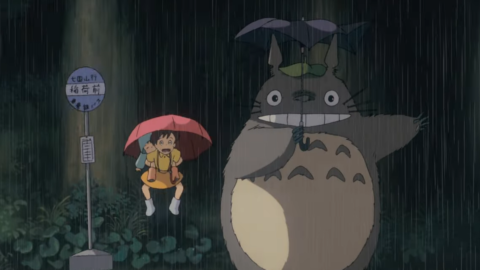
In world of Japanese animation the trait it's not just a sign: it is a sacred act, the moment when ink becomes breath and paper comes to life. It's the mease of an art who, from Totoro to Chihiro, has taught the world that even a drawing can have a beating heart. But when someone, or rather, something, tries to imitate her without permission, the alarm goes off. That's exactly what's happening. between manga giants and OpenAI, accused of “steal the dreams” of the Land of the Rising Sun with his latest video model, Sora 2.
The Ghibli-style video craze and the arrival of Sora 2
It all started as a game. In March, during the launch of GPT-4o, social media was flooded with Ghibli-style images generated with ChatGPTEven Sam Altman, CEO of OpenAI, had his portrait drawn as a Miyazaki character, adopting that face as his profile picture on X. For Silicon Valley it was an ironic gesture, a cultural provocation for Tokyo.
Then came Sora 2, at the end of September, and fashion has turned into a fireOpenAI's new video model enables create short ten-second clips in any visual style, including, coincidentally, that of Studio Ghibli, Square Enix, Bandai Namco and Shueisha. In just a few hours, the internet has become populated with Totoro dancing among the cherry trees, Pikachu in the mist and Mario flying over Mount Fuji. All AI-generated. Everything too similar to the original works.
For the Japanese authors the line between homage and imitation has been crossed. “Every image generated without consent is a blow to the dignity of the creators,” denounced the Shueisha, publisher of One Piece and Dragon Ball, openly speaking of an "act of lèse-creativity". Studio Ghibli's response was equally clear, “no neural network can replicate the human hand that brings the poetry of our films to life.” A message as simple as it is definitive.
Within a few days, the Content Overseas Distribution Association (Coda), which protects the rights of the animation giants, sent OpenAI a formal warning: immediate stop to the unauthorized use of its members' works.
Japanese cartoonists in unison: "Altman, san, you're copying our dream."
At the end of October, seventeen publishing houses, including Kodansha, Kadokawa, Shogakukan and Shueisha, along with the main associations of cartoonists and animators, signed a joint statement against OpenAIAccording to the prosecution, the use of the works by models like Sora 2 “violates the fundamental principles of Japanese copyright law and international conventions.”
In the letter sent to Sam Altman, Coda reiterated that “sAccording to Japanese law, prior authorization is required to use protected works.. There are no shortcuts or subsequent excuses.” In other words, what in America is tolerated as “fair use” or regulated by opt-out systems, in Japan is considered a direct violation: only opt-in is valid here, first ask, then create.
"The dignity of authors who have poured their heart and soul into their works cannot be trampled upon. It is unacceptable for a service to be based on the violation of others' rights," reiterated the publishing house Shueisha.
Coda argues that “the act of reproduction during the machine learning process can constitute copyright infringement” and asks OpenAI to rrespond transparently to infringement reportsThis isn't a closure; Japan is still attentive to innovation, but publishing houses want clear rules, prior consent, and adequate compensation.
Tokyo intervenes: "Anime and manga are national treasures"
La each other did not remain confined to the world of art but it has also become political with the intervention of the Japanese government, which has lost a clear position. The Minister for Intellectual Property Strategy, Minoru Kiuchi, defined anime and manga “irreplaceable treasures of Japanese culture" and has officially asked OpenAI to stop any unauthorized use of national works.
Tokyo, which has always been attentive to the protection of copyright, is evaluating the creation of new specific rules on training AI models, more stringent and transparent than the American ones. The aim is to guarantee technological development, but in full compliance with the principles established by Japanese law and the international conventions of the WIPO (World Intellectual Property Organization).
Law versus algorithm
The clash between the Japanese creative world and Silicon Valley now goes far beyond the legal issue. It's a comparison of visions, almost philosophical: on the one hand the American approach, where the principle of fair use grants wide margins of freedom to the use of protected works in the name of research and innovation; on the other hand Japanese tradition, which considers the creative act an inviolable heritage, an extension of the author's soul.
In the Rising Sun, Copying a character like Totoro or Kiki without permission is not only a legal violation: it is an artistic sacrilege. For this reason Coda wanted to clarify that his is not a crusade against technology, but a defense of the human value of creation. "The development of artificial intelligence must proceed with respect for the rights of creators," the letter reads, "so that collaboration between humans and machines is a source of value, not conflict."
A message that resonates even outside Japan. If artificial intelligence really wants to be creative, must first learn to recognize and respect those who invented creativity.
The Future of Digital Totoro
OpenAI is officially silentBut the pressure is growing, and not just from Japan. In recent months the company has already signed licensing agreements with several international publishing groups and media, a sign that even in San Francisco it has been understood that the future of artificial intelligence depends on respecting copyright.
Accepting Tokyo's demands, however, would have a different weight: it would mean extend that principle to the world of animation and comics, requiring AI to ask permission before drawing on the visual heritage of a country that has made imagination a religion. After all, "the new Totoro may fly in the cloud, but first it must ask permission from those who taught it to draw the sky."