Without fear of exaggerating, we are not going far from reality if we say that the great confectionery tradition of Palermo, but also of all of Sicily, was born... blessed by God, and yes, because the most traditional sweets handed down to the present day , from Martorane to curly biscuits, from the triumph of gluttony to pistachio couscous, were all born in the silence of the kitchens of monastic convents, often cloistered. We prayed to God, and we mixed creams, ricotta, sugar, honey, candied fruit, almonds.
The ancient pastry-making tradition of Palermo's convents: in 1700 there were 21 in the city
Suffice it to say that in Palermo alone in 1700, 21 conventual confectionery workshops were registered, but the tradition dates back centuries ago. “At the beginning, producing sweets was a way to repay one's debt” explains Maria Oliveri, author of an illustrated booklet “The Secrets of the Cloister” which deals historically and anthropologically with the Sicilian conventual confectionery tradition. “The book – he explains – was born from the intention of writing down stories and small curiosities of the female monasteries of Palermo and at the same time to try to focus attention on a gastronomic wisdom matured in eight hundred years of conventual history in Sicily, an important spiritual and material heritage that cannot be lost, but which must be valorised and handed down to future generations".
But why did this activity develop in the convents? Because with the rich endowments of the great noble families who applied the bonus rule, the convents could afford to procure expensive raw materials, denied to the poor people, with which to keep the young conventuals engaged in the most varied craft jobs, including pastry making. .
The sweets of the cloistered nuns as a contact with their families of origin, so as not to feel forgotten
For the majority of the inmates - not all of them were from noble families - it was also a way of fulfilling themselves despite the constraints, to maintain a connection with their families of origin to whom they sent their sweets as gifts, leaving a trace of themselves to outside the convent. Desperate condition masterfully described by the young Giovanni Verga in "Story of a blackcap", the moving story of Maria forced to become a nun due to the poverty of her family, who cannot afford to pay her dowry to get her married nor to support her . Over time, however – explains Maria Oliveri – the activity became a way to obtain economic income. Even before the war, however, only wealthy families could purchase them, because the price was quite high given the use of expensive raw materials, such as sugar. Most of the seasonal products, however, came from the funds brought as dowries by the girls who took their vows." In Sicily, specifically, this artisanal activity is loaded with cultural values, inheriting recipes, tastes and pastry making techniques from the peoples who have come and gone on the island, from the Arabs to the Normans.
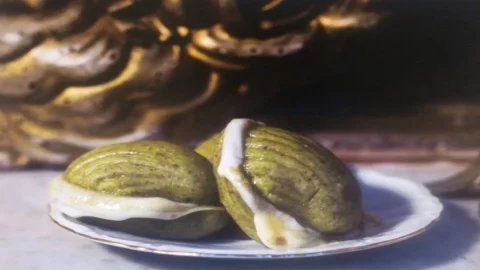
From the history of the ancient monastery founded in 1171 by Matteo d'Ajello, Grand Chancellor of Sicily (i.e. prime minister under the government of the Norman sovereigns William I and William II). which stood in via Celso, now disappeared, comes an irreverent dessert for a monastic convent: the chancellor's Fedde (Fedde di lu Cancidderi) which risked extinction. Let's start from the licentious name: fedde in Sicilian dialect means buttocks. Evidently the chancellor Matteo d'Ajello, accustomed to abundant libations, had developed particular roundness in the lower back parts... but over time, to avoid resentment, the dessert took the shape of a rounded shell.
It is a shell of soft almond paste that hides a filling of blancmange cream and apricot jam.
Giuseppe Tomasi di Lampedusa in The Leopard on the fedde: "Just by pronouncing their names one would commit a sin."
Fedde were considered by the people of Palermo to be exquisite delicacies, superior in goodness to all other sweets. Abbot Meli in fact exclaimed: “Who cannola, cassate or cassateddi!. More four fedde of lu Cancidderi/ I'll make it seven years with remi in manu!” (But what cannoli, cassata or cassatelle! For four slices of the Chancellor/ I would do seven years with the oars in the hands of forced labor!"). Even Giuseppe Tomasi di Lampedusa in The Leopard, speaking about these sweets, ironically says that they should have been banned "because just by pronouncing their names one would commit a sin".
The current shape of the dessert is the one it had already taken in the nineteenth century, that of a bivalve shell. The idea that the pious nuns were the ones manipulating appetizing sweets in the shape of male buttocks caused a certain amount of hilarity among the city's inhabitants...
According to other scholars, the fedde were similar to the "prucitanu", a now obsolete biscuit in the shape of a female sex, once produced in Comiso, in the province of Ragusa and given by the bride to the groom as a sign of good luck.
Tradition kept alive in St. Catherine's Monastery
It was said that this original but very tasty dessert had risked extinction. Antonino Uccello wrote in 1981: "Due to excessive processing, some desserts such as the Chancellor's fedde and the Virgins' pastries are uneconomical and are no longer packaged." Fortunately today they can be found in the sweet shop of the imposing monastery of Santa Caterina, right in the center of Palermo. Founded in 1312 by Benvenuto and Palma Mastrangelo, daughter and wife of Ruggero, captain of Palermo in the aftermath of the Sicilian Vespers of 1282, the building was initially intended for simple prostitute women, then transformed into one of the noble and cloistered monasteries richest and most important in the Palermo area and then fell into abandonment in the 900s, remaining active until 2014 when the few remaining nuns of the Dominican order had to move for safety reasons.
From a side entrance at the entrance of the ancient church you can access "The Secrets of the Cloister", a place which, thanks to a cooperative project carried out by Maria Oliveri and Maria Carmela Ligotti, offers Sicilian convent sweets for sale, the proceeds of which go to the restoration of the monastery.