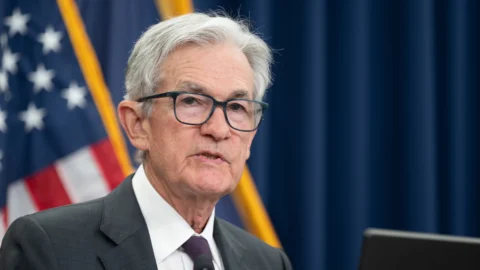
It had been expected for weeks, if not months, and loudly and publicly called for by President Donald Trump himself, to the point of generating no small amount of institutional tension: in the end, the cut in US interest rates by the central bank, the Federal Reserve, arrived and met the markets' expectations, that is, a reduction of 0,25 basis pointsThe base interest rate thus moves into the range between 4 and 4,25%, as practically all of the consensus, 95,5%, had expected. However, in the hours preceding the decision communicated by Fed Chairman Jerome Powell, there were prices of a larger denomination have risen, by half a percentage point: interest rate futures gave this possibility at 4,5%, down from last week when the probability had been estimated at 8%, but double that of the day before when it was just 2,1%. The decision was taken with the only vote against by the new advisor Stephen J. Miran, a loyal supporter of Donald Trump, who he would have preferred a more aggressive cut, of 50 basis points.
Powell, repeatedly attacked by Trump, has thus decided to make the cut, made possible by a macroeconomic context that the Federal Reserve has finally found it favorableIn particular, the hoped-for signals have arrived from inflation, which, with its ups and downs, has continued to fall since the beginning of the year and is now steadily below the 3% threshold, despite a slight increase in August, which, however, is not a cause for concern, as it is considered physiological as a consequence of the introduction of tariffs. The Fed's forecast is for a Core inflation on an annual basis at 3% at the end of 2025, with tariffs representing a one-off change in prices and not something that will lead to more persistent inflation, while energy costs, slowing rents and especially the weakening labor market will all contribute to weaker inflation between late 2025 and 2026. This is why, the financial institution further communicated, they are two further 25 basis point cuts expected before the end of the year.
Stock market reaction: Dow Jones accelerates, Nasdaq rises. Euro at 1,19 to the dollar.
The reaction of the financial markets it couldn't have been anything but positive. The Federal Reserve's communication has arrived with European stock markets closed for a while now but with Wall Street still open and more than ever at the window: before knowing about the data update the Dow Jones index was already travelling in largely positive territory, while the Nasdaq was in the red weighed down by losses in some major technology stocks, such as especially Nvidia's, slowed down by Beijing's halt to purchases of chips for artificial intelligence, but also Tesla and Google itself Alphabet. After the announcement instead the Dow Jones immediately accelerated, rising by 1%, and the Nasdaq composite also began a rapid recovery. Moments after the news of the 25 basis point cut, the Nasdaq went from losing about half a percentage point to reaching parity, although it then closed in negative territory. On the currency market, the dollar lost ground after the news, with the euro jumps above 1,19 dollars, at a four-year high.
Powell's other communications and words
At the same meeting as the expected rate cut, the Federal Reserve also released updated estimates on the GDP growth at the end of 2025, which have been raised to 1,6%. As regards the unemployment rate, the Fed notes that it has increased but remains low, and forecasts a figure of 4,5% for 2025. "The latest data - these are Powell's words in the press release, to explain the reason for the persistence of caution "They suggest that economic growth moderated in the first half of the year. Job growth weakened, and the unemployment rate rose but remains low. Inflation rose and remains somewhat elevated." "We are not on a predefined path," the Fed chairman added, explaining that they are essentially navigating by sight, "but are proceeding meeting by meeting."
“The probability of a sudden rise in inflation is lower, and the difficulties in the labor market are due more to immigration than to tariffs,” Powell added, specifying that inflation is moving in an unbalanced manner due to tariffs but that the worsening of employment has changed the outlook. "Changes in government policies continue to evolve and their effects on the economy remain uncertain," Powell also argued, who then claimed the autonomy of the Federal Reserve's choices, in response to pressure from the White House: “We are strongly committed to maintaining our independence.”