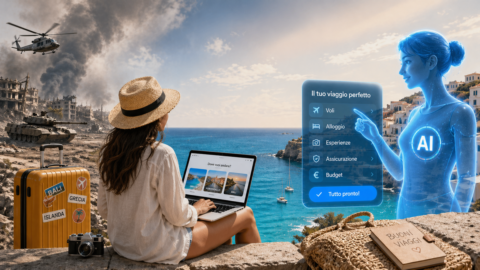
83% of Italians plan at least one summer vacation, a trend that has grown steadily over the past 10 years (53% in 2016). 41% even plan to take more than one, and only a little over half (53%) will choose to go abroad. This is according to the Holiday Barometer, a global survey conducted by Ipsos-Europ Assistance, which finds that International tensions are not affecting Italians' desire for holidays, in fact, 46% of the sample plans to increase their holiday budget, which this year averages around 1.896 euros, even though there is an increased focus on security: the risk of armed conflict (56%) and political instability (44%) do influence the choice of destination.
Security impacts destination choice: Middle East goes out of fashion
Among the reasons behind choosing a destination, in Europe 30% of the sample cites safety which has become the main criterion also in North America (32%) and in Northern Asia (37%). The United Arab Emirates entered the top 5 of destinations that travelers might miss due to the political climate and Asia is also losing ground, cited as a travel destination by only 7% of Europeans (-8% compared to 2025) and 11% of North Americans (-12%).
Artificial Intelligence Sets New Record in Travel Planning
The other big news from the Holiday Barometer is the growing use of Artificial Intelligence. 26% of Italians (+6% compared to 2025) have already used AI to book or plan a trip and 41% are considering using this technology in the future. And the Italian figure is even lower: in India, approximately 7 in 10 respondents say they have already used AI to plan a trip (69% versus 51% in 2025); in the United Arab Emirates, the figure is 60% (versus 46% in 2025), in Malaysia, 54% (versus 37% the previous year), and in Saudi Arabia, 54% (versus 40%).
Levels are significantly lower in Europe (24% compared to 16% in 2025) and North America (24% compared to 19% in 2025). The same trend is also visible in future usage forecasts: 79% of respondents in India and 70% in the Middle East say that would consider relying solely on AI to plan their trips, compared to only 26% in Western Europe and 27% in Oceania.
Babinet (Europ Assistance): "Travel paradigms are changing."
Following last year's record levels, the desire to travel remains strong and unchanged, despite increasingly difficult choices and the cost of living, which continues to be a major global concern. What is changing is the travel landscape. Safety considerations are increasingly impacting destination choices, with decisions increasingly influenced by risk assessments. At the same time, artificial intelligence is now a fully-fledged planning tool for a growing share of travelers worldwide, experiencing rapid growth, particularly in emerging and high-growth markets. Virginie Babinet, CEO Travel Insurance & Assistance of the Europ Assistance Group.