All around the bedside of the bills. The increases in electricity and gas prices, hopefully cyclical, determined by the soaring costs of raw materials, are frightening. Promises are multiplying to make the measures activated by the Government to decongest prices structural by sterilizing the "accessory" items that contribute to inflating prices. But is it really all the fault of the tensions on raw materials (oil and above all gas)? And why ours race for renewables, which could be quicker but is still substantial (almost half of the electricity we consume is produced with "green" sources), doesn't it protect us from international hydrocarbon prices? The problems, and the answers that everyone expects, concern more complex but crucial issues for tackling the energy transition. There is the problem, strangely known, of the more or less improper charges saddled with our bills, but there is also the problem of operating rules of our energy market. Questions are added that seem incidental but have significant weight. Among these is the lack of exploitation of our hydrocarbon reserves, which in a transition phase can decongest the problem.
DOUBLE MANEUVER WANTED
The current diagnosis is somewhat partial: our bills are trapped in a heavy traffic jam of items, charges, surtaxes and taxes which produces two perverse effects. It inflates the total cost and, even worse, makes it difficult to pass on the long-awaited effects of the law to end customers liberalization and competition between operators, given that the costs that are difficult to compress are predominant and leave little room for truly different price offers. Less than 40% on average of our bill refers to the cost of the raw material used to produce the energy that is sold to us, while management costs represent a small share. The rest concerns a rampant sea of ancillary items (such as transport and distribution, with parameters governed by the Energy Authority) but also of subsidies that increase over time, such as incentives to promote renewable energies and dragging costs for decommissioning our old nuclear power plants. And there is no shortage, directly in the bill, of the financing costs of many of the energy efficiency measures, in addition to the social bonus that weighs on the vast majority of consumers for the benefit of those in need.
Let's spread a pitiful veil on the improper additions like the one, now at sunset due to explicit action by the EU, with which even the television license fee had been included in the electricity bill.
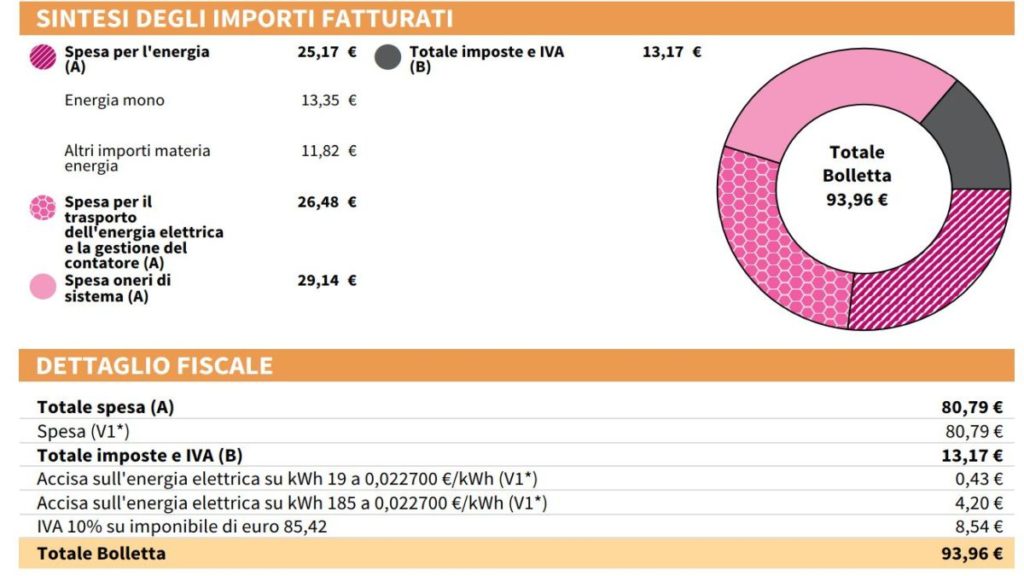
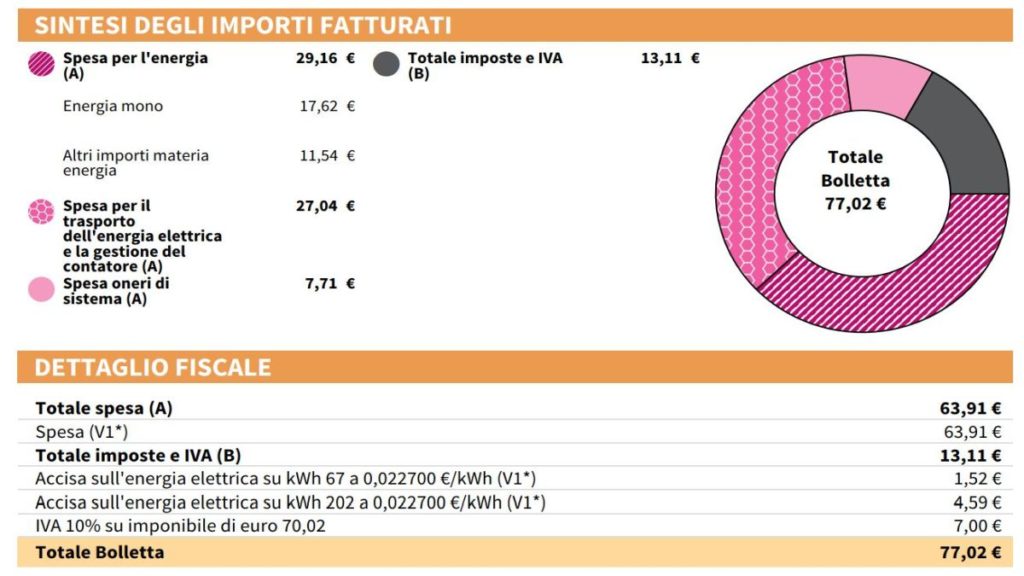
Cleaning, decontaminating, taxing (that is, separating them and transforming them into taxes of another kind) the many items that have little or nothing to do with the energy we consume: this is the promise of past governments and of course this one too. Meanwhile the bill is a traffic jam. The "cake" of the two invoices reproduced below by way of example, which refer to the same user (July and November 2021) with a 6 kW peak power contract but reduced global consumption typical of a second home, is clear.
MECHANISMS TO REVIEW
But the problems, in need of interventions, do not stop there. As is well known, our institutions have not yet given the green light to what would be imposed by the Community rules on competition, i.e. the end of the contracts "of Greater protection” legacy of the old pre-liberalization administered tariffs. From year to year the appointment is punctually postponed. Now the new deadline is set for January 2023.
Too many unknowns, it is said, in the obligation to protect the final consumer from the possible dirty tricks of a market smelling of speculation. But on closer inspection, speculation can also be found in the current price formation mechanism. And he finds himself right on the first level of the game: the power bag. Its prices, which serve as a reference for the entire energy market, are in fact formed with a mechanism which, in the name of safeguarding the balance between supply and demand, relies on the system of "system marginal price”. In practice: everyone makes his offer, whether it concerns energy produced from fossil sources or from renewable sources. The offers are received on the Stock Exchange, those with the highest price progressively come out and once the maximum price produced by the transactions has been set, all those who have offered less are also recognized the product price. Result: those who actually have the lowest marginal energy production costs, typically those that make use of renewables, are rewarded with a very rich margin.
A mechanism that, like explains with lucid simplicity Carlo Stagnaro of the Bruno Leoni Institute, on the one hand encourages the installation of renewable energy systems, which can count on excellent remuneration, on the other, hinders the transfer of these price advantages on the bills of final consumers. A mechanism that deserves a review, perhaps with a "controlled liberalization" that gives birth to an electricity exchange truly entrusted to the game of competition, although dutifully supervised and administered by our excellent authority (Arera).
ELECTRIC BRAKING FREEDOM
But what if one wanted to produce and consume the energy he needs on his own, in a completely private way or perhaps in a consortium? Here's another problem within the problem. With the development of renewables (the solution of choice for new plants, whether small or large) and the progress of the related technologies, the debate on the so-called energy communities and on the constraints and rules that should promote them. Our authority believes in it very much, well aware of the problems that exist in amalgamating the production and consumption systems of more or less private networks with public ones. The GSE, the public manager of energy systems, has even included a simulator on its Web portal to evaluate its convenience. But the operation remains full of obstacles and pitfalls.
The fact is that to date all the rules concerning incentives for private renewable energy plants offer very few alternatives to very rigid system which governs the so-called "net metering" by remunerating the excess energy fed into the grid. Rigid because it does not actually allow a private individual to consume his own energy directly, even simply to create a reserve system (backup) capable of powering a single home if there is a temporary lack of supply. But the rules still impose an immediate disconnection today: the public supply is also temporarily interrupted and the photovoltaic system of the house is also instantly deactivated, including its internal and external connections, even if equipped with a battery accumulation system. Quite a problem, which deserves attention and possibly a solution.
In the name of the coveted and promised "energy communities" the freedom to produce and consume in connection with the public network is tested locally, for example in the north-east area of Bologna thanks to the initiative coordinated by Enea, but the "free all ” national still seems far away. Some of our institutions speak of dangerous impacts determined by the new complexities of the system. Instead, there are those who believe that the technologies to solve problems are available and that these solutions are absolutely worth promoting. “The first of the advantages – observes Gianni Girotto, who among the men of the Five Stars is endowed with good technical competence and presides over the Industry Commission of the Senate – is the economic one, with a savings of 20-25% on the bill. Furthermore, there is a benefit at the national level, since with the growth of communities and self-consumption we are able to reduce imbalances on the grid, which cost us a lot”.
THE FORGOTTEN FIELDS
Hopefully in new energies, in the further development of renewables but also in new generation nuclear power, the one that should solve the problem of waste thanks to the fusion mechanism. Few illusions and very many modesty on this front. The timid appeal to continue the research launched by our minister of ecological transition Roberto Cingolani was enough to unleash yet another uproar. But it was Cingolani himself who stated that in this phase of emergency determined by the peaks in international oil and gas prices, it is worth tackling the atavistic problem of lack of exploitation of our hydrocarbon reserves, which could constitute a very useful buffer in this transition phase. Why – asks Cingolani – meanwhile not push on the already authorized deposits, to add to the little that we continue to extract? The answer is there for all to see: the absolute no, fueled by a lot of political propaganda, to any energy infrastructure, which in many cases goes as far as wind turbines and solar panels.
A forgotten treasure? That's right: estimates say that there are under the Italian seas official reserves for over 90 billion cubic meters of methane, compared to our annual consumption which travels around 70-75 billion cubic metres. But in the estimates of the technicians the quantities available in our subsoil, but above all under our seas, would be much higher. Furthermore, they can be exploited at a very low cost: 5 euro cents per cubic metre, compared to normal import prices which range between 50 and 70 cents. But in a country where even a very precious and environmentally harmless gas pipeline, the Tap that arrives from Greece to reach Puglia, has had a very difficult life, we have to have few (very few) illusions.