A ghost materializes on the already rough road of the electric car. It has the forms of disillusionment, of derogations to the ambitious programs for the replacement of thermal engines, to the realistic rethinking of the times and methods of the operation. Is 2035 the frontier drawn by the European community for the definitive switch off from internal combustion engines to electron ones? The date will be postponed. Or at least - we have now understood - obligations and constraints will become softer and less definitive.
Is it the fault, as some hastily claims, of an operation that was too ambitious, or even wrong from the start? Not at all: electric vehicles are and remain the future. If anything, it was the fault of a poorly conceived and coordinated operation, hampered not only by the most evident and underestimated problems of such a drastic revolution (the difficulty of adapting industrial processes and related fears of an onslaught of Asian technologies and artefacts, the delays in setting up an effective charging network) but also of macroscopic errors to which the media hype has given rise so far little attention, which also risk penalizing the entire arsenal of environmental policies.
On the eve of a new round of European debate on incentives, rules and constraints that should give new credibility to the abandonment of internal combustion engines in favor of electric vehicles, a mea culpa is (it would be) necessary not from the technicians, nor from the market, but from the institutions that should make this credible path.
Let's take two emblematic examples. The first concerns the cross-eyed treatment that is being reserved for what should be the last historical phase of internal combustion engines, i.e. the unjustified criminalization of the latest generation diesel. A short-sighted, scientifically incorrect choice, which even risks worsen the emissions balance in the transition phase. Second example: the guilty lack of awareness that the entire industrial life cycle of the electric car can have true environmental credibility only if it is an integral part of an environmentally-focused rethinking of the entire cycle of generation and distribution of power. Otherwise we even risk reproducing, on a larger scale, the effect of the criminalization of diesel. Let's see, in detail, why.
Diesel cars, a fake enemy cornered by demagogy
Compared to a year ago, the registration of diesel cars in our country has more than halved, under the blows of a true institutional campaign of indiscriminate attack. Rome, leader of the barriers in the city walls promulgated a few years ago by the five-star junta of Virginia Raggi but also Solomonically confirmed by the current PD-led leadership of the Capitol, has set a precedent. Many great ones Italian municipalities are aligning. As in truth many other European partners are also doing (even the rigorous Germany) and beyond.
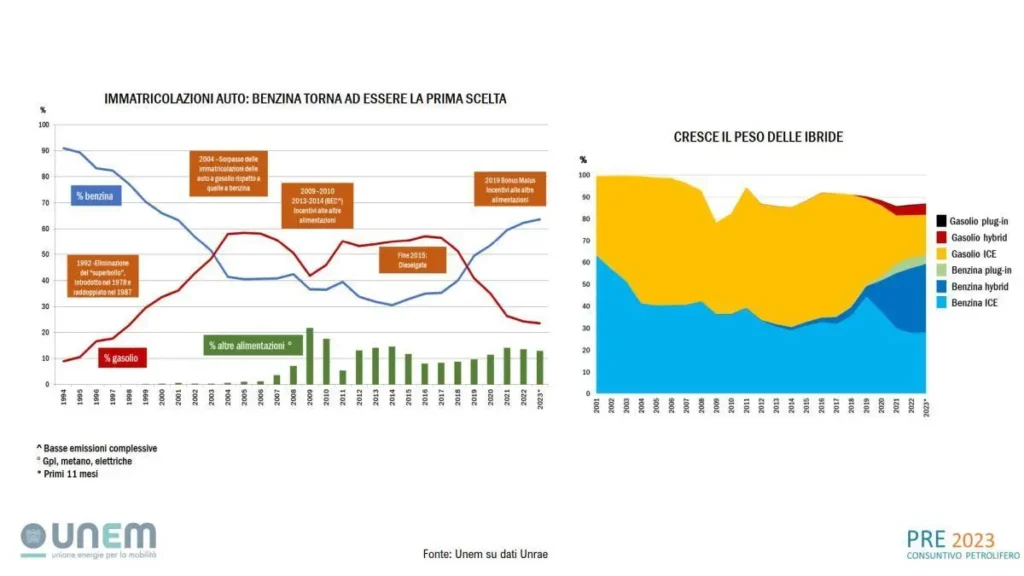
Justifications? Diesel emissions cannot be curbed, they are however macroscopically higher than those of a petrol engine, especially in particulate matter (PM) and nitrogen oxides (NO2). Real? False, the real experts try to explain to politicians who are more fond of demagogy than science. Until about fifteen years ago, the diesel engine was actually responsible for a significant share of polluting emissions. For a few years now this has no longer been the case, especially after the technological adjustments that all car manufacturers have implemented, or rather had to implement in the wake of the scandal that hit the Volkswagen group at the end of 2015 regarding counterfeiting. in emissions measurements from some of their diesel engines. Problem solved. Indeed more. There punitive cleaver on fake diesels it then produced an admirable technological effort, certified by science and by new and more stringent detection and approval criteria.
“The decision of the Municipality of Rome to limit the circulation of Euro 5 and Euro 6 diesel cars appears completely unjustified from a scientific point of view, without any environmental benefit, therefore unnecessarily penalizing a large segment of citizens" the Unione Petrolifera (now Unem) thundered already in January 2020, explaining that these engines "have PM emissions close to zero, as demonstrated by various studies, including recent tests on road carried out according to the new RDE (Real Drive Emission) homologation cycles". Result: considering the real emissions, the average distance traveled and the quantity of latest and penultimate generation diesel cars circulating in Rome, their total block would produce "a cut of just 0,15% of the total PM released daily in Rome".
Is that of the Italian oil companies a biased position? Apparently not. Moreover. With the full replacement of Roman citizens' diesel cars (which has practically been achieved in the meantime) the benefits for the environment would not only be non-existent but there would even be a risk of worsening the emissions balance, if we consider the independent scientific findings. The latest sworn findings not only confirm but attribute further advantages to diesel compared to petrol engines compared to a research carried out way back in 2019 by Altroconsumo in collaboration with the main European consumer organizations and the Adac (the German Automobile Club) .
Already five years ago the research - conducted with the RDE (real driving emission) method, i.e. with equipment that constantly monitors a car actually circulating in different road and traffic conditions - highlighted a surprising fact: after the technical progress in containment of emissions resulting from "dieselgate" a latest generation diesel (at that time we were at euro 6d-temp, now we are at the debut of euro 7) polluted less than a petrol, considering the emissions per quantity of fuel but especially the greater efficiency than diesel in kilometers traveled for every liter burned. Yes, because this is one of the discriminating facts that institutions still seem to ignore today: diesel remains more energy efficient than a petrol engine and for this reason it should not be penalized compared to the latter, on the contrary.
The most worrying consequence of these bizarre assessments? The loss of credibility of an environmental strategy, which inevitably ends up undermining rather than promoting "cleaner" mobility by releasing the true potential of electric vehicles. Yes, because they too pay for worrying errors in evaluation and maneuver.
Cleaner cars? In the “life cycle” this is not always the case
The research promoted by consumer associations (still very current) did, and does, more: to the comparison between petrol and diesel it adds that with hybrid cars (with battery 60-70% charged) and even with "pure" electric ones (with the battery initially at maximum charge). A four-way comparison that provides one overall scenario fully confirmed also by the most recent findings.
First surprise: already five years ago a euro 6 standard diesel engine polluted less overall than a petrol engine. Second surprise, which for true experts is not a surprise: hybrid cars produce better results only in certain circumstances. They really cut consumption and emissions significantly, up to halving them, within urban centres, where the contribution of the electric motor and energy recovery while braking is greater. On extra-urban routes the savings are significant only by driving up to 90-100 km per hour with calm driving, while on the motorway they consume as much if not more (due, among other things, to the greater average weight) compared to a normal petrol car of the same size.
But the real surprises come from an objective examination of what an electric car actually produces in terms of emissions. Consumer research focuses on real consumption in kilowatt hours (kWh), which in practically all cases examined is at least 20% higher than declared. With all the consequences, here too, on the environmental front. Because the "propellant", i.e. electricity, still needs to be produced with more or less polluting industrial cycles: less polluting if generation occurs with renewables, more if this occurs with polluting power plants, perhaps super-polluting like the coal-fired ones still prevalent in the world and, although to a lesser extent, also in Europe.
And here we come to the point. Objectivity and completeness require us to explore the true virtues of the electric car by examining the emissions produced in the entire industrial cycle and not just the use of the electric car. Yes, because building an electric car means building, installing and manage (even at the end of their life) the batteries, which have a significant impact from an environmental point of view.
The hidden environmental cost of electric mobility
The hat comes directly from the automobile industry. In the new policies on constraints and incentives for mobility, the problem - Gilles Le Borgne, head of Engineering of the French giant Renault, insists speaking to the authoritative specialized magazine Quattroruote - is that we do not proceed "on the basis of life cycle from the cradle to the grave, as they say, but considering only the exhaust emissions". Batteries – insists Le Borgne – weigh heavily on the CO2 debt accumulated by the electric car already in the production phase. A debt proportional to the size of the battery when it is installed, and at the charging stage when it is used. Debt which is then progressively disposed of, in a time acceptable only under certain conditions.
“It can take 35.000 kilometers but also an infinite amount of time.” With a large car and a 100 kWh battery "and you live in Poland you risk never extinguishing it", says Renault's technological guru, citing the nation where coal-fired electricity generation is still hegemonic, with all its immense burden of emissions not only of CO2 but also of sulfur dioxide, nitrogen oxide (the last one the protagonist of the demonization of the old diesels, which have now solved the problem) but also arsenic, lead and mercury, well more lethal of the much maligned carbon dioxide.
Numerous scientific studies fully confirm Le Borgne's assessments. One for all that of the meticulous researchers of Paul Sherrer Institute of Villigen (Switzerland) who, analyzing the entire life cycle of the main electric cars, highlighted a greater accumulated debt in terms of CO2 in the production phase compared to a car with a combustion engine equal to at least 20%. And here the electric car really pollutes less - the Swiss scientists also insist - only if in the reference energy mix they prevail, with a minimum contribution of 60%, renewable sources.
Evaluations that are only a little more favorable to the electric car, but which confirm the problem, even came at the end of 2021 from a report prepared by another protagonist of the automotive industry, the Swedish Volvo which had already passed under the control of the Chinese giant Geely: the debt against the electric car (or plug-in hybrid) in the production phase exists, and must be reabsorbed more or less quickly depending on how much truly green energy is used to recharge it.
What to do? What will happen? The automotive industry lives in uncertainty. Focus on a technology that works for everything? “It's not like that,” insists Renault's chief engineer. He equips himself accordingly. “Hybrid is a technology that has already been developed and in our vehicles you will still find both solutions, full and plug. For electric vehicles, the charging network remains an unknown." Therefore "we will see if the speed of the transition slows down", concludes Le Bogne, summarizing the situation well industry distress automotive in the development of strategies and plans that clash with indeterminacy and confusion, even on environmental figures and their correct evaluation.