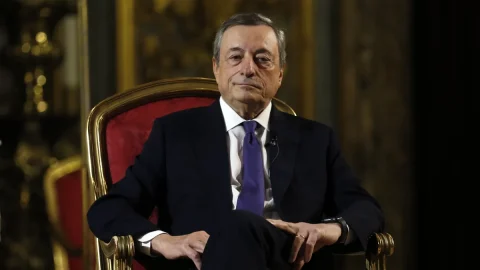
The warning, the umpteenth, of Mario Draghi This time it comes from the prestigious University of Louvain where he received an honorary degree.global order is dead: if theEurope wants to save himself in the "new world" he must become afederal political entity.
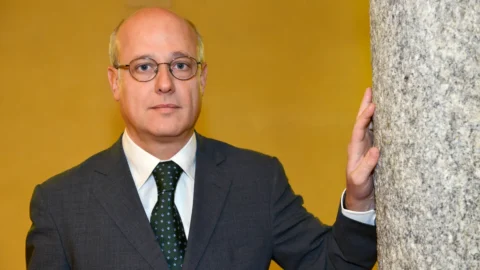
In European history, appeals to the federal path have been numerous and pronounced by illustrious Europeanists, the latter of which Draghi However, it has a'urgency never experienced before, dictated by the rapid exhaustion of the old twentieth-century global order. "To quote Antonio Gramsci, we are in a sort of interregnum: a moment of transition where the old order is collapsing but the new one has not yet emerged as such. We are facing a multipolar world? But underneath what rules? If there are still rules…», he comments Arturo Varvelli, senior policy fellow of the prestigious European Council on Foreign Relations and head of the Italy section.
Draghi's reference to the US defense umbrella, which guaranteed European defense while Europe focused on trade and financial integration, is significant. Have transatlantic relations changed forever?
They've changed for structural reasons; Donald Trump is certainly acting as a major accelerator. The world that the United States had somehow helped build after World War II is disintegrating: it's a process that began at least twenty years ago, coinciding with the rise of Chinese power. Today, we're adding the resurgence of an openly revisionist military power like Russia, and the emergence of medium-sized regional powers aspiring to become global players, like India or Saudi Arabia. But transatlantic relations are profoundly marked by a shift within American public opinion that sees the world very differently than in the past.
For Europe, this is a fundamental issue: it's one thing to be part of the "new world" in an alliance with the US, but it's quite another to play the game on its own, setting aside eighty years of foreign and economic policy.
The new US foreign policy, which is currently influenced by the MAGA group, will continue to exist even after Trump. The old transatlantic relations will not return. I'll add one thing: Trump's key characteristic is realpolitik, in the sense that he deliberately doesn't distinguish between allies and adversaries. For him, they're all more or less the same; he's only capable of grasping power relations, and he sees and deals only with the great powers. He recognizes who counts and who has power; privileged relationships no longer exist.
Draghi again in Leuven: once China joined the WTO (in 2001), the boundaries between trade and security began to blur. More than a change in US foreign policy, should we fear Chinese overcapacity for Europe's future?
The Chinese are dumping in every industrial sector thanks to a political investment: the Chinese state is investing money to enter individual markets, ousting all its competitors. We saw this with the electric motor, although it must be said that they were facilitated by our own EU regulations. What Draghi describes is already happening and risks continuing with even more destabilizing effects.
If we aren't a major power, we'll remain just a large market. Draghi's path is toward a federal Europe. What's the highest step toward this integration?
Most European countries still believe they live in a peaceful, rules-based world. But outside Europe, everything has changed. Public opinion in Europe is sensitive to very different issues: in the East, they're very sensitive to the Russian threat, while we Italians and the Spanish are much less so. The French want to do everything without the United States right away, quickly and even brutally. The Germans aren't yet willing. Draghi's appeal is directed at the political elites who must take responsibility for a leap forward in European integration. The alternative is the political death of the Union.
Many European states are poised between latent Euroscepticism and full sovereignism
The sovereignist solution leads to complete irrelevance. Britain has emerged defeated by Brexit in every respect. Economically, it matters much less; it has experienced no growth. However, it finds itself having to adapt its economy to European rules because trade with Europe accounts for about half of its GDP. It hasn't even gained any greater international influence, quite the opposite.
The sovereignist parties have very large consensus gains precisely in opposition to the Union
But how can they expect to compete in a world of predators? Russia militarily, China economically, with the United States changing its foreign policy, and in the near future with India and the emerging powers. Either the European states will accept less sovereignty in favor of Europe, or we will simply become a rich outlet market.
At one point, Draghi says: where Europe hasn't advanced in integration, defense, industrial policy, or foreign affairs, "we're treated like a loose assembly of medium-sized states, to be divided and managed accordingly." Let's start with defense: are you optimistic?
I'm more optimistic about European defense than I am about other issues. Germany is investing heavily in the defense sector, approaching 5% of GDP in military spending. France already has a significant military force, especially nuclear weapons. Italy is Europe's second-largest manufacturing industry and boasts national champions such as Leonardo and Fincantieri.
Industrial policy? We're witnessing the recent glaring errors in the automotive sector.
"We've lost the battle in some sectors, but we could be competitive in other high-tech sectors. Europe has scientific and cultural resources no less significant than those of the United States and China. It's a matter of putting them at the service of even greater economies of scale."
Foreign affairs? Ukraine, the Mediterranean, Greenland, NATO. Is this a turning point in history too complicated for further integration?
If we spread ourselves thin, no one will achieve anything. I'll take the Mattei plan as an example: Italy has identified a priority area of interest and has chosen a very intelligent diplomatic approach, bringing Italian industries to Africa. However, we have limited geopolitical clout; it would be a different story to approach relations with African countries with the global weight of the European Union. This can only be achieved by eliminating Brussels' veto rights.
The real point: a two-speed Europe, those who want to proceed, those who hesitate lose a round of integration
“If the European Union is unable to reform itself in this direction, some countries will create enhanced cooperation outside the Union.”
Germany, Italy, France, Spain at the government level, or the major European political families. Who can give legs to the Louvain debate?
"States build confederations; federations require a push from below. This is a historic acknowledgement by the major European parties, elites, and civil society. We will soon see further chaos in the United States: it could be an unprecedented warning to European voters."