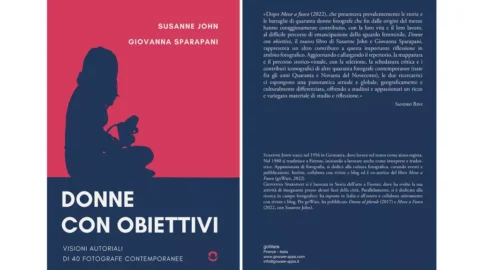
A work that was missing from the Italian publishing scene has been available on online platforms and in bookstores for a few weeks now, with a truly fitting title: Women with goals – credit to whoever created it.
The title immediately recalls a milestone of early cinema and of all time, now restored and available on Mubi: “The Man with the Movie Camera”, by Russian filmmaker and theorist Dziga Vertov. A film so modern it seems to have been created with CGI. The film eloquently demonstrates how cinema has gradually succeeded in freeing itself from the arts that accompanied its birth.
With Vertov and masters such as Méliès, Porter, and Eisenstein, the medium acquired an autonomous and identifying expressive code that marked the maturity of film art as an art of synthesis.
This in no way diminishes the decisive role of photography, the essential foundation of every visual language in every artistic field.
It is no coincidence that Vertov insists on the motif of the eye in the camera, often framed through the lens: it is the symbol of a new look at the world.
It's a leitmotif that even echoes in the logo of the first versions of Photoshop, which showed an eye surrounded by a blue oval, as if seen through a photographic lens or camera lens.
A special book
Let's return to the book. Women with Goals, conceived and written by the Florentine photographers and artists. Susanne John and Giovanna Sparapani, is a journey through the profiles of 40 contemporary female photographers, born in the second half of the twentieth century.
Artists with diverse backgrounds, personalities, and styles, united by a passion for telling the world through their lens. The book, moreover, is the fruit of years of research.
The book's protagonists all trained and work in very different cultural and geographical contexts, but they are all united by the same goal: to tell the world through their photographs.
This volume is the natural continuation of Focus. 2022 (another happy title, in the feminine), which had collected the stories of forty pioneers capable of breaking the glass ceiling of photography.
From four continents
In the meantime, you can read the introduction to Women with Goals here, where you will also find the complete list of the artists covered in the volume, whose discovery could be a happy surprise for the general public.
In this and the next articles we will propose you the portrait of four artists, adapted to the space available to us. Let's start with the Neapolitan one. Raffaela Mariniello, whose profile is edited by Giovanna Sparapani.
The other three artists we will introduce to you, Angelica Dass, Zanele Muholi, and Spandita Malik, come from three different continents, proving—if any were needed—the universality of photographic language.
Raffaela Mariniello: Between Memory and Transformation
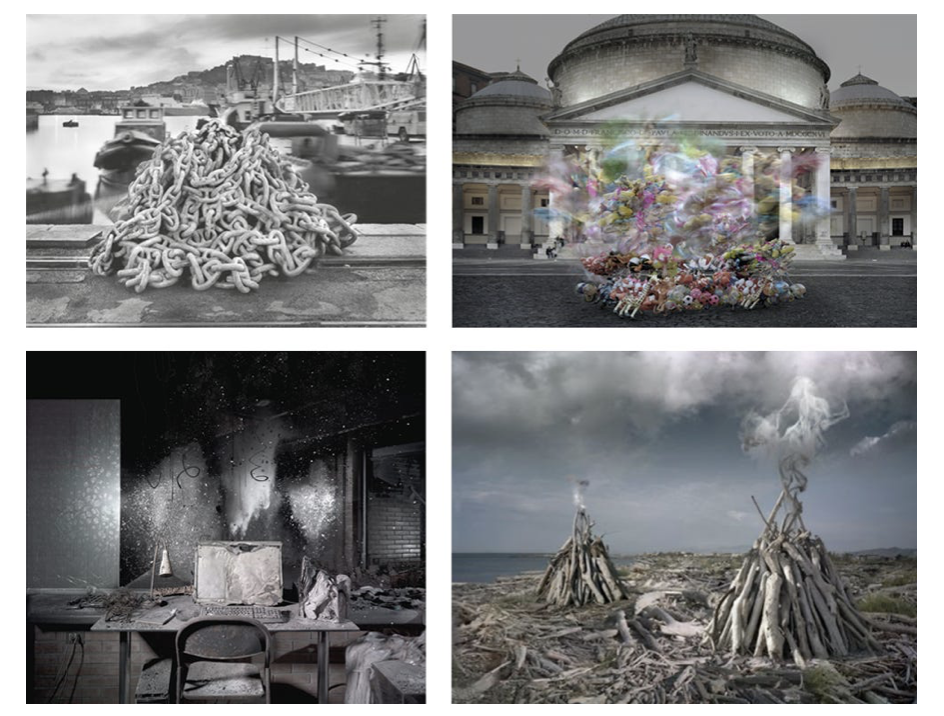
Raffaela Mariniello was born in Naples in 1961 and currently divides his time between Naples and Milan, pursuing photographic research marked by a strong contemplative depth.
After studying languages, he discovered a passion for photography. Self-taught but guided by his journalist uncle, he acquired his first skills in reportage, which he soon abandoned.
The frenetic and hectic method of reportage does not suit his artistic temperament. In fact, he prefers to create more thoughtful and contemplative images, dedicating the necessary time to reflection and composition.
She enrolled at the Le Grenoble Institute in Naples, where she discovered and experimented with the use of a tripod for long exposures. She used the optical bench, which led her to prefer the black and white developed strictly in the darkroom.
This artisanal technique deeply fascinated her and would remain with her for the following years. Her artistic journey spans four decades of relentless expressive experimentation and linguistic exploration.
The investigation into the places of transformation
His research is expressed through the use of different expressive mediums, ranging from refined black and white to color, from video to feature films, always in search of new creative languages.
Conducts a careful investigation into marginalities, focusing on places where something significant happened or where a process of social and cultural change is underway.
Since the 1980s, his research has focused on social and cultural issues, paying particular attention to the processes of transformation of the urban landscape in the post-industrial era.
In 1991 he made an important Report on the Italsider steelworks in Bagnoli on the occasion of its definitive closure, documenting this crucial moment in the history of 900th-century Italian industry.
The photographs, exhibited both in Naples and in other European cities, are included in the volume Bagnoli, una fabbrica (Electa), which brings together fifty images of strong expressive intensity, all shot in black and white.
Technical and conceptual experimentation
Raffaela fully grasps the extent of the social problems arising from the closure of Italsider. Her shots capture the "hellish" atmosphere that hovers among the ruins of the historic steelworks.
In the mid-nineties, the Trisorio Studio in Naples hosted the Multitudes exhibition, where the artist's predilection for experimenting with new techniques and original and innovative installations emerges.
Multitudes consisted of a photo-sculptural installation made of several panels placed at varying distances from the wall. This created a perceptual interplay between the photographic dimension and architectural space.
The photographs portrayed two apparently different subjects – anchovies and nails – which nevertheless appeared surprisingly similar in black and white, demonstrating how photography can alter and deceive the perception of reality.
This profound reflection on the intrinsic nature of photography leads her to an important statement: “What we see represented in photographs does not reflect reality at all. Photography is not absolute reality".
Naples and contemporary urban visions
Ten years after working on the decommissioning of Bagnoli, Raffaela dedicates to her hometown a series with an evocative title Naples imaginary view, composed of urban photographs taken at dusk.
The result is visions of suburban landscapes dotted with natural elements. Mariniello favors long exposure times and the careful use of flash as key technical and compositional tools.
These devices allow her to transfigure real glimpses of desolation into metaphysical scenarios with dark and leaden atmospheres that offer a poetic vision of the contemporary metropolis.
The significant project finds its full expression in the volume Napoli veduta immaginaria, published in 2001, which definitively consolidates its investigation of ever-changing urban landscapes.
In the five-year period 2006-2011 he dedicated himself with particular intensity to the creation of Souvenirs of Italy, a complex series of large-format color images taken in the historic centers of the most famous art cities of the peninsula.
From Bagnoli to the cinema
In 2013 Mariniello once again turned his attention to the Bagnoli area, focusing on the City of Science complex devastated by fire malicious which has thwarted every attempt at rebirth.
The following year, at Studio Trisorio, the artist developed a remarkably complex project that unfolds through multiple expressive registers: installation, light box, photography, and the emblematic video Still in Life.
The rubble and ash are sublimated by the artist's work, in which she sees strong signs of resilience. The City of Science evokes a Contemporary Pompeii, where horror and beauty merge. This particularly significant work was donated to the Madre Museum in Naples and is now part of the permanent collection.
Tireless experimenter, in 2022 he tries his hand at cinema by making “ZioRiz”, feature film showing a modern Charon along the Volturno: a refined documentary that reveals the author's photographic training.