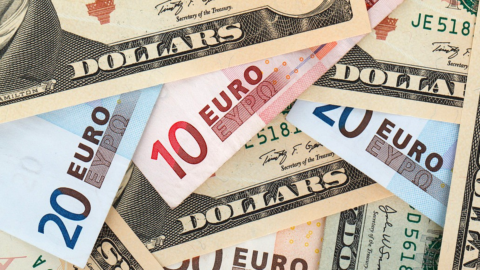
This morning the dollar It seems to have found a balance, but what happened yesterday cannot go unnoticed: Trump, answering journalists' questions about the weakness of the US currency, did not show indifference, but, on the contrary, judged the situation to be excellent. Investors, given that not even the president of the United States believes in the strength of his currency, have accelerated sales, causing the deepest single-day drop since the introduction of tariffs last year. But above all, Trump's words have fueled speculation that the US currency it would be at thebeginning of a long-term decline.
When Trump told a reporter in Iowa that the dollar “it was doing great” and that its recent decline is “good for U.S. companies,” the greenback's sell-off turned into a cascade. The dollar index Bloomberg fell to lowest level in nearly four years in New York trading, before easing declines in Asian and European trading hours. The dollar's collapse helped push both the euro that the GBP at the highest levels since 2021, while the Swiss franc reached its highest level since 2015. In Asia, the South Korean won and Malaysian Ringgit led gains against the U.S. currency. Dollar weakness helped'gold in its frantic race, even reaching above the $5.300 level.
“Often officials oppose sharp currency movements, but when the President expresses indifference or even approves the move, it encourages dollar sellers to keep pushing"He said to Reuters Steve Englander, head of G10 global currency research at Standard Chartered in New York.
European concerns about the euro's strength. Could the ECB cut rates?
The euro's rise against the dollar is starting to cause concern in Europe. Two European Central Bank officials said this morning that the euro's strength could influence monetary policy. The governor of the Austrian Central Bank Martin Kocher stated to Financial Times that the ECB may have to consider a further interest rate cuts if the strength of the euro were to start to impact the inflation outlook.
Il Governor of the Bank of France, François Villeroy de Galhau, said in a post on LinkedIn that policymakers are “closely monitoring the appreciation of the euro and its potential impact on reducing inflation.”
Investors want to protect themselves from further moves away from the dollar
La geopolitics and policies of Trump in addition to concerns about theindependence of the Fed had already helped push the dollar index down by more than 9% last year, and the year also started off on the wrong foot, with a drop of about 2,3% in January. Now, with nerves still raw over Trump's disturbing diplomacy in Greenland, as well as signals that the United States would be willing to act by selling dollars to support the JPY, investors want to protect themselves.
Last week Reuters reported that the second Australian Superannuation Fund, the Australian Retirement Trust, stands reducing exposure to the dollar through hedging transactions, while maintaining its investments in the United States. This view helps explain how stocks have continued to reach record highs despite exchange rate fluctuations.
Is the dollar entering a new phase of decline? Here's what analysts think.
For Stephen Jen, founder of Eurizon SLJ Capital, Trump Administration's View of the Dollar Marks the'beginning of a new phase of decline, as the goal is an exchange rate that supports U.S. exporters. “This could very well be the beginning of a new downturn in the dollar, and many may not be prepared for it,” Jen, a former currency strategist at Morgan Stanley. “There was a generation of currency analysts accustomed to dealing with a strong dollar and a strong U.S. economy, and incapable of processing the scenario of a weak dollar and a strong U.S. economy.”
“When those who might defend the currency seem indifferent, the perception of support under the dollar dwindles,” said Anthony Doyle, head of investment strategy at Pinnacle Investment Management in Sydney. "Markets are reopening the question of whether the United States is asking investors to accept a lower stability standard, and thus demanding a higher price for taking on US risk."
Not everyone sees Trump's comments as the start of a long-term dollar sell-off. "President Trump's comment is a signal that the U.S. administration is not opposed to the recent decline in the dollar, but rather that the United States wants to see currencies like the Chinese yuan and the Japanese yen appreciate," said Rodrigo Catril, currency strategist at the National Australia Bank Ltd. in Sydney. "I don't think the president wants to trigger a generational shift in the dollar, but the ambiguity about the dollar's position adds another layer of uncertainty," he said.
The fear is not only for the dollar, but for the US debt
Market fears about a prolonged weakening of the dollar pose a number of other dangers for the U.S. economy. "It's true, a weaker dollar stimulates exports. However, the United States has a debt of $39.000 trillion, set to exceed $40.000 trillion, and when you have debt that high, I think currency stability probably trumps exports,” said Robert Kaplan, vice president of Goldman Sachs Group Inc. in an interview with Bloomberg Television.
The dollar is trying to settle. The euro is falling back below 1,20.
After yesterday's slide, the greenback is attempting to find equilibrium through Asian and then European trading hours. Late in the morning, following statements from European monetary policymakers, the euro fell as much as 0,56%, hitting a session low of $1,197025, after rising to $1,20 yesterday, but maintaining a 2% gain this month. The pound also reversed its highs, losing about 0,33% to settle at $1,3796, after rising 1,2% in the previous session, reaching its highest level since 2021. The dollar index, which tracks the U.S. currency against six other currencies, rose 0,22% to 96,114 but remained near four-year lows, having lost nearly 2,8% since last Wednesday, its steepest weekly decline since the Liberation Day market turbulence last April.