An official decision has not yet been made but Donald Trump is reportedly considering the idea of imposing 10% duties on all products imported from the European Union and not asymmetrically across sectors and countries as happened in the previous Trump administration.
The news was reported by Telegraph which cited a source close to the US administration. The move is intended to throw fuel to the fire of the trade war global after the United States on Saturday imposed tariffs of up to 25 percent on goods imported from Mexico and Canada and 10 percent on goods from China, then delayed the move for a month. A source close to the Trump administration said there was no deal yet “but some want to impose a 10 percent tariff on the EU and are talking about doing that on all EU imports.”
US tariffs catch the EU off guard
The decision, if taken, is destined to catch the EU Commission off guard which already last August, when Ursula von der Leyen had already obtained the vote of the European Parliament (but not yet the entire Commission) had set up an ad hoc working group to study possible countermeasures in the event that Trump was elected president of the United States. In addition to a series of trade retaliations on imports from America, the possibility of negotiating agreements in the energy sector (liquefied gas) and defense for purchases aimed at reducing the weight of duties was also evaluated.
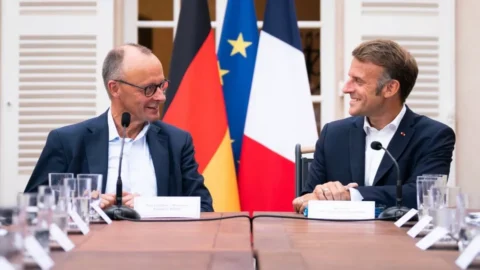
Meanwhile, European sources have revealed that on Sunday the Canadian Prime Minister, Justin Trudeau, had a phone call with the President of the European Council Antonio Costa to warn him of the intention to take countermeasures against the United States. Entering yesterday morning at the informal summit at the Palais d'Egmont in Brussels convened for an informal exchange of thoughts and proposals on common defense, many leaders including French President Emmanuel Macron, German Chancellor Olaf Scholz and Polish Prime Minister Donald Tusk reaffirmed their willingness to respond in a firm and decisive manner to an increase in US tariffs.
The topic then dominated the morning's discussion on transatlantic relations, often intertwining with the issues of the EU's strategic autonomy in the defence sector. "Europe, as a power that it is, will have to fto respect and react“, Macron announced. Scholz also agreed, saying that “it is clear that, as a strong economic area, we can manage our issues independently and react to tariff policies with tariff policies that are harmful to both sides of the Atlantic, when problems arise, solutions should be found”. For Poland, led by the EPP Prime Minister, Donald Tusk, the rotating president of the EU, it would be “stupid” to end up in a trade war at this delicate moment. For the High Representative for Foreign Affairs, Kaja Kallas, in a trade war between the EU and the US "only China would laugh".
EU still divided on defense funding
One thing seems clear: all EU leaders want to avoid a direct clash with Trump, but they will not back down if he were to declare a trade war. There is unity on this and awareness that the European Union is a strong commercial power with a single market of 450 million people capable of holding its own against the United States. The 27, however, remain divided on how to make Europe also a military power, without relying entirely on the protection of NATO and the United States.
In short, the attempt is to create a common front of the countries affected by the new American measures. However, it is precisely on purchases from the United States that questions have emerged divergences among the Twenty-Seven. France, for example, claims the need to give preference to the European defense industry when it comes to joint purchases. In short, putting into practice a 'buy european' to support the sector and strengthen strategic autonomy. A decision that is rejected by Germany and Poland that close to any form of selectivity or restrictions.
Once again the sore point concerns the funding for common defense and how to use EIB programs and private resources. Mark Rutte, Secretary General of NATO, attended the informal lunch where he reiterated that in June a defense spending target will be indicated that is much higher than the current 2% that several countries – including Italy – still do not respect. The new Belgian Prime Minister, Bart De Wever, a Flemish sovereignist making his debut at the summit, promised that his country will reach 2% of GDP for defense, for a question of "credibility" with respect to allies. "Then in the future we will talk about 5%," he added.
On how to increase spending, some states propose to allocate more public funds, including France. But even frugal Finland is open to “the possibility of new instruments” to finance the arms race. The Netherlands and Luxembourg remain of the opinion that there is no need for new common funds, much less common debt or eurobonds. Lithuania, together with Greece, supports the Italian proposal to separate defense funds from the calculation of the Stability Pact.