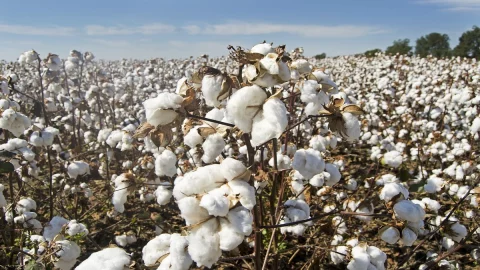
Sixty years later, cotton returns to being a made in Italy production and demand on the international market.
In fact, the harvesting of this natural fiber has started in recent days in Puglia and Sicily, involving approximately 300 hectares in the two regions. A rediscovery of 100% Italian cotton thanks to the world of fashion which is increasingly looking for national fabrics for its creations. Fashion but not only, because cotton has multiple uses.
100% Italian cotton: a tradition that dates back 60 years
Cotton was once widespread in Italy especially in the South, because this plant fears the cold and grows well in areas exposed to the sun and heat. And the South is the Ideal. And precisely for this reason its cultivation was particularly widespread in Sicily, in the Agrigento area, e in Puglia, in the Capitanata. Just to get an idea: in Sicily alone at the end of the fifties, we read on the official website of Cotton of Sicily, the cultivated area was close to 350 thousand hectares, of which 140 thousand in the province of Agrigento. But starting from the 60s, cultivation in Italy was progressively abandoned essentially for two reasons: the advent of synthetic fibresand and the weight of skyrocketing production costs. since the harvest was done by hand and required a lot of staff.
But now it has regained strength, Italian cotton 2023 it is of excellent quality - Coldiretti points out - with a production of over 35 quintals per hectare, with prices of 140 euros per quintal if organic and 110 if traditional.
Who produces cotton today
In Europe there are essentially three cotton producers: Greece, the main producer and represents 80% of the cotton cultivation area on the continent, followed by Spain (and in particular Andalusia), which covers the remaining 20%. Then, there is Bulgaria which produces cotton on an area of less than 1.000 hectares. And now, in its own small way, Italy is also entering the market.
Beyond European borders, they are United States, China, India, Pakistan and Brazil to dominate, but lately the big fashion brands and not only are approaching Italian cotton. Because, as Coldiretti underlines, beyond weaving for clothing, the Cotton has multiple uses: from feed for livestock to oil for cosmetics and pharmaceuticals, while the plant can reach up to 3 meters and can be reduced to shavings to be exploited as fuel in thermal power plants for the energy recovery of plant biomass. Cotton wool and wadding are also produced from the fibre.