

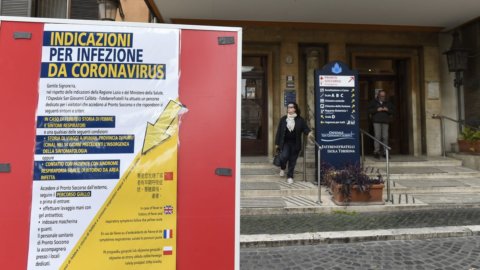
The cases of coronavirus infection increase and with them also the concern of citizens who, while continuing to lead a normal life, wonder what are the most effective prevention methods to adopt to avoid being infected by the now famous Covid-19. In this context, the experts of LabLaw, an Italian law firm specializing in labor law and trade union law, have drafted a guide a little more specific than those in circulation. The handbook is in fact aimed at employers who every day within their companies have the task of taking care of the health of their employees. Whether it's large companies or medium-small companies, precautions need to be taken that apply to workplaces, to the management of suspicious cases or to situations in which it is necessary to suspend work activity and resort to layoffs.
“On the basis of the national and international information currently available, it is therefore believed to provide the following operational indications the behaviors to be adopted by the employer in order to prevent the spread of the COVID-19 infection within the companies”, explains LabLaw, specifying however that the indications provided may be subject to updating based on developments in the coming days and possible new decisions by the institutions.
For those wishing to delve into the matter, Adapt (Association for International and Comparative Studies in Labor and Industrial Relations) has organized a free webinar scheduled for Wednesday, February 26.
CORONAVIRUS: THE EMPLOYER'S OBLIGATIONS
The employer, according to the law, has a duty to adopt all the security measures necessary to ensure physical and moral integrity of its employees. Decree Law No. 81 of 2008 - which can be applied in situations such as the current one - also establishes that the employer "has the responsibility to protect workers from exposure to "biohazard". By virtue of what has just been said, LabLaw recommends updating the Risk Assessment Document (DVR), at the same time making available to its staff all the tools indicated by experts capable of improve the healthiness of the working environment. It is therefore necessary to provide for the installation of antibacterial gel dispensers, the provision of gloves or protective masks. Furthermore, "in accordance with the indications dictated by the circular of the Ministry of Health on February 3, 2020, the employer must invite its employees to resort to common preventive measures of the spread of diseases transmitted by the respiratory tract. In this case we are faced with the most common prevention systems: wash your hands frequently and thoroughly, pay attention to the hygiene of surfaces, avoid close contact with people with symptoms.
HOW TO BEHAVE WITH SUSPECT CASES
If the employer becomes aware of the presence of a person who "responds to the definition of a suspect case", LabLaw continues, he has the duty to contact health services immediately. While waiting for their arrival, it is necessary to avoid close contact with the person who may have contracted the virus, to provide them with a surgical mask and to pay attention to the surfaces with which they have come into contact. It is also necessary to have the person concerned eliminate the used paper handkerchiefs directly, throwing them in a waterproof bag that will be disposed of with the materials produced during the medical activities of the rescue personnel.
WHEN TO SUSPEND THE ACTIVITYWORKING TIME
In the presence of suspicious cases, the employer is obliged to suspend the work activity:
– for workers who have had close and continuous contacts with confirmed cases of diffusive infectious disease COVID-19,
– for workers who, in the last 14 days, have entered Italy after having stayed in China, in the areas affected by the epidemic.
SMART WORKING AND REMOTE WORKING
In the above cases and as a precaution, the employer can ask his employees to work remotely, using smart working and teleworking. This is also foreseen by the Government decree of 23 February.
“The employer is also required to evaluate employees with particular health conditions (such as pregnant workers) and could adopt, even in this case, specific measures suitable for protecting health at work, such as carrying out the work remotely", points out LabLaw.
Finally, in cases where it is not possible to resume work due to the coronavirus the employer can resort to the Ordinary Redundancy Fund, which is granted by INPS in the presence of "company situations due to transient events not attributable to the company or its employees, including seasonal bad weather".
TRANSFERS
Due to the spread of the coronavirus, the employer must cancel any travel or transit through risk areas, including of course areas declared off limits by the authorities.




HELLO, I WOULD LIKE TO KNOW WHAT ARE THE RIGHTS AND DUTIES OF WORKERS IN THE DEROGATION CASH.
MUST THE WORKER BE AT THE EMPLOYER'S DISPOSAL DURING THE WANTED WORK, IE MUST BE AVAILABLE TO CARRY OUT REGULAR WORK IF THE EMPLOYER REQUESTS IT (WITHOUT SUSPENSION OF THE WANTED)?
Hi, I would like to know if among the employees present on the premises and not present, in the event of contagion, the employer is obliged to inform all employees that there have been two or more cases?? Or do they have to keep privacy secret?
I apologize for the duplicate comment, The last one sent is free of spelling errors.
thanks for the interesting article. The writer works in a particularly large industrial group such as Finmeccanica, which has often set the standard in terms of union relations. My case has the potential to affect many people.
Shortly after the creation of the One Company Leonardo, the confederal trade unions and the parent company signed an agreement on smart working in Rome which implemented the decree of the then Renzi government.
At Oto Melara in La Spezia where I write from, it was never implemented and in the rest of the group it was in any case foreseen in a few pilot projects.
Membership was on a voluntary basis by the individual worker concerned. After the outbreak of the coronavirus, it was communicated via email that it would be extended on a rotational basis to 50% of staff required to connect from home.
Unlike usual, no hard copy was posted on the union bulletin board.
I requested, as always without any response, the publication of a calendar of workers' and employees' shifts indicating name, surname, start and end date of the period during which the employee is required to report to the workplace.
Instead, we have individual e-mails, in which colleagues are not included in the knowledge. It is an unusual method for this company, which, in the event of a police check, prevents the employee from proving that he is actually going to work. The individual e-mail, moreover not even in cc to third parties, has little probative value if not to say none.
From the document sent, it would appear that employees can connect from their homes only via the notebook provided by the company and set up by it with a specific client and authentication token, for obvious IT security reasons. The notebooks were NOT distributed to all workers, but only to those who already had the opportunity to travel outside the province before the crisis, or to work on the move.
.
What should other colleagues like me do? I gave my willingness to consume holidays and leave for 2020. I also added that, at the end of this period, I was willing to accept a temporary contractual variant with the introduction of a vertical part-time schedule (and consequent salary reduction).
There is no evidence of an agreement that provides for the right to request vertical part-time work on a voluntary basis, nor are we aware of the request and/or granting of social safety nets to cover periods not covered by the total number of hours of holidays or permits.
thanks for the interesting article. The writer works in a particularly large industrial group such as Finmeccanica, which has often set the standard in terms of union relations. My case has the potential to affect many people.
Shortly after the creation of the One Company Leonardo, the confederal trade unions and the parent company signed an agreement on smart working in Rome which implemented the decree of the then Renzi government.
At Oto Melara in La Spezia where I write from, it was never implemented and in the rest of the group it was in any case foreseen in a few pilot projects.
Membership was on a voluntary basis by the individual worker concerned. After the emergence of the coronavirus, it was communicated by email that it would be extended on a rotational basis to 50% of staff required to connect from home.
Unlike usual, no hard copy was posted on the union bulletin board.
I have requested, as always without any success, the publication of a calendar of the shifts of workers and employees indicating name, surname, start and end date of the period during which the employee is required to report to the workplace.
Instead, we have individual e-mails, in which colleagues are not aware. It is an unusual method for this company, which, in the event of a police check, prevents the employee from proving that he is actually going to work. The individual e-mail, moreover not even in cc to third persons, has little probative value if not zero.
From the document sent, it would appear that employees can connect from their home only via the notebook provided by the company and prepared by it with a specific client and authentication token, for obvious IT security reasons. The notebooks were NOT distributed to all workers, but only to those who already had the opportunity to travel outside the province before the crisis, or to work on the move.
.
What should other colleagues like me do? I gave my willingness to consume holidays and permits for 2020. I also added that, at the end of this period, I was willing to accept a temporary contractual variant with the introduction of a vertical part-time schedule (and consequent salary reduction).
There is no evidence of an agreement that provides for the right to request vertical part-time work on a voluntary basis, nor are we aware of the request and/or granting of social safety nets to cover periods not covered by the total number of hours of holidays or permits.
The handbook of this occupational doctor is interesting
https://www.aziendamedica.it/nuovo-coronavirus-guida-facile-per-aziende-e-lavoratori/