“What else can happen?” This is the question that many people from Catania ask themselves, but also many tourists, after the nightmarish summer experienced by theCatania airport. Before thefire which led to the prolonged closure of the airport, then the eruption of Etna complete with volcanic ash that covered the city and all the municipalities in the province of Catania. The result? After three weeks of inconveniences, delays, cancellations and hijackings - and with no responsibility yet identified - the airport also closed its doors on the eve of August XNUMXth, at the climax of a summer season which should have been a record-breaker and which instead turned into a sort of horror film for Sicilian travelers and businesses, forced to deal with a loss of turnover precisely in the period in which the takings should have been higher.
Etna: the latest updates from the Ingv Volcanic Observatory
The alert has gone down from yellow to green, but for the moment Etna remains under "special surveillance". After days of puffs, lava, lapilli and ash, the Catania volcano has "decided to subside", returning to the pre-eruption state. Yesterday, Wednesday 16 August, the regional Civil Protection Department spoke of a "high probability of an imminent occurrence", while the Ingv Volcanic Observatory - the National Institute of Geophysics and Volcanology which monitors any "intemperance" of Etna - had recorded an expansion of the oscillations. In the following hours the alarm stopped, but after the eruption which took place in the night between 13 and 14 August, experts and institutions they keep attention.
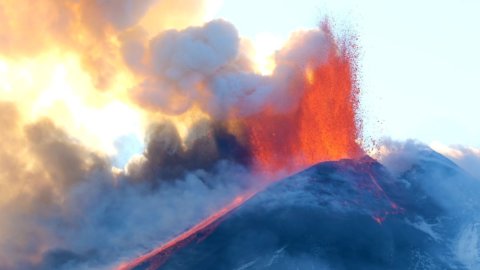
What really happened is explained by volcanologist Boris Behncke on his blog Ingv Volcanoes: "the amplitude of the volcanic tremor recorded by the surveillance instruments of the INGV-Osservatorio Etneo showed a sudden surge, and through short gaps in the cloud cover flashes could be seen at the Southeast Crater. The activity rapidly intensified from Strombolian activity to low lava fountains, which then grew in height up to 300-400 m above the crater.
“The peak of the paroxysm occurred between 03:40 and 04:30 local time (on the night between 13 and 14 August, ed,) when at least 5-6 vents with lava fountains, from the eastern to the south-western flank - continues the volcanologist - In particular, the easternmost vents have produced oblique lava fountains, which have subjected the underlying flank to a very heavy fallout of incandescent pyroclastic material, triggering a series of small pyroclastic flows . This phase of activity was also accompanied by spectacular lightning, both in the eruptive column and in the pyroclastic flows… The eruptive cloud, loaded with pyroclastic material, rose a few kilometers above the summit of the volcano and was pushed southward by the wind, causing fallout of ash and lapilli in the Rifugio Sapienza area. Subsequently, the fallout of pyroclastic material affected the foothill towns (Nicolosi, Mascalucia), and finally Catania, up to the Syracuse area".
Catania airport: the situation on 17 August
What for many was a show given by the highest active volcano on the Eurasian plate has turned for others into yet another nightmare of a summer that doesn't seem to want to leave Catania alone. The ash has covered a large part of the municipalities of the hinterland, causing the closure of the Catania airport. The airport was forced to stop again, this time for almost 24 hours, plunging the city back into isolation and travelers into the whirlwind of delays and cancellations experienced a few weeks earlier after a fire in Terminal A – the main one – the causes of which have not yet been fully clarified. Activities resumed from 6 in the morning on August 15 and since then situation has returned to normal.
The nightmarish summer of Catania Airport
This does not mean that the 2023 one will be remembered as "a nightmare summer" for Catania Airport. First the fire that sent the Etna airport into a tailspin for 24 days, whose management at times incomplete caused quite a few controversies in the Etna province and beyond, then the volcano also got involved.
In the meantime, the Sac - the company that manages the Fontanarossa airport, has provided some numbers: according to the company, in July he would have gone lost only 5% of passengers, largely due to the cancellation of flights by Turkish airlines, Fly Dubai and Jet2.com (English market) who have chosen not to re-route flights to other Sicilian airports. Numbers in hand, before closing, the airport recorded 823 passengers in transit, to which must be added the passengers re-protected in other airports of the island. The losses, therefore described as "limited", however, appear to be quite far from the estimated 40 passengers lost per day during the closure, without counting the reputational repercussions and the very numerous inconveniences experienced by those who had to grind hundreds of kilometers to reach Catania or, conversely, , move to the other airports to leave. To know the "truth" we will have to wait for the official numbers provided by ENAC, hoping in the meantime that there are no other hitches and that the summer curse that hit the airport is over. This time definitely.