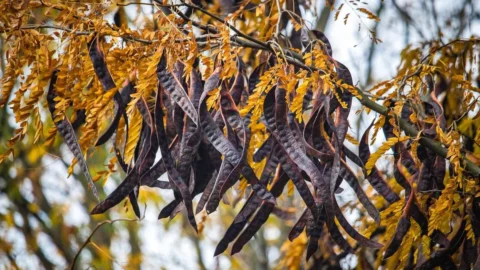
In the heart of Sicilia, among olive trees and breathtaking landscapes overlooking the sea, stands proud and majesticcarob tree. This ancient evergreen tree, a symbol of longevity and resistance, brings with it a thousand-year history and a wealth of often little-known benefits. With its fruits, called carobs or vajane, it offers considerable nutritional value, rich in fibre, vitamins and minerals.
The origin and history of Sicilian carob
Native to western Asia and the eastern Mediterranean, the carob tree has also found a home in the fertile lands of Sicily, bringing with it its load of legends and traditions. Already during theGreek and then Roman times, carob was appreciated for its fruits, used to feed livestock and to produce sweet sapa, a natural sweetener.
Le origins The precise details of its introduction into Sicily remain shrouded in mystery, some attribute the credit to the Greeks, Arabs or Phoenicians. What is certain is that its cultivation has been a vital economic resource for the island for centuries, particularly in the regions of Modica, Scicli, Ragusa, Avola, Noto and Comiso.
The most common carob varieties in Sicily include "Latinissima", "Racemosa", "Morescona", "Saccarata" and "Falcata". There cultivation is mainly concentrated in the province of Ragusa, particularly in the Dirillo and Anapo valleys, where the climate and soil are perfect for the growth of this tree.
Characteristics and cultivation of carob
The carob tree, also known as "St. John's bread" due to a legend that sees it as the protagonist in the saint's meals during periods of asceticism, is a tree with majestic foliage that can reach a height of 10 metres, lives up to 500 years, and finds its natural habitat in rocky and limestone soils with warm climates. Its dark green and shiny leaves, the reddish flowers that adorn the foliage in summer, and the flattened pod-shaped fruits make it easily recognisable. The carob tree is also very useful from the point of view ecological. In fact, thanks to its deep roots, it is able to retain water in the soil, thus preventing soil erosion and desertification. Furthermore, its cultivation is a low environmental impact.
La flowering it begins in the warm months of the year, from July to August, continuing until December. The fruits develop in spring and ripen towards the end of summer. It takes about a year for the flowers to turn into mature fruit. At harvest, the fruits have already developed flowers for the next fruiting season.
I fruits they are pods of various sizes (from 10 to 20 centimeters) with a dark brown color, with a very hard external surface. Inside, the pulp is fleshy, mushy and sweet, but tends to harden over time. However, it has a high tannin content, which can be irritating if consumed in large quantities.
There is a curiosity about the carob seedsor, from which the term "carat" derives, still used today as a unit of measurement for precious stones: in Arabic, the carob seed is called "karat" and in the past it was used as unit of measurement for gold, as it was believed to have particularly uniform dimensions and weight.
Uses and nutritional properties
Carob, known as the "poor man's chocolate" for its cocoa-like flavour, has a wide range of uses in the kitchen. From whole fruits consumed natural or toasted, to the pulp reduced to powder to create "carcao", a substitute for cocoa low fat, carob lends itself to multiple preparations.
His flour, gluten-free, it is ideal for making bread, pasta (for example gnocchi and tagliatelle), risotto but also desserts and granitas. Furthermore, the dense carob extract, sweet and with an intense brown colour, is excellent natural sweetener and a delicious topping for meats, vegetables and cheeses.
But it is not just a delicacy for the palate: carob is rich in vitamins, fibers, polyphenols, Calcium, Iron e Potassium which make it an ally for digestive and cardiovascular health. Furthermore, its use as an adjuvant in slimming diets is supported by its ability to give a sense of satiety and lower cholesterol levels.
Products based on Sicilian carob
Today, thanks to the passion of local companies who have handed down the ancient traditions linked to the processing of carob, it is possible to find a vast range of products based on this fruit. From the hazelnut and carob cream to concentrated carob extracts to be used as natural sweeteners up to liquor with carobs, which is easily reproducible even at home.
And let's not forget the deliciousness Sicilian carob, available in various flavor shades such as ginger, hazelnut and orange.
Sicilian carob remains a forgotten jewel that is worth discovering and valorizing. With its thousand-year history and its health benefits, it represents a precious heritage to be safeguarded and shared with the world.