Le European stock exchanges they slow down after a positive start and pass in negative territory at mid-sessionThe return of the stock market also contributes to slowing down the price lists. oil towards 100 dollars per barrel, while investors wait to understand what the concrete developments will be talks between the United States and Iran and look at the top between Donald Trump and Xi JinpingEven the better-than-expected data on the Eurozone economy are, for now, failing to give momentum to the markets.
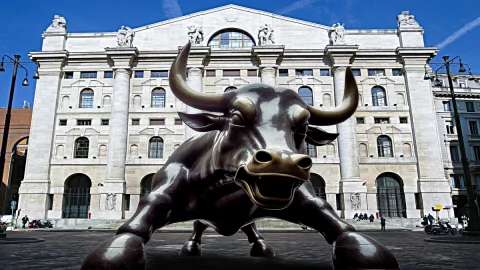
In this context, the main stock markets of the Old Continent are moving without a direction. Business Square The FTSE MIB dropped 0,19% and slipped back below 52 points. Frankfurt loses 0,43%, Madrid 0,26%, Amsterdam 0,19% and Paris 0,05%. However, it resists London, up 0,10%. The stocks are also cautious Wall Street futures, with the Dow Jones up 0,05%, the S&P 500 up 0,08% and the Nasdaq up 0,01%. In the background, theartificial intelligence continues to support the technology sector, with the Nasdaq setting a new intraday record on Tuesday.
EU stock markets on hold, with eyes on Iran and the Trump-Xi meeting.
Geopolitical developments are taking center stage, with new signs of openness between the United States and Iran and anticipation for the meeting between Donald Trump and Xi Jinping.
On the edge of theUN General AssemblyThe American and Iranian delegations held a meeting that lasted approximately three hours, which Trump described as "very constructive." The US president announced further contacts shortly, raising expectations of possible progress also on the Strait of Hormuz, a strategic hub for the region's oil flows.
Investors' attention now shifts to the face-to-face between Trump and Xi Jinping, scheduled for Thursday, September 24. The Chinese president is expected in the United States until September 25, and the topics on the table will range from trade to artificial intelligence, from supply chains to major geopolitical issues. Ahead of the summit, the Chinese ambassador to the US has identified Taiwan and human rights as "red lines" for Beijing.
Eurozone PMI: Economy accelerates, but markets remain cautious.
I preliminary data on the Eurozone PMI paint a stronger-than-expected picture. In September, the composite index rose to 53,1 points from 52 in August, marking the third consecutive month of expansion and the fastest pace in nearly three and a half years.
The acceleration affected both manufacturing and services, with their respective growth rates at 55- and 10-month highs. According to Chris Williamson, Chief Business Economist at S&P Global Market Intelligence, the data points to possible GDP growth of 0,4% quarterly, while strengthening orders suggest a still-solid fourth quarter. This resilience, however, could also have implications for the monetary front: according to Williamson, the economy's resilience could fuel expectations of a new hike in ECB rates already in October.
Also 'OECD sees a more resilient global economy than expected: the organization confirms global growth estimates to 2,9% e raise that of Italy to 0,9% in 2026, leaving the forecast for 2027 at 0,6%. However, several risks remain, from energy prices linked to the Hormuz crisis to investments in artificial intelligence and US tariffs. The OECD also warns that the reserves that have so far cushioned shocks are running out.
Piazza Affari, luxury goods and banks stand out. Utilities and oil companies are weak.
In Milan, the picture remains selective. Among the increases, the most notable are: Classic Ferrari for sale (+ 1,41%), BRUNELLO CUCINELLI (+ 1,18%) and Moncler (+0,96%). Well too Amplifon (+0,86%), supported by positive indications on the hearing aid market and the prospects linked to the acquisition of GN Hearing, which should generate synergies of 60-80 million euros.
The banking sector is in good shape, with Banco Bpm, Mediobanca and Mps among the titles in pole position. Positive also Unicredit, while among the weakest stocks on the list stand out Fincantieri (-1,85%), Buzzi (-1,6%), Unipol (-1,55%) And Inwit (-1,27%). Energy-related stocks are also cautious, with Tenaris among the weakest. Under the spotlight Post (-0,89%) And Tim (-0,71%), on the third day of the reopening of the offer terms: in the meantime, Poste has risen to 70,5% of the capital.
Little move Pirelli (+0,22%), following the transaction that increased Marco Tronchetti Provera's control of the company to 29,9%. The group also approved a €1 billion plan to expand its US plant.
De Nora Industries remains negative, but recovers ground after the sharp drop the day before, following the sale of 5% of the capital by Snam.
On the bond front, it spread The spread between 10-year BTPs and German Bunds starts at 88 basis points, down slightly from 89 points at the previous close. The yield on the 10-year BTP also fell to 4,32% from 4,34% the day before.
Brent crude oil rises again but remains below $100.
After the recent series of declines, the Brent tries to recover ground and returns slightly above 99 dollars a barrel, with an increase of 0,11%, but still remains below the 100 dollar threshold. wtf moves in the opposite direction and falls just below 90 dollars. More stable is the gas, with the Amsterdam futures around 73 euros per megawatt hour.
Crude oil is being held back primarily by the prospect of improved supply from the Middle East and hopes for a diplomatic solution to the conflict between the United States and Iran. Added to this is the resumption of operations on Saudi Aramco's East-West pipeline to the Red Sea, which has been closed since September 11th. However, the market continues to focus primarily on Strait of Hormuz, A strategic hub for energy flows in the region. Any signs of easing tensions on the Iranian front could ease supply concerns and help contain prices.
The issue remains central to the markets, however, because a return to normality in traffic through the Strait could reduce the pressure on energy prices and, consequently, on inflation and interest rate expectations.
Strong dollar, euro hits lowest since late June
On the currency market the dollar continues to strengthen. euro It fell to $1,1420, its lowest level since late June or early July. The dollar/yen exchange rate is approaching 158, while the euro/yen remains little changed around 180.
Gold and Bitcoin are also weak: the precious metal reaches the $4.300 an ounce area on the spot market, while the cryptocurrency falls to just above the $85 mark.