Nine hundred works
The protagonist of the 29th episode of the series by the Italian best-selling authors is a narrator of very high narrative prolificacy. It is the Neapolitan writer Francesco Mastriani, very close, even narratively, to his city and to Southern Italy. For many he is considered the forerunner of realism.
There are extremely prolific writers, today as yesterday, able to write a book in a month or even less, without this necessarily relegating them to the lowest category, indeed, sometimes they are at very high levels. One of these was certainly Simenon, who took about ten days to churn out one. And what books! According to some even among the most beautiful of the twentieth century. Others instead take a lifetime, as Manzoni did with his masterpiece, which he waited for a total of 25 years.
In short, there is no rule to define or not a masterpiece based on the time needed to compose it. And this not only in our century, but also in the previous two.
The presence of extremely fruitful authors has also remained the same over the centuries, capable of writing dozens of books, sometimes even over a hundred, almost as if they were machines, from Salgari to Carolina Invernizio.
And today we get to know another of them, a writer of more than a hundred novels as well as plays, short stories, articles and various pieces, for a practically endless total, which his son and biographer did not hesitate to calculate in about 900: Francesco Mastriani.
An extremely fruitful author
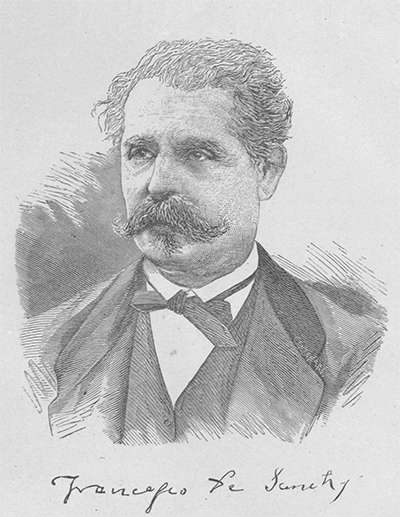
He was a writer, a journalist, a teacher, an employee and we will see other things in Naples in the mid-nineteenth century. He gave his fellow citizens books and stories in industrial quantities. The official criticism has always turned upside down in front of him, and being unable to ignore his presence, has relegated him to something that was not literature, but rather "consumable material" for the good mouths of the country, i.e. the masses. Starting with his illustrious fellow citizens Benedetto Croce and Francesco De Sanctis, who could certainly say something on the subject.
A low-ranking writer who, however, was liked by readers, and how if they liked it, a bit like writers with large circulations are today, but who perhaps don't have much in common with literature as the two greatest critics understood it.
A character whose pace of life is unsustainable for anyone
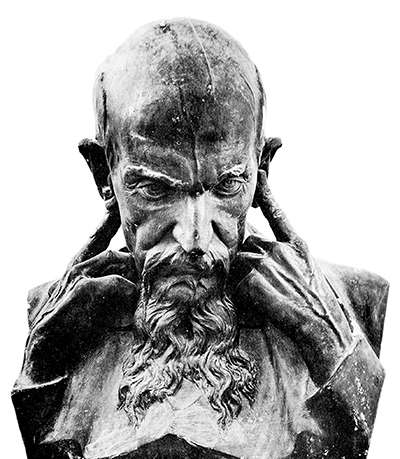
Francesco Mastriani was a character of inexhaustible creativity and unsustainable pace of life for anyone, especially one often afflicted with serious disabling pathologies and always grappling with financial problems, a bit like Salgari, with whom he also shared the type of family : wife and four children.
He was always intent on his "main" activity, that of a writer, to which, however, he added the others: that of a journalist, first of all that of an employee in an "industrial" company, and then modest more or less official jobs, simultaneously that of private teacher of foreign languages, French, English, German, Spanish, and finally at the age of 55 also tenured professor at the gymnasium.
But that's not all, given that he managed theatrical performances derived from his writings, sometimes he even acted there as an actor, or, if the occasion arose, he didn't even miss the job of tour guide for foreign customers, also, he said, to review some of those languages which he then taught privately to the boys.
In reality he did it to scrape together some money and keep the family going, pay the many expenses and the rent of a house, which he did not always succeed, given that about thirty changes of residence are attributed to him, sometimes even after a few months. And not only for non-payment, but for health reasons, for excessive noise, for confined spaces, for internal humidity, for squalid views, to get closer to relatives and so on.
A life, in short, troubled like few others, marred by the death of three out of four beloved children, tormented by complicated pathologies, for long months even by blindness, always in trouble and without ever pulling back, until his deathbed, where exhausted and with a thread of voice concluded the last novel dictating it to his wife or to some compassionate soul, two days before he died and inside himself he planned others, if the Madonna had granted him the grace of another little breath, of a few more years of life.
The life
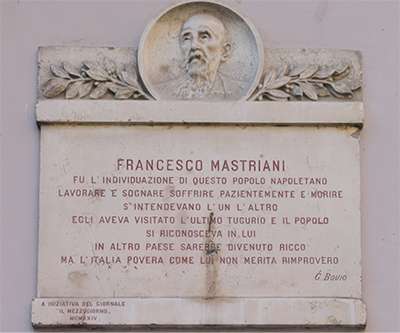
Francesco Mastriani was born in Naples in 1819 into a medium-level but numerous family: six brothers and two half-brothers, given that the mother, before marrying her father, to whom she would have given seven children, had had two from a previous marriage.
He completes his studies showing an omnivorous and insatiable ability to know, to know, to learn. Hence the study of some foreign languages, in addition to the Italian language, which must have appeared to him as another foreign language compared to its original dialect. And then the passion for medicine, which he studied for a few years at the university, without however graduating, the one for the lawyers, to which he dedicated other demanding studies, and then the love for French literature which he read avidly, taking books from his teacher's library, 400 volumes strong, not a few at the time, and he read them all. How he managed to keep all these activities together, to which others are then added, remains a mystery. Other than the mysteries of Naples that he would write later!
When his mother died in the cholera epidemic in 1836, when he was 17, his father found him a job in the Neapolitan industrial company. At the same time he begins to collaborate with some newspapers, then much more numerous than today, but with limited circulations, and to collect some pennies.
He begins his career as a journalist
Seeing that his articles are liked and that his imagination seems inexhaustible, it is the father himself who advises him to leave the job he has found for him and to devote himself to journalism, which Mastriani does willingly. He will deal with news, city curiosities, popular and cultural traditions, theater: topics that in his city, from which he would never leave, certainly weren't lacking.
Then, on his father's death in 1842, he returned for a while to the company where he worked, but in 1844, at the age of 25, he left it permanently, to devote himself to journalism and private teaching of foreign languages.
Marriage with cousin
In 1844 he married the daughter of a cousin who bore the same surname and began that very troubled family life always grappling with financial problems. Sometimes he too is forced to settle in his father-in-law's house when he sees that he is unable to afford the rent. But he will always be constantly moving and moving, always looking for a better accommodation, more suited to his needs, which he will never find.
Debut as a novelist
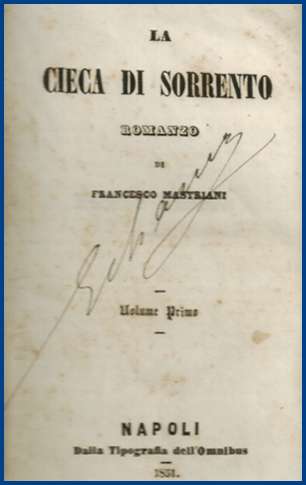
At the age of 29, in 1848, alongside his work as a journalist, always precarious and linked to city newspapers with very low sales and short-lived duration, he also joined that of storyteller. In 1852, with The blind woman of Sorrento, achieves a resounding success, which makes it one of his best known and most appreciated novels by readers. And he thus begins to write a multitude of novels one after the other.
In some periods, from 1875 onwards, when he collaborated on a permanent basis with a national newspaper, the "Roma" of Naples, he was even required by contract to compose five a year, which would first appear in the newspaper's appendix and then be put up for sale by volume.
It is, as one can easily guess, a life bordering on the unbelievable.
Politics
He is a conservative when it comes to political ideas, he dislikes the ideas of the Risorgimento, in his heart he prefers an orderly life that respects hierarchies and traditional values, guided by the aristocracy and supported by a solid religious faith. When Garibaldi completes his expedition, he does not hesitate to side with the Bourbons. A choice that he will then pay for when his beloved sovereigns will have to leave.
But later, after an initial phase of adjustment to the new regime, he slowly returned to the local and even national press, and began to take an interest in social problems, to speak of the many underprivileged, the exploited, the marginalized, with their tragedies , of which his city is very rich.
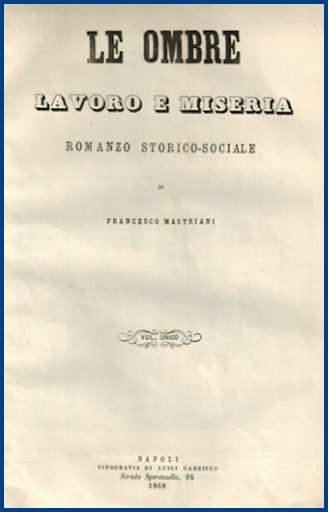
Some see in the books of this period a landing on the themes of the nascent realism, even prior to it, as can be seen in the trilogy The worms of 1863–64, The shadows: work and misery 1868 and The mysteries of Naples of 1869–70. Or even socialist issues, which he tackles, however, with the religious perspective of a good Christian, attentive to the problems of the least, rather than with an established adherence to socialism, which will never exist.
Appointment as professor of literature
In 1874 he finally obtained the chair of literature in a high school in Aversa. Is it perhaps the arrival at a quiet life, at a secure salary, even if not very high, which he then integrates with the reborn journalistic and narrative profession?
Nope! To go to the workplace he is forced to get up very early to catch the train, and his health conditions do not allow him to, to the point that after a few years he will have to leave the coveted job. And so that fixed salary is missing, and the usual problems begin again, economic hardships, sometimes misery and hunger.
It is a life that will not have moments of respite all the way, until his death in 1891, at the age of 72. A passionate commemoration of Matilde Serao will be held in memory of him.
Its endless production
His endless production starts from the proposition of the themes of the nineteenth-century feuilleton, with ingenious plots, strong colors, "one-dimensional" characters that fit well into a Manichean vision of life, where the various figures oppose each other between those attributable to the good and those to its opposite, in a clash that repeats itself continuously.
He knows the ingredients of the feuilleton and knows how to dose them wisely so as not to tire or bore. And with each episode, sometimes not only weekly, but also daily, he has to create a new fact that keeps the reader's attention alive, that rekindles the tension, which then melts in the next episode, to then start again. A bit like what happens today in many serial television productions, such as telenovelas, soap operas, and so on.
The mysteries of Naples
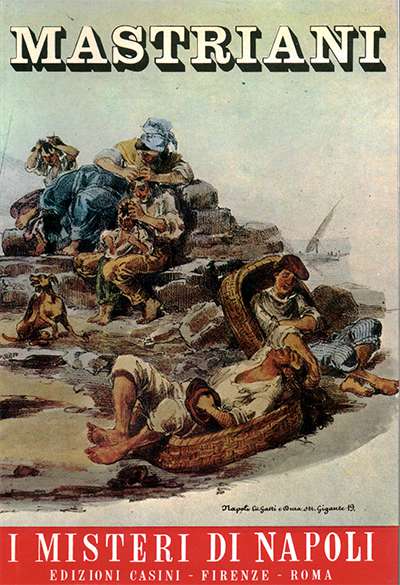
With The mysteries of Naples fully enters the "mystery" genre, a narrative vein born from the pen of Eugene Sue, with his mysteries of paris, released in 1842. Since then across the continent, and also in our country, there had been a swarm of novels that recalled Sue's work both in title and in content. But Mastriani, so many years after the original model, does it his way, revisiting it and enriching it with social motivations.
The work was by no means contemptible, on the contrary it proved to be a good product, in all probability his best, as well as one of the most valid ever of this narrative genre.
A minor of the second half of the XNUMXth century
His was a long, very articulated literary path, sometimes not unrelated to bold innovations, which led him to approach even the comic, the noir, to experiments that would have established themselves long after him.
However, all this was not enough to make him ascend to a higher step. He remains a minor author of the second half of the XNUMXth century, certainly of popular success, which however never assured him any wealth, let alone economic tranquility. But nothing more!
Even today there is no in-depth study of his work that sheds light on the most significant aspects. A few passages by him appear in some school anthology and sometimes a work by him is reprinted. That's all.