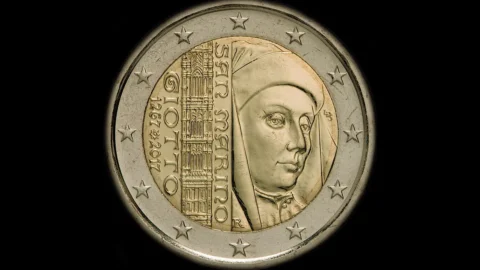
The artist has never been an isolated creator, but a figure inserted in a network of clients, merchants, bankers and patrons which have determined not only the material conditions of creation, but also its forms and languages. From this perspective, Giotto di Bondone (1267–1337) He represents a pivotal figure: not only for having introduced the revolution of space and perspective in Western painting, but also for having embodied a new model of artist: professional aware of the economic and symbolic value of his work.
Giotto's financial vision
A vision that today offers us a key to understanding the coexistence of art and finance in the contemporary world. Between the late 13th and early 14th centuries, Italian cities, particularly Florence, became centers of economic and financial power. The birth of the exchange counters, merchant companies and a monetary economy favors the circulation of capital, but also the birth of new forms of representation of power. The great banking families—such as the Bardi, the Peruzzi, and later the Medici—commissioned works not only out of religious devotion, but as reputational investmentThrough images, they consolidate their legitimacy, build trust, and convey stability.
Giotto, more than anyone else, understands this mechanism
His painting, characterized by an emotional realism and a rational spatiality, translates into images the idea of trust, balance and measure, the same principles on which nascent finance is based.
In him, art ceases to be mere decoration to become means of communication and value construction. Giotto is not only an artist, but a image entrepreneurHe manages workshops, organizes workforce, draws up contracts, negotiates fees, plans time and materials. He is one of the first to understand that art, in order to exist, needs structure, clients and marketIn this sense, Giotto anticipates the modern figure of the artist as economic and cultural operator, capable of mediating between aesthetics and patronage. His ability to valorize his work to the point of becoming, according to the chronicles, a rich and esteemed man reflects a crucial passage in the history of art: the artist as producer of symbolic capital which can be translated into economic value.
Towards a new synthesis: cultural finance
The future of the encounter between art and money lies in a new emerging category: the cultural finance.
An area in which economic capital and symbolic capital merge to generate shared valueFinancial institutions can become modern patrons, supporting artistic and cultural projects as levers of sustainable development, urban regeneration and social innovation. At the same time, art can offer finance a language of humanity and identity, restoring depth and meaning to an economic system that risks abstraction. This convergence is not an aesthetic utopia, but a necessary evolution: an economy of the future that recognizes beauty and culture as the foundations of long-term investment forms, not only financial but also social and civil. Giotto, in the fourteenth century, inaugurated a new perspective: space, measure, vision. Today, in the twenty-first century, we need the same perspective: recognizing that economics and culture are not rivals, but allies in building the future.
"Because where there's art, there's trust. And where there's trust, value is born."
This sentence summarizes a fundamental principle that runs through the history of art and economics: art is not only aesthetic expression, but trust building toolIn the Middle Ages, patrons, banking families, merchants or religious institutions, invested in works of art not only out of devotion or prestige, but because art testified to their credibilityA fresco, an altarpiece, or a decorated chapel conveyed stability, good governance, and financial solidity, essential elements in an economy where trust was the true currency. This dynamic has not changed over the centuries: today, trust remains the foundation of every economic and financial system. Capital circulates more easily where it exists. signs of reliability and reputation, and art continues to play this role as a cultural, social and patrimonial asset. Investing in art therefore means investing in tangible and intangible value: beauty creates attraction, quality inspires respect, and the whole generates economic and symbolic value.
I conclude: art works like confidence multiplierWherever it exists, human, social, and economic capital thrives. And where trust grows, value—both cultural and financial—consolidates and thrives.