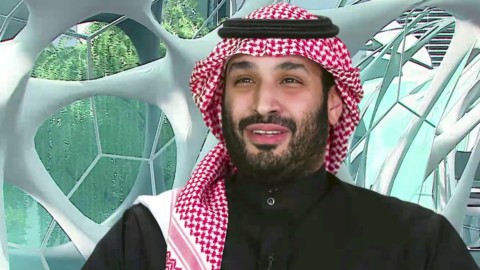
Il route change of the Crown Prince Mohammed bin Salman regarding the future of theSaudi Arabia is gathering more consents from the financial giants of Wall Street and Big Tech. Having realized that the pharaonic Neon project he began to falter and yet continued to search for a alternative project to the oil pump alone, the prince moved on to the idea of creating an equally pharaonic hub for artificial intelligence, which cuts a fine figure among the titans already present in the sector, the United States and China.
Listening to Saudi Arabia's Energy Minister, Prince Abdulaziz Bin Salman Al Saud, who spoke at the ninth edition of the Future Investment Initiative (FII) conference in Riyadh in recent days are everyone came running: heads of state, consultants and managers of the technological sector, but above all the big names on Wall Street, from Citigroup to Barclays to Goldman Sachs, Blackstone Inc. and JPMorgan Chase who have shown they want to be in the game.
The Saudi prince's new dream: to become the "new digital Aramco"
In 2017, at the first annual Saudi Arabian financial summit, Crown Prince Mohammed bin Salman arrived with entirely different plans: to present a city of the next century called Neom, a $500 billion plan that envisioned a metropolis with more robots than humans and enough solar panels to fill the Great Wall of China. But even princes' dreams sometimes come to nothing. on the difficulties of reality.
However, the intention to to unleash Saudi Arabia's economy laid down by the oil dependence. So, in this year's edition, the tone has completely changed: less oil and fewer robots, but more computing, data centers and artificial intelligence in general. So on Red Sea, A five-billion-dollar data center will provide computing power to European developers, while on the East Coast, a twin complex will serve Asia and Africa. The goal is to become the “new digital Aramco”.
The project is in the hands of Human, the company founded in May by Crown Prince Mohammed bin Salman and controlled by the Public Investment Fund (Pif), the sovereign wealth fund over 1000 billion dollars“We want to be to artificial intelligence what Aramco was to energy,” said its CEO. Tareq Amin during the panel From Oil to Compute. The goal is titanic: to manage by 2034 6% of world computing power, against the current 0,8%. Humain intends to install 18.000 chips in 2026, the first phase of a plan that will lead to 400.000 units by 2030. In parallel, the Public Investment Fund and Aramco They announced the signing of a preliminary agreement for the oil company to acquire a minority stake in Humain, while the sovereign wealth fund will retain majority control.
The path it's not all downhill. Data center expansion will require a increase of 40% of the national electrical capacity in the next ten years, with environmental and logistical impacts still uncertain. The government promises renewable energy and hydrogen, but the dependence on the gas remains high. Furthermore, a lack of skills, Particularly programmers and researchers. Riyadh is trying to bridge the gap with fast-track visas, international scholarships, and the creation of "data embassies" to attract foreign companies under neutral jurisdiction.
Wall Street giants take the field alongside the prince
But the new project seems to convince the international community. During the FII, Humain presented a package of partnerships with Nvidia, AMD, Qualcomm and Groq and all these groups have already started the process to obtain export licenses to Riyadh. Already last May Amazon Web Services had announced a $5 billion cloud infrastructure deal with Humain and Elon Musk had discussed with the Saudi company the possibility of using future data centers to train xAI models.
Not only that: also the Wall Street financial bigwigs They showed they believed in it. Even before the financial conference began. Citigroup inaugurated its new regional headquarters in Riyadh, while Barclays Plc had announced its return to the kingdom. Then during the Future Investment Initiative, David Solomon, CEO of Goldman Sachs Group, said the bank plans to triple its local staff to about 60. Goldman is already keeping an eye on the kingdom's nascent private credit market and plans to expand its wealth management business. "We believe the changes resulting from the kingdom's investments in infrastructure and the local economy represent a great opportunity for Goldman to collaborate with the kingdom,” Solomon said. In addition, the private equity giant Blackstone announced a partnership with Humain, for the construction of the data center with an initial investment of about 3 billion dollars and according to Amin, the initiative could expand to include BlackRock, KKR and Digital Bridge.
Saudi Arabia and its state-linked entities are also among the largest debt issuers to the world, offering Profitable business opportunities for credit giantsAnd while Riyadh's focus has shifted to domestic development, its sovereign wealth fund continues to support large-scale international deals. For example, JPMorgan Chase & Co. secured $20 billion in financing to help investors, including the Public Investment Fund, privatize Electronic Arts Inc. in a $55 billion deal. Banks competed for a share of the approximately $500 million in financing fees.
Investment Minister Khaled al-Falih also highlighted the Kingdom's turning point. "It's time to reduce public spending and give more space to the private sector“. After years of giga-projects like Neom, Riyadh is preparing for phase two of Vision 2030, that of profitability and consolidation. strategy 2026-2030 of the Public Investment Fund will be announced “very soon”“, he announced during the meeting and will focus on six main ecosystems: travel and tourism, urban development, advanced manufacturing, industry and logistics, clean energy and renewable infrastructure, and Neom, but as an ecosystem in its own right.
The Saudis backed by Trump
The Saudis have presented themselves stronger, despite international instability, also thanks to a relationship very solid with theadministration Trump. The relationship with Washington has returned to being the cornerstone of Saudi policy after Donald Trump's visit to Riyadh last May, the first official mission of his new mandate, when the United States gave preliminary approval for the sale of Nvidia and AMD chips. At the same time, Riyadh maintains a calibrated posture towards the China, welcoming their investments but avoiding clear-cut alignments.
During the forum, Humain's CEO reiterated the confidence in an imminent green light from Washington for sale of advanced chips to Saudi Arabia. “We have provided detailed guarantees to the US authorities,” he explained, “including the commitment never to purchase components from Huawei.” A non-random reference: the United States maintains a regime of restrictions towards Chinese technology and to obtain the chip export licenses, Humain had to demonstrate that he could operate with full transparency and security. So the Saudi manager created a “defense package”, a security plan to ensure that the country's infrastructure is not compromised by external influences.