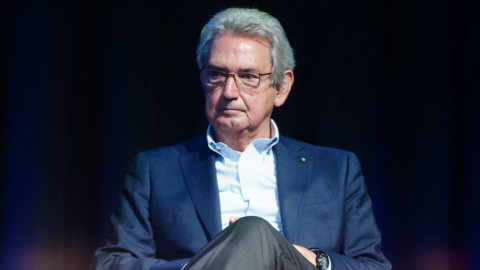
Energy e geopolitics: two forces in constant conflict. Franco Bernabe, long-time manager, former CEO of Eni and Tim, and figure chosen by Draghi to tackle the Ilva crisis, in an interview with The print sends a clear warning on the urgency of rethinking the European energy system. By lining up problems and solutions, it highlights how the Old Continent is losing competitiveness, risking compromising its industrial development model.
The Russian Gas Crisis and Yet Another Challenge
With the company blockade of gas supplies through Ukraine, Europe is facing a further obstacle in an already fragile context. Bernabè is under no illusions: “The interruption of gas supplies through Ukraine adds another negative element to a complex energy picture for Europe. We are talking about about 14 billion cubic meters less. It is a significant volume, even if it is not strategic”. The real issue, however, goes beyond the short term: “The problem cannot be analyzed only with the short-term impact”, he warns, inviting Europe to think with a broader perspective.
Mild winters, but not forever
The lack of Russian gas has been mitigated in recent years by winters specifically myths, as Bernabè points out: “In the last two years, the lack of Russian gas has been compensated by mild winters, with temperatures that are decidedly mild compared to the average and therefore favorable”. El Niño, with its climatic impact, has played a crucial role: “That phenomenon and the growth of renewable energy have made a substantial contribution to reducing dependence on supplies from the Russian Federation”.
However, the forecasts for the future are not as optimistic. This year it seems that there is a more severe winter, as Goldman Sachs points out. “Temperatures are expected to drop, because there is the reverse process of El Niño. There will be a colder and drier season. And this is another critical factor, because it will translate into less availability of hydroelectric sources”. In fact, in 2024, the humid climate facilitated the filling of reservoirs, but “it will probably not be the case this year”.
Renewables: a breath of fresh air… but not a solution
Bernabè recognizes the importance of the renewable energy, but he does not consider them the panacea for all ills: "They cover about 16% of Europe's primary energy needs. This is a significant figure, double that of the rest of the world. The increase has been particularly significant in the last two years, after the Russian invasion of Ukraine". But, he warns, we cannot rely only on these: "Renewables help, but they are not the definitive answer in the very long term and therefore Europe's precariousness remains too marked".
The urgency of a stable energy system
For Bernabè, the priority is clear: “Europe must, not should, must find a energy asset much more stable and more competitive than there is today”. The problem, however, is the lack of a common and shared strategy among the member countries: “Either the European countries all get together to make joint purchases or else I don’t see how there can be manageable solutions. The point is that many countries would not agree to do so. Think of Germany, which introduced a tax on methane exports. Everyone does it for themselves and no one wants to give up their national autonomy. And that’s a mistake”.
One of the central issues, according to Bernabè, is the poor awareness of the strategic role of energy: “In Europe, the role of energy in ensuring the competitiveness of our industrial system is not adequately perceived. It should be at the top of government agendas”. But why is it not? “Unfortunately, energy policy requires a balance between different aspects, from environmental impact to the availability of raw materials, through security. However, the EU has only addressed one of the problems each time. A holistic approach would definitely be a turning point”.
Price cap: a false solution
Among the proposals to contain prices, the price cap continues to be discussed. For Bernabè, however, it is a impassable road: “A price cap wouldn’t work. Either European countries all get together to make joint purchases or else I don’t see how there can be manageable solutions.” The problem is the lack of unity: “Many countries would not agree to do so. Think of Germany, which introduced a tax on methane exports. Everyone goes their own way and no one wants to give up their national autonomy. And that’s a mistake.”
US Gas: Manna from Heaven or Noose Around Your Neck?
Another crucial issue concerns gas imports from United States, which have become the leading supplier of liquefied natural gas (LNG) for Europe. “American producers have a great advantage in exporting their gas to Europe because they sell it at a much higher price than they sell it in the United States,” says Bernabè. And here comes the problem: “The difference in gas prices between the United States and Europe has increased dramatically in the last three years. Before the crisis, the difference was double or triple, today it is five or six times. And this translates into one thing: a collapse of European competitiveness.”
This disparity risks strangle European industry and, in the long run, not even the United States could benefit from it: "If you export across the Atlantic, how can you keep prices low on American soil? It will be a big problem for Trump. It is not certain that American methane will continue to represent the solution to the lack of Russian gas in the long run".
The decline of European energy security
“In Europe, well-being has been guaranteed by two centuries of abundant and cheap energy guaranteed by coal, today these conditions no longer exist”, says Franco Bernabè. Now, the continent depends on expensive foreign fossil fuels and from technologies renewables imported from China.
The criticality is evident: "There is no sense of urgency with which we must address the structural issues of energy to guarantee us the levels of well-being we have enjoyed so far. We cannot muddle through month after month or winter after winter".
The lack of stable and affordable sources undermines the European industrial model: “This affects our development model, which has a strong industrial base”.
Italy and the Mediterranean: a leading role?
The Italy could play a role fundamental in the new European energy chessboard: “The development of methane in Mediterranean Eastern Europe can make Italy an important hub. But we need to push on infrastructure, which is crucial. In this sense, a specific European plan would be needed”.
It is not just about building gas pipelines, but doing so with a strategic vision that guarantees our country a key position in energy routes.
Decoupling and the Energy Future
Finally, Bernabè highlights the importance of a structural reform of the energy market: “The priority is to get to the decoupling complete” of the price of electricity from that of gas. “As done by the Spain successfully”. This would reduce costs for consumers and increase European competitiveness, without being dependent on fluctuations in gas prices.