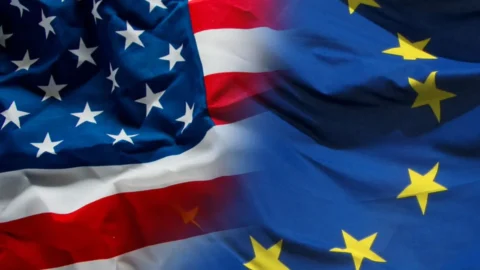
Il new trade agreement between European Union e United States It resembles a truce signed with reservations. Tariffs are set—almost everywhere—at 15%, but the game is far from over: crucial technical details, the definitive list of exempt products, and above all, a legally binding text are still missing. Brussels has made it clear: "Nothing is final until it's written." And the text could only arrive by August 1st, the date by which technical and political negotiations must begin to dot the i's.
Meanwhile, the US and EU versions of the story are contradictory. Washington talks about a European ban on digital taxes (goodbye Web Tax?), but Brussels denies this: "The decision is ours." Confusion also reigns over steel, pharmaceuticals, and chips: between those who consider them exempt and those who already subject them to duties, there are still significant gray areas.
Meanwhile, the Italian companies They're doing the math. With €65 billion in annual exports to the US, our country is at serious risk: Confindustria estimates losses of up to 22 billion euros, also due to the unfavorable exchange rate. Centromarca, which represents 193 consumer goods companies, estimates a €767 million impact on food and non-food alone. For now, judgment is pending: some call it a "lesser evil," others a "missed opportunity."
Reactions to the US-EU agreement on tariffs
While Washington celebrates a "colossal agreement," the Old Continent is divided between those who defend the line and those who cry surrender. In Brussels, they're trying to hold their ground: "It's the best possible," says the European Trade Commissioner. maros Sefcovic, recalling that "we started from 30%". A reading that, however, does not convince many European capitals. Starting with Paris, where the Prime Minister François Bayrou He spoke bluntly of a "dark day" for Europe, which would have "submitted" to Trump. The German Chancellor was also critical. Friedrich Merz, which warns of "considerable damage" to the German economy. The Belgian Bart DeWever he comments: “a moment of relief, but not of celebration.”
More diplomatic tones come from Madrid, where the Foreign Minister Jose Manuel Albares stresses that the agreement "avoids a tariff escalation," but awaits a "more detailed analysis." As did the Prime Minister Giorgia Meloni who welcomed the agreement, while underlining that "there is still a fight to be made" to defend Italian and European interests.
Then there are the hints of sarcasm, like that of the Hungarian Prime Minister Viktor Orbán, who jokes: “Trump ate Von der Leyen for breakfast.”
Read EVEN Tariffs: Is it an agreement or a surrender to Trump?
US-EU Agreement: Products subject to 15% tariff
The agreement provides for a 15% tax rate on most European exports to the US. Among the main sectors:
- Cars and componentsAfter months at 27,5%, the duty drops to 15%, a significant result for German producers, but still penalizing compared to the past.
- Semiconductors and electronic equipment: included in theory, but some critical components may be excluded.
- Pharmaceutical: most products fall within the 15%.
- Machines industrial: excluding those related to chips, which enjoy selective exemptions.
- Standard chemicals: resins, solvents and industrial additives included.
- Plastic, rubber e metals non-ferrous: included in the list, but in a smaller number than in the initial drafts.
Duties-free products: a "zero for zero" agreement
Will duty-free on both sides of the Atlantic, thanks to the mechanism “zero for zero”, applied to products considered strategic or to closely integrated transatlantic supply chains:
- Some chemicals: especially those used in electronics, aerospace, and green tech.
- Semiconductor manufacturing equipment: exempt to avoid hindering joint investment in the Chip Act and the digital transition.
- Non-sensitive agricultural products: some types of dried fruit, legumes, aromatic herbs, fermented dairy products, sweet wine.
- Critical raw materials functional to green technologies and the chip industry: graphite, rare earths, lithium, gallium, tungsten.
- Natural resources: some categories such as silica sand, deionized water, carbon dioxide for industrial use.
- Aircraft and spare parts: given the interdependence of the Airbus-Boeing chains, the sector is completely exempt.
At the same time, the EU will open its market to approximately 70 billion euros of US imports, eliminating tariffs on products such as soy, nuts, fish, and pet food.
Excluded categories: steel, alcohol and meat
Not everything is defined: some crucial categories immense have been again including neither in the 15% rate nor among the exempt ones, and will be the subject of specific negotiations:
- Steel and aluminum: remain subject to US tariffs of up to 50%. Brussels is proposing a quota system, but negotiations are complex.
- WINE, alcohol, beerThe EU is seeking inclusion in the "zero for zero" regime, also supported by American producers. For now, they remain subject to variable tariffs.
The most sensitive categories, such as beef, sugar, ethanol, rice, and poultry from the United States, remain excluded from this liberalization. The EU still maintains protective tariffs on these products, given the risk of agricultural market imbalances and political sensitivities.
Ambiguity in the agreement: energy and weapons
The trade agreement between the EU and the US goes beyond tariffs, including an important energy pact which commits the EU to significantly increase imports of oil, liquefied natural gas (LNG) and coal from the US, with a target of 250 billion dollars per year for three years. However, the goal appears more political than realistic: Current US exports account for less than half. One official admitted that there is no government constraint or centralized control to ensure this flow.
The same goes for the $600 billion of European industrial investments promised in the US: these are intentions gathered among companies, not formal commitments as in the case of the US-Japan agreement. EU institutions can only facilitate, not direct.
On the military front, however, the negotiations on tariffs do not officially include the purchase of US armamentsBrussels defines this issue as a general "expectation" to increase defense spending in Europe, consistent with NATO's target of 2% of GDP and the agreed-upon increase to 5%. Washington, on the other hand, considers the purchase of American military equipment an integral part of the agreement.
Other unresolved issues: should the Web Tax be stopped?
The knots to be unraveled in the agreement remain numerous and complex. Among the most controversial points, the US claims that the EU has decided "neither to adopt nor maintain network usage tariffs", thus obtaining a sort of stop to the Web TaxBut this statement is missing from the EU declaration and is denial From a European spokesperson: Brussels “will not change our rules and our right to regulate independently in the digital space.”
On the front agri-foodThe US is pushing to simplify health certificates, but Brussels only talks about "mutual recognition" and guarantees: "no changes to the EU's food, health and safety systems," says spokesman Olof Gill.steelThe EU proposes quotas to reduce duties by 50%, but Washington maintains unchanged tariffs on steel, aluminum, and copper. Differences also exist on semiconductors e pharmaceuticalsFor Brussels, the 15% tariffs are hypothetical; for the US, they will start as early as August. The agreement is still being finalized.
Italy and US tariffs: which sectors are most at risk (and which are not)
'SItaly, the third largest manufacturing exporter in Europe and the leader in several segments of the mechanical and agri-food sectors, the consequences will be tangible. Not catastrophic, but selective. Confindustria and trade associations have already launched the first alarmsSome sectors risk a net loss of competitiveness, while others benefit from exemptions. Let's see. the impact sector by sector.
In 2023 l'Italian export of cars and components Imports to the US exceeded €8,5 billion. The tariff, previously 27,5%, was reduced to 15%, an improvement that still weighs heavily on high-end products like Maserati, Ferrari, and Alfa Romeo. Anfia recognizes the benefits of the reduction, but emphasizes that 15% remains an obstacle for a high-value-added sector. Stellantis forecasts a tariff impact of 1,5 billion in 2025, with effects already evident in first semester.
With 12 billion in annual exports, the sector Italian machinery It risks a blow: the 15% duty, even with possible exemptions, could cause orders to drop by up to 3% in 2025, according to Ucimu, especially for durable goods and automation.
Exports in 2023 pharmaceuticals Italian imports to the United States have exceeded €11 billion. Some products, such as generics and strategic medicines, may be exempt, but others will fall below the 15% rate. According to Farmindustria, the impact remains uncertain: the fear is a loss of competitiveness on key active ingredients.
La precision mechanics Italian manufacturing, with over €9 billion in exports to the United States, will face a 15% tariff. The impact, according to Confindustria Meccanica Varia, will be medium to high: those most at risk are components that are not included in American "integrated" systems, where Made in Italy is recognized for its quality but often penalized for its costs.
The Italian agri-food It is among the sectors most exposed to the new 15% US tariffs, with exports to the United States exceeding 2023 billion euros in 6,4, of which over 2,1 billion euros in wineThe wine sector is among the hardest hit: according to the Italian Wine Union, losses could reach €317 million over the next 12 months, rising to €460 million if the dollar depreciates. Brunello di Montalcino, a symbol of Made in Italy in the US, is also at risk, accounting for 30% of the denomination's exports. "With these tariffs, it will be difficult to reallocate unsold bottles elsewhere in the short term," warns Giacomo Bartolommei, president of the Consortium. Pasta, oil, cheese and wine – still excluded from the “zero for zero” regime – risk a drop in exports of between 10 and 15%, according to Coldiretti and Federvini.
The sector chemist Italy, with 5 billion in exports to the US, will suffer a variable impact: according to Federchimica, "it will be necessary to evaluate each sector individually: fine and specialty chemicals are often exempt, but basic chemicals could be affected by the 15% duty."
The sector is most penalised wood-furniture (4,5 billion in exports), where 15% could cause a loss of competitiveness, especially for mid-range products. Assarredo and FederlegnoArredo have already estimated a drop of between 10 and 20% in exports to the USA. The situation is even worse forsteelWith US tariffs stuck at 50% and no agreement on quotas, the sector – Eurofer denounces – has been ignored, even pushing Italy to ask Brussels for extraordinary countermeasures.