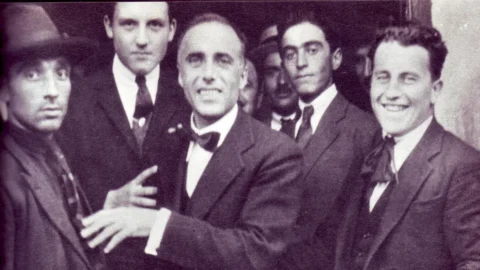
The anniversary of the assassination of Giacomo Matteotti it must be an opportunity to remember the man without building a holy picture of him to venerate because his greatness is found in his life and not in his death. Giacomo Matteotti was a victim of fascism, like Giuseppe di Vagno, Don Giuseppe Minzoni and many others in a civil war fought with unequal weapons against the organized military force of a faction, tolerated and often aided by the betrayal of the institutions at every level. The causes, complicities and errors committed by the democratic forces and the Vatican that led to the collapse of democracy in Italy in the post-war period are quite well known. Precisely for this reason a figure like Giacomo Matteotti, who understood the nature of fascism and its reality well in advance threat to democracy, deserves to be shown as an example to the new generations.
Read also: Matteotti, one hundred years after the fascist assassination: "A civil hero who today is also a warning for the left". Talk Concetto Vecchio
Matteotti's life was varied and busy
In its life he was a municipal administrator, a laborers' unionist and then the leader of the Chamber of Labor of Ferrara, a jurist of great value despite renouncing a university professorship, a socialist political leader, and finally a parliamentarian. In October 1922, expelled by the maximalist majority of the PSI together with Turati and the other reformists, he gave life to the Unity Socialist Party of which he was elected secretary. Endowed with a strong conviction of the need to give life to a profound social revolution without resorting to the "dictatorship of the proletariat", he addressed the more concrete issues such as education and housing for the poorest classes which in his Polesine constituted an example of backwardness and shocking poverty. He was a bourgeois who could live on an income but he betrayed his social class and deserved the accusation of a "furred socialist" by placing himself at the service of the proletariat of his time with rare dedication and professionalism.
Matteotti: an authoritative voice in the political arena
He approached every problem with great seriousness and analytical skills with the aim of offering useful, even if partial, solutions. The in-depth analysis of the issues on the table gave credibility to his initiatives and reliability in the results. In his work he had a very high sense of responsibility for what he said and did. His strictness and its activism tireless they procured him quite a few hostility, even within his party. Not only his writings but also his speeches in the Chamber of Deputies were carefully prepared and punctually documented. His speeches were those of an opponent who proposed himself as a government alternative, much more insidious for the power than those of the preachers of the revolution who stoked fear among the bourgeoisie and played into the hands of their adversaries without realizing it. Not excluded a priori the violence but he rejected the maximalist line which preached violent action as an end and not as a means. He said that “We are for the class struggle, not for the class war”.
If he was convinced of something he was consistently consistent with it and assumed every one of it risk. He personally paid for his firm hostility to the war when he arrived in 1916 Provincial Council of Rovigo to call for the use of all possible weapons, including an outbreak of violence, to stop the world conflict. He was considered a kind of conscientious objector ante litteram and when he was called to arms, he underwent a sort of military confinement in Sicily. This didn't stop him from taking the distances from Turati and by the other reformists who after Caporetto sided with the Italian soldiers and in defense of their homeland. He defined himself as "reformist because revolutionary" and indicated for socialism the path of municipal administrations and peasant and workers' leagues as an alternative to that of the Soviets. He claimed the autonomy of local administrations and understood the need for one Union between the States of Europe.
Matteotti's rebellion: the transformation of the PSI and the fight against fascism
In his speech at PSI congress in Milan in October 1921, a year before his expulsion from the party, Matteotti intervened on the "tendencies", as the party currents were called at the time. The maximalists excluded the hypothesis of any "transigence", any agreement between the socialists and the "bourgeois" parties, even more so a participation of the PSI in the government. In reality, the hypothesis of building a government majority with was under discussion Giolitti for defeat fascism on a parliamentary democratic level, the only possible way to cut Mussolini's way. Matteotti asks the majority to "admit transigence perhaps never to use it, participation in power perhaps never to use it" but in front of the barrage of absolute intransigents, whose lack of any concrete program he denounces, he becomes caustic: "You speak ill of the Socialist Parliamentary Group which does not dish out socialism and revolution every day, but to which you then write asking by letter for the lowest, most useless and least decent services". The report records “very lively and prolonged applause” from the delegates.
In his speech Matteotti warns the majority underlining that the feared expulsion of the reformists will only produce two or more weak and useless socialist parties, incapable of stopping fascism which has already created a terrible situation in some territories to which the party is unable to give any response. Matteotti says he heard one of the party's best leaders say: "Yes, comrades, things are quite better because we don't die as frequently as before, but we don't die anymore because we don't live anymore." Matteotti underlines that the scorched earth around the leagues is not an isolated phenomenon but risks spreading to the whole country in the most dangerous form and it is necessary to worry about it while there is time by immediately discussing within the party, "without idle talk and useless threats", which way choose between institutional violence and violence.
Matteotti: the inconvenient democrat
That Giacomo Matteotti was one of the most determined and feared opponents of fascism is beyond question and this is the reason why he is fully considered the symbol SCTI is recognized of anti-fascism. But Matteotti was not just the anti-fascist, he was above all the Democrat, a title that doesn't come from simply being anti-fascist. In his capacity as secretary of the PSU he responded through "La Giustizia", the PSU newspaper, to a proposal from the Communist Party which, in view of May 1924st 25, proclaimed a general strike and invited the PSI and the PSU to joint initiatives. The language is sharp. According to Matteotti, the communist party's proposals are formulated only for polemical purposes, which "can create pleasure and advantage for you, as well as for the dominant fascist government with the same methods of dictatorship and violence that you hope for. Let us each remain what we are: You are communists due to the dictatorship and the method of violence against minorities; we are socialists and for the democratic method of free majorities. There is therefore nothing in common between us and you." On May 1924, XNUMX in his last article on "La Giustizia", Giacomo Matteotti takes inspiration from the refusal of the PSI leadership group to accept the proposal for unity between the two socialist parties, the PSI and the PSU, which had been put forward by Matteotti's party who underlines: "I have always seen a substantial identity among all socialists and a clear antithesis only with communism”.
Matteotti, an inconvenient democratic anti-fascist
Matteotti expresses a certain indignation in the face of the formal proposal of the maximalist leadership of a "rapprochement between Moscow and London for a common understanding" and to unitedly oppose a valid resistance reactionary forces and asks himself: “How? There is no possibility of union between unitarians and maximalists because the paths and concepts are, according to them, opposite and they propose nothing less than the union between Moscow and London, that is, between the socialist and communist Internationals, of which yes, truly and recognition of all, are the methods opposite and incompatible? “And he concludes: “We must have clear ideas on the way forward, misunderstandings are not allowed.” For the secretary of the PSU it is no longer enough to repeat that we are intransigent.” We have to do it: either here or there! Either with socialism or with communism. With equivocal maximalism nothing is concluded." Finally, the last consideration: “Workers can no longer avoid thinking and deciding. Freedom and socialism do not rain from above. We must conquer them, marching together against the adversary and breaking the misunderstanding that prevents the march." This was Giacomo Matteotti, a inconvenient democratic anti-fascist who must be known for his entire, albeit short, life. It certainly may not be shared or even criticized (he wouldn't mind that much) but he has the right to be freely judged for what he was, for his principles, for what he said and did.