Eighty years ago, at 8:15 in the morning, the Hiroshima sky it was pierced by a white light more intense than the sun. An entire city dissolved in a few moments. The the world entered the atomic age. The bomb dropped by the United States That August 6, 1945 was not just an act of war. It was a point of no returnHiroshima and, three days later, Nagasaki changed the destiny of humanity forever.
That collective trauma generated not only death and rubble, but also a culture of memory. From the first Godzilla, born as a metaphor for nuclear terror, in films, songs, comics, the Hiroshima's silent cry has spanned decades and generations.
Today, between wars in Europe, expanding arsenals and threats that are once again becoming explicit, that memory is more relevant than everThe war in Ukraine has brought the nuclear specter back to the center of global debate. Russia is using the threat as a deterrent. The United States is responding with a strengthened military posture. China is accelerating the construction of its intercontinental missiles. the world is no longer divided into two blocs, but it is perhaps more unstable than ever.
Hiroshima, August 6, 1945, 8:15 a.m.: light, then nothing.
On August 6, 1945, the sky above Hiroshima was clear, then a flash of lightning. From Enola Gay bomber it was dropped Little Boy, the first atomic bomb never used in war. It exploded at 580 meters with the force of 16.000 tons of TNT. In a few seconds, the city turned into a giant bonfire.
Circa 80.000 people died instantly. By the end of the year, the casualties had risen to 140.000 (and the trail of death continued for years, between diseases, tumors, radiation). The temperature at the center of the explosion exceeded 4.000 °C. The shadows of people fixed themselves on the asphalt. Hiroshima was annihilated: 90% of the buildings destroyed, 51 temples obliterated, entire neighborhoods reduced to dust.
The survivors – the hibakusha – they walked like ghosts. Burned, mute, their skin in tatters. Hiroshima was no longer a cityIt was a scar etched into the flesh of humanity.
Why was Hiroshima hit?
The the main objective was not only military. Hiroshima was hit to break, once and for all, theat the will of resistance of Imperial JapanThe war between the United States and Japan had become a dead-end conflict. After years of fierce fighting in the Pacific, the Japanese continued to oppose, rejecting any suggestion of surrender. Each island retaken by the Allies had cost tens of thousands of lives. The invasion of Japan, scheduled for autumn, promised millions of deathsWashington wanted to avoid a massacre and send a clear signal. The atomic bomb was that signal: new, absolute, definitive.
But Hiroshima it was also chosen for another reason, more cynical and scientific: it was a city still intact, never hit by bombing. Perfect for accurately observing the effects of the new weapon, never used before in war. There were three American aircraft in flight: theEnola gay, which was carrying the explosive device The Great Artist, responsible for collecting scientific data and Necessary Evil – the “necessary evil” – to photographically document the explosion.
Il The intended target was Kokura. But that morning the sky was overcastThe crew was forced to turn around. At 8:14 and 45 seconds, Little Boy was dropped on Hiroshima. After 43 seconds, it exploded. The bomb worked. The mission was accomplishedIt was hell on earth.
Tamiko Sora, three years old, was just over a kilometer from the epicenter. "When we left the shelter," he said, "Hiroshima had disappeared. The mountains, which had previously seemed distant, now seemed upon us." Father Pedro Arrupe, a Jesuit missionary, wrote: “I will never forget those girls dragging themselves along, burning alive. We prayed. There was nothing else to do.”
Ninoshima, the island of the dying
The massacre did not end with the explosion. South of Hiroshima, on the rural island of Ninoshima, start another chapter of the tragedy: that of despair. The Hundreds of dying survivors were transported From small military vessels, often crewed by suicide missions. They arrived with their faces unrecognizable, their skin peeling off, their clothes melted into their flesh. The island's field hospital was set up as a last resort, but it could do little. The care was minimal, water was scarce, doctors were few.
Only a few hundred managed to surviveThe others died amidst screams, silence, and delirium. The bodies were buried in mass graves, hastily and chaotically. No one recorded the names. No one cried anymore..
Decades later, Ninoshima is still a land of unfinished memory. The researchers dig for remainsBone fragments, jawbones, small skulls. One day, even a baby's jaw was found, with its teeth still intact. "If we don't honor them, for them the war is never over," he said. Rebun Kayo, archaeologist at Hiroshima University.
But death did not remain confined to August 6thIt continued for years, silent and slow. Radiation continued to kill, in the form of infections, leukemia, and tumors. Many hibakusha survived the explosion, but not its legacy.
To understand the long-term effects of the bomb, the Radiation Effects Research Foundation, (Rerf), established in 1950 to study the health consequences of nuclear attack, has followed over 120.000 people since 1950, including survivors, controls and descendants.
Among the monitored hibakusha, approximately 10.800 deaths from cancer, Of which 500-600 directly attributed to radiation exposureA limited percentage – around 5% – but scientifically unequivocal.
The forms most closely related to the explosion are the leukemia, appeared in the early years, and various solid tumors: thyroid, lungs, breasts, stomach, colon, liver.
Nagasaki: the horror replica
The nuclear horror did not stop at Hiroshima. It was repeated, as a warning and an ultimatum. And so the August 9, 1945, three days after the first bomb, the same fate befell Nagasaki. Again, the initial target was kokura, but clouds and smoke from the incendiary bombs of the previous days forced the crew to divert.
there 11:02, Fat man, a plutonium device more powerful than Little Boy, exploded over a narrow valley between the hills. Another 74.000 people died.A city erased in an instant.
Why strike again, and so soon? Washington wanted to push Japan to surrender without conditions, also discouraging the Soviet Union's possible entry into the Pacific War. A second attack – close and more destructive – served to demonstrate that the United States they had other bombs and the will to use them.
Il August 15th, Emperor Hirohito announced Japan's surrender. World War II was over. But theatomic age it had just begun.
The Cold War and the Balance of Terror
With Hiroshima and Nagasaki, the atomic bomb left the scientific laboratories and became an instrument of geopolitical power. The world was never the same again. A new military doctrine was born: the Mutually Assured Destruction (MAD), the mutually assured destruction. A concept as simple as it is frightening: if two nuclear powers attacked each other, there would be no winner. Only total annihilation.
It was this paradox that to maintain the balance of the world for the whole Cold WarThe bomb was never used again in war, but remained at the heart of the global strategy, brandished as the ultimate deterrent.
The United States led 1.054 nuclear tests, Of which 278 in the atmosphere, and in 1966 they reached their peak: 32.000 warheads in their arsenals. Today, they possess 5.044, Of which 1.770 operationalRussia is no exception: 5.580 warheads, with 1.710 ready to use. Then comes China (500), France (290), United Kingdom (225), followed by India, Pakistan, Israel and North Korea.
According to the Sipri Yearbook, in 2024 were present in the world 12.121 nuclear warheads, Of which 2.100 on immediate alert. Ready to be launched in a few minutes.
The nuclear bomb today: the returning threat
For decades, the fear of nuclear apocalypse seemed like a distant memory of the twentieth century. But today that threat has returnedSilent, but more concrete than ever.
The war in Ukraine he broke a taboo: Russia has explicitly called for the use of tactical nuclear weapons. Not only as a deterrent, but as possible operational tool in a conventional war scenario. Moscow It also transferred warheads to Belarus, breaking with decades of balance. United States, for their part, have strengthened their nuclear posture in Europe and the Pacific. They speak of "integrated deterrence," but behind the formulas there is a real fear of an escalation.
Meanwhile the China is rapidly expanding its arsenal. Once limited to a few hundred warheads, today – according to estimates – it aims to have over 1.000 warheads by 2030For Beijing, the bomb is no longer just a “defensive shield,” but part of a global power strategy.
India and Pakistan, historically in tension, continue to modernize their respective programs. North Korea has increased missile tests and openly threatens its neighbors. Iran, despite years of negotiations and the recent Israeli attack, seems to continue with a program ambiguous and unstable, suspended between ambition and risk. And then there is Israel, which continues to maintain its traditional “strategic ambiguity”: neither confirms nor denies, but according to estimates it has at least 80 operational warheads.
Il Nuclear Non-Proliferation Treaty (NPT), signed in 1968, appears today emptied of effectivenessIt's ignored, evaded, or considered obsolete by many emerging players. No one seems willing to trust it anymore.
Meanwhile, the new nuclear warheads they are more powerful, more mobile, more precise. Decisions are played in minutes, the margin of error has been drastically reduced. The risk of accidents, cyber attacks, strategic misunderstandings. Like the Cuban Missile Crisis in 1962, but without red lines, red telephones, or clear blockades. The world is no longer divided in two. It is multipolar, fragmented, unstable. And the bomb is again at the center of history.
Hiroshima, today: memory and awareness
Only country to have suffered a nuclear attack in war, Japan ha transformed trauma into civic commitmentHiroshima and Nagasaki are not only places of memory but have become living symbols of a universal message against nuclear war.
Over the decades, Japan has made nuclear pacifism their own flag. The battle has been long and often silent, but constant: in international forums, in schools, in public commemorations. And above all through the voices of the hibakushaThe survivors. Ever older, ever rarer, but still heard.
In 2024, their commitment has received the highest recognition with the Nobel Peace Prize which was assigned to the Nihon Hidankyo, the association that brings together hibakusha. Their testimonies – given over decades throughout the world – are today considered World Heritage Site.
"We must convey the spirit of Hiroshima to young people. Not out of hatred, but for peace," declared the mayor. Kazumi Matsui, who for years has led the city in promoting remembrance as a tool for disarmament. "As the first city to experience nuclear devastation," he added, "we intend to share this spirit and promote awareness of peace, starting with the education of the youngest."
'S80 anniversary of the bombing, representatives of 120 CountriesFor the first time there will also be Palestine e Taiwan. China, Pakistan and North Korea will be absent. The United States will officially participate in both commemorative ceremonies. The Russia could be present: a symbolic gesture, if confirmed, in times of deep diplomatic rift.
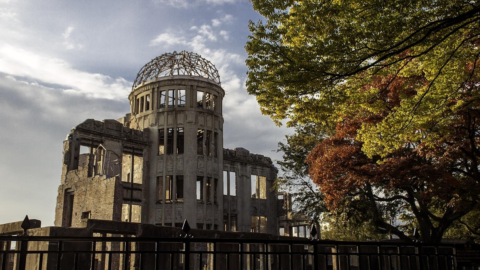
Il heart of memory stay the Genbaku Dome, the only structure left standing near the epicenter. Today it is world monument recognized by UNESCO, visited every year by millions of people. Not far away, the Museum of Peace It welcomes schoolchildren, heads of state, activists, and ordinary citizens. Hiroshima continues to tell its story. And to ask the world not to forget.
Culture, cinema and songs: Hiroshima survives in the story
Hiroshima did not remain alone in history. It has crossed time entering the language of culture, turning into memory alive, reworked, transmitted, told. The explosion not only destroyed a city, but generated an echo that still resonates today in cinema, music, comics, books, video games.
In 1954, in a still shocked Japan, was born Godzilla. The mutant creature, generated by radiation, became a living metaphor of atomic terror, the symbol of fear that Japan carried imprinted in its flesh and soul. In Europe, it was the director Alain Resnais who told the intimacy of the trauma with Hiroshima mon amour, a film that mixed memory and poetry, love and pain.
Il cinema giapponese he never stopped returning to that wound. From Black rain a Rhapsody in August of Kurosawa, up to Fat Man and Little Boy. In the United States, more recently, Christopher Nolan's Oppenheimer He brought the scientist and the genesis of the bomb back to the forefront, recounting its moral and political weight even when the explosion remains off-screen. The same thing happened in the world of animation. Gen of Hiroshima, A tomb for the fireflies of Studio Ghibli, In this corner of the world: three works that have the tragedy was told through the eyes of children, showing the disaster not through emphasis, but in the everyday sweetness swept away in an instant.
Even the music picked up the echo of the explosionIn 1980 OMD released Enola gay, one of the most iconic songs of post-nuclear pacifism. Iron Maiden talked about the atomic bomb in Brighter than a thousand sun, while the Polish composer Krzysztof Penderecki composed the Threnody for the victims of Hiroshima, a cry of pain transformed into a score. From Yoko Ono to Paul McCartney, from Rush to the Nomads, to U2, many artists have left their mark, helping to keep the story alive.
La story of Sadako Sasaki, the little girl who he folded paper cranes to survive, has become a global symbol of hope and peace. Today, millions of students all over the world they repeat that gesture, in his name.
And even where you least expect it, Hiroshima is present. In video games including Fallout o Call of DutyThe bomb is not just a tool, but a constant shadow. A silent threat that continues to loom.
The nuclear nightmare was born that morning of August 6, 1945. And he has never died since. If there is a lesson that time has not erased, is that when man uses the absolute weapon, not only a city dies. A part of humanity dies.
Mattarella: "Nuclear power in conflict is a crime against humanity."
“The eightieth anniversary of the tragic atomic bombing of Hiroshima, followed three days later by the one on Nagasaki, marked the experience of an apocalyptic event.” The President of the Republic said this morning, Sergio Mattarella. “Those tragic events, the manifold suffering endured in the years that followed by the survivors, remain a warning to humanity that cannot be forgotten. The annihilation of humanity is the prospect that the use of nuclear power has placed before us all. Today we must forcefully reiterate that the use or even the mere concrete threat of introducing nuclear weapons into conflict appears to be a crime against humanityThe global architecture of disarmament and the non-proliferation of nuclear weapons, one of the cornerstones of the multilateral system painstakingly built after the Second World War, cannot be abandoned."