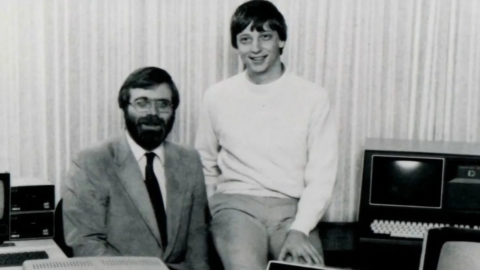
Il 4 April 1975, to Albuquerque, two young visionaries, Bill Gates e Paul Allen, founded what would become one of the most influential technology companies on the planet: ecosystem. Their goal was as simple as it was ambitious: making computers accessible to everyone. At the time, computers were bulky, expensive, and reserved for laboratories and large companies. Gates and Allen dreamed of turning them into tools that anyone could use, not just experts.
The intuition was born from Paul Allen, who reading an article on Popular Electronics dedicated to Altair 8800 microcomputer, understood that the world of computing was about to change radically. Together with Gates, he immediately set to work to develop a programming language that could support this new machine. Thus was born Microsoft Basic, the first step towards creating a company destined to rewrite the history of technology. From that moment, an unstoppable rise began.
Today, fifty years later, ecosystem is one of the most powerful and influential multinationals in the world. Headquartered in Redmond, in the state of Washington, employs over 220mila people in more than 190 countries. Its market capitalization, which at 2 April 2025 exceeds i 2,84 trillion dollars, makes it the second largest company in the world, immediately after Apple . Its products and services – from Windows to the suite Office, from Azure cloud to the devices Surface and at the console Xbox – are present on billions of devices all over the planet.
To maintain its leading position in recent years, the company is strongly focusing onartificial intelligence. The multi-billion dollar investment in OpenAI – the company behind ChatGPT – is reshaping the future of technology. But how did it get here? Here his story.
Curiosity: The name Microsoft comes from fusion di Microcomputer e Software, an idea of Paul Allen. Originally written as Micro-Soft, the hyphen was dropped in 1981, but the name remained unchanged.
First Steps: The Language That Spoke to Computers
In 1975, Microsoft – at the time still Micro Soft – made his first big move, developing a version of the programming language Basic for Altair 8800 microcomputer, produced by Micro Instrumentation and Telemetry Systems (Mits). Bill Gates and Paul Allen were able to demonstrate that their software was perfectly compatible with the device, starting a collaboration that marked the beginning of the history of Microsoft.
When the Basic worked correctly on the Altair, the Mits decided to distribute it, marking the first major success of the fledgling company. From that moment on, Gates and Allen began working full time on their vision: to develop software that would make computers accessible to everyone.
The world of computing was evolving rapidly and Microsoft quickly established itself as a growing reality. In 1976, Paul Allen finally left his job in Boston to dedicate himself to the company, while Bill Gates Dropped Out of Harvard (getting a degree honoris causa subsequently) to pursue the dream of building a software empire.
Curiosity: In the early years, Gates and Allen worked tirelessly in their small first office in Albuquerque, feeding almost exclusively on pizza and coca-cola. It is said that this programming lifestyle was their only source of energy during the long nights of development.
The stroke of genius: Ms-Dos and the alliance with IBM
In 1980, Microsoft made a strategic choice that would change its destiny forever. IBM, the computer giant, was looking for an operating system for its first personal computer and turned to Microsoft. From this collaboration was born MS-DOS, the software that revolutionized the entire industry.
Microsoft's winning intuition was to do not grant exclusivity to IBM, retaining the right to sell MS-DOS to other manufacturers as well. This move allowed the operating system to spread rapidly, making it the standard for PCs of the time.
Meanwhile, the company began its global expansion. Also in 1980, opened its first international office in Japan, with the name of AsciiMicrosoft, which would later become Microsoft Japan.
In 1982, Microsoft moved its headquarters to Bellevue, Washington, consolidating its growth. Expansion continued rapidly with the opening of offices around the world. In Italy, the company has been present since 1985, with a headquarters in Milan (today the Microsoft House) and another one to RomeIn the neighborhood EUR. Today, Microsoft Italy has approximately 860 employees.
Another fundamental step came in 1983, when Microsoft introduced the mouse as a tool for interacting with the computer, forever changing the way users used technology.
Curiosity: Ms-Dos was born from the purchase of the rights to another operating system, Qdos. Microsoft improved it and adapted it to its own needs, thus managing to enter the market with a ready-to-use product. A strategic move that proved to be a winning one, but which cost them a lawsuit over the years.
The Windows Era and Global Success
In 1985, Microsoft launched Windows 1.0, introducing the graphical user interface to personal computers and forever changing the way people interacted with technology. The early years were difficult, but in 1990 it arrived Windows 3.0, which marked the beginning of an extraordinary success. The real turning point, however, was 1995, with the launch of Windows 95, the operating system that definitively consolidated Microsoft's supremacy in the global market.
Windows 95 revolutionized the user experience with the Start menu and taskbar, becoming an icon of modern technology. The public responded enthusiastically: in just one year, over 40 million copies, an achievement that strengthened Microsoft's dominance. At the same time, the company continued to expand into the applications sector, with Microsoft Office (launched in 1989) which quickly became the standard for the corporate world.
In 1998, Microsoft released Windows 98, another success that further consolidated its dominance. The global diffusion of its operating systems allowed the company to impose its formats as standards in the computer industry.
But it wasn't just about operating systems: already in 1987, Microsoft had made a major acquisition, purchasing Forthought Inc., the company behind Power point, which would become one of the most widely used presentation tools in the world.
The expansion was unstoppable: Microsoft products were translated into 13 languages, including Arabic, Chinese, Hebrew, Japanese and Korean. Windows 3.0 dominated the market, selling over 4 million copies in the first year e 6 million in the second. At his 15 anniversary, Microsoft became the first PC software company to surpass $1 billion in annual sales.
In 1994, during the COMDEX, Bill Gates he uttered a sentence that would become historic:
"Information at your fingertips.” Meanwhile, Microsoft was strengthening its global presence: it reorganized its international operations, dividing Europe into three regions and the rest of the world into four, while the number of employees abroad rose to 2.866.
Curiosity: The launch of Windows 95 was accompanied by a $300 million advertising campaign, with the famous soundtrack “Start me up" by Rolling Stones, which immediately became an anthem of the digital age.
The advent of the internet and the challenge of browsers
In the 90s, Microsoft faced a new technological revolution: Internet. In 1995, to respond to the growing popularity of the network, he launched Internet Explorer, challenging Netscape and managing to establish itself as the most used browser, thanks also to its direct integration into Windows. A winning strategy, but not without consequences: the antitrust authority and competitors accused Microsoft of abuse of dominant position. Although the company managed to avoid dismemberment, the long process marked a difficult time and left room for new players, such as Apple and Google, which in the following years would redefine technological innovation.
Despite the legal disputes, Microsoft continued to expand and innovate. In 2001, it entered the gaming world with the Xbox and also tried the mobile telephony route with Windows Phone, which however turned out to be a flop.
The company's aggressive business strategies have repeatedly come under fire. Some internal documents, known as “Halloween Documents” (1998), revealed his strategy to counter the software Open Source and open standards like theopen document format, sparking strong criticism from the technology community.
2001 is another turning point: it is the year of the launch of Windows XP, one of its longest-running and most popular operating systems, which unified the main lines of Windows under a single code base. But 2001 is also the year that marks the company's entry into the video game console, challenging giants like Sony and Nintendo, with the release of the first Xbox.
Il June 27, 2008, another important chapter in Microsoft's history closed: Bill Gates Resigns as Chief Software Architect, while remaining honorary president and strategic advisor. His place was taken by Steve Ballmer, already CEO of the company since 2000, who led Microsoft through a complex transition phase.
Curiosity: The first Xbox should have been called “DirectX Box”, in homage to the APIs DirectX used in video games. The name was, however, shortened to make it more catchy and commercial.
The return as protagonist, acquisitions and focus on cloud
After years of unchallenged dominance, Microsoft had tofacing a transition phase complex. Therise of other big tech, in particular Google with its Chrome browser, marked the end of the Internet Explorer era, which was officially discontinued in 2022. But Microsoft has never backed down in the face of challenges.
To strengthen its position in various sectors, it has focused on strategic acquisitions of great impact. In 2011 it purchased Skype or Whatsapp for 8,5 billion dollars (which will be replaced by Teams in May 2025), in 2016 he detected LinkedIn for 26,2 billion, in 2018 it acquired GitHub – the reference platform for developers – for 7,5 billion, and in 2023 completed the acquisition of Activision Blizzard for 75,2 billion, entering forcefully into the gaming industry. Some of these moves were risky, but they helped make Microsoft an even stronger and more diversified company.
The real turning point, however, came in 2014 with the arrival of Satya Nadella as CEO. Nadella understood that the future of the company could no longer be based only on operating systems and traditional software, but had to focus on cloud services. So, Microsoft went all in on Azure, its cloud platform, which in just a few years has become one of the pillars of the sector, capable of competing directly with Amazon Web Services and Google Cloud.
Curiosity: Microsoft is not only a giant in the world of software and cloud services, but it also owns one of the largest collections of historical hardware, including all of its devices and software from 1975 to today.
Microsoft Today: Between AI and Quantum Computers
Under Satya Nadella, Microsoft has not only consolidated its leadership in the cloud, but has also accelerated in the field of artificial intelligence. The collaboration with OpenAI has led to the integration of AI technologies into its products, giving rise to Copilot, an intelligent assistant capable of supporting users in Microsoft 365, suggesting texts, analyzing data and automating repetitive tasks. The company has thus moved from a model based on the sale of software to an ecosystem of digital services in constant evolution.
But the Microsoft's future is not just in AI. Recently, he presented majorana, a quantum computer chip, named after Italian physicist Ettore Majorana, who promises a new computing revolution: “Our success depends on how we harness artificial intelligence to amplify human achievements and create positive change for society. Today’s innovations will define the next fifty years,” the company wrote.
For celebrate 50 years of activity, Microsoft has organized a special event on his campus, a chance to look back on its history and share its vision for the future of AI, with updates on Copilot and other upcoming innovations.
Today, Microsoft is one of the most influential companies in the world, with a market capitalization exceeding 2,84 trillion dollars. But its story is far from over. With the continued development of artificial intelligence, expansion into gaming and research into quantum computing, Microsoft is ready to dominate the future, just as it has done for the last fifty years.
From a small startup born in a garage to one of the big tech most powerful on the planet: Microsoft's story is the history of the evolution of computer science. And the future? With AI and quantum computing on the horizon, it looks like Microsoft has no intention of slowing down. If the first 50 years were revolutionary, the next could change the world even more profoundly.