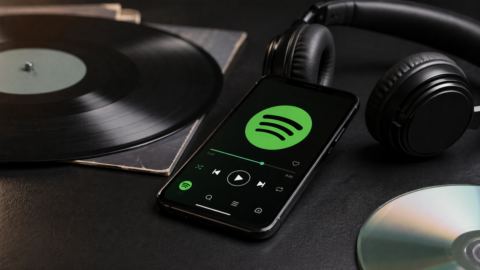
Twenty years ago, April 23, 2006, in Stockholm one of the most profound revolutions in the contemporary music industry was taking shape: Spotify. Since then that name has become synonymous with a change of era, marking the transition from owned music to accessible music at all times, from CDs and downloads to streaming as a daily experience. Founded by Daniel Ek and Martin Lorentzon, the platform has transformed the way we listen, discover and share songs, to gain a dominant position in the global digital audio market.
Twenty years after his birth, the USEFULL confirm the scale of the phenomenon. Spotify closed the fourth quarter of 2025 with record results and a significant strengthening of profitability, also supported by the boost from Wrapped and the evolution of its free offering. Monthly active users They reached 751 million, up 11% year-over-year and exceeding the group's own forecast of 745 million. In the quarter alone, users added 38 million, the highest number ever recorded by the company.
Spotify: An idea born in the most difficult moment for music
La Spotify's story begins In a very delicate moment for the music market, caught between piracy, the collapse of physical sales and the difficulty in finding a new business model. It is in this context that Ek, former CTO of Stardoll, and Lorentzon, co-founder of TradeDoubler, set up a platform capable of offering immediate access to a vast legal music catalogue, supported by subscriptions and advertising. The name itself, born from the union of “spot” and “identify”, recalls the initial idea of the platform: to instantly find the music to listen to.
Il service was launched publicly on October 10, 2008, initially with a structure that combined free, invitation-only accounts and paid plans open to all. The first few years were anything but straightforward, with initial losses, technical issues, security concerns, and constant adjustments to the offering. But the trajectory quickly changed, with deals with major labels, geographic expansion, growing user base, and a model that gradually won over the market.
From streaming as an alternative to streaming as a habit
The real the watershed is cultural even before it is industrialSpotify doesn't just distribute songs, but move the center of gravity of music consumption. The personal library leaves room for a nearly infinite catalog, accessible from computers, smartphones, consoles, and the web. Listening it no longer revolves around the purchased album, but to continuous discovery, playlists, thematic radio, algorithms and social sharing.
Over time, the platform has refined a double formula that has proven decisive, with a free version supported by advertising and a seamless Premium version, with higher audio quality and offline listening. This is where streaming stops being a novelty for enthusiasts and becomes mass consumption. It is no coincidence that Spotify, which began as a Swedish startup, has progressively expanded into Europe, the Americas, Oceania, Asia and other markets, until become the world's leading music streaming service.
Spotify: the milestones that marked the race
The construction of the giant passes through precise joints. The llaunch in the United States in July 2011 is one of the key moments, which came after lengthy negotiations with major record labels. At the same time, Spotify strengthened its identity as a platform not just for listening, but also for discovery, with personalized radio, integrated apps, social features, and a growing focus on collaborative playlists.
In 2013 the free service is extended more decisively to smartphones and tablets, accelerating the transition from desktop to mobile use. In the following years Spotify also entered the collective imagination with products like Wrapped, the annual campaign that transforms listening data into a personal narrative and a social phenomenon. Spotify it doesn't stop and expands beyond just music, including podcasts and other audio content, while the brand is also consolidating outside the app, as demonstrated by the multi-year agreement with Barcelona and the renaming of the Camp Nou.
Italy, Sanremo and an increasingly exported music
Spotify arrives in Italy on February 12, 2013, coinciding with the Sanremo Music Festival. This detail also clearly illustrates the platform's strategy: to enter markets by tapping into the great popular rituals of music. Since then, the service's influence in our country has grown structurally, to the point of becoming one of the central channels of the Italian music industry.
The latest data from the Loud & Clear report confirm a booming market. In 2025, royalties generated by Italian artists on Spotify they have exceeded 165 million euros, up 10% compared to 2024 and almost tripled compared to 2019. Around 40% of these royalties come from independent artists or labels, a sign that digital platforms have expanded access to the market even outside traditional channels.
What is particularly striking is the international pushOver 40% of Italian artists' royalties in 2025 came from listeners outside of Italy. And Italian remains one of the fastest-growing languages on Spotify. Royalties from Italian-language songs increased by 17% compared to 2024 and 46% compared to 2023. Yet the strength of the domestic market remains intact. In 2025, 82% of the songs in the Daily Top 50 Italy were by Italian artists, one of the highest figures in Europe.
Spotify, not just success: criticism and the issue of royalties
Spotify's success has never erased the critical on the most delicate topic of streaming, that of artists' remuneration, especially independent ones. Since the early years, musicians and labels have contested a model considered unbalanced, accusing the platform of guaranteeing too low compensation compared to listening volumes.
Over time, several have emerged symbolic cases, from protests by artists like Magnus Uggla to protests by independent labels and industry observers, who have questioned the economic sustainability of the system and the distribution of revenue between major and smaller labels. The economic criticisms have also been joined by those related to digital rights management.
Twenty years later, it remains one of the most controversial issues in the entire digital music economy: Spotify has expanded global access to music, but the debate over how value is redistributed along the supply chain remains ongoing.
Spotify, twenty years later
Twenty years after its foundation, Spotify remains the most obvious symbol of the transformation that has affected the music industryIt has changed the way we listen to, discover, and share music, rewriting the relationship between audiences, artists, and the market, and bringing streaming to the center of global consumption. At the same time, its growth has also accompanied the contradictions of the new digital economy, between ever-widening access, international pressure and a still open debate on how value is distributed along the supply chain.
Certainly, after April 23, 2006, the music world has never been the same. Listening has become instantaneous, mobile, shareable, measurable, and global. CDs have become niche, vinyl has returned as an object of identity, but everyday consumption now relies on streaming. And in this transformation, twenty years later, the name that continues to mark the times remains one: Spotify.