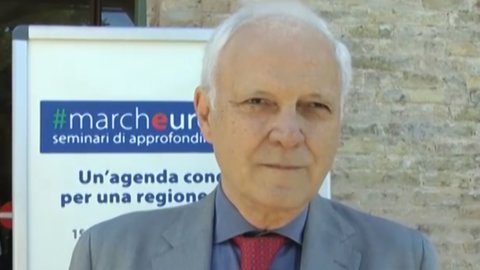
The book "A life as an economist”, published by Elective Affinities of Ancona, aims to bear witness to my life as an economist, as a university professor, for two reasons. The first is of autobiographical nature linked to advanced age which justifies the understandable desire to draw up financial statements, knowing that by now the most is accomplished. The second motivation, fueled by the passion for teaching, is of a didactic nature. It corresponds to the need to explain a profession, that of the economist, having noted that it is not clear to everyone what it consists of. As it was not clear to me when I came across this discipline by pure chance. After all, it's a common problem: few people know how the economy works. A fortiori the modern economy, with its intricate network of operators, markets, institutions that interact. The ritual phrase is "I don't understand anything about economics". Let alone if in rebound we understand what the economist is about. Even Giorgio Fuà, my teacher, admitted that he had always struggled to make his children understand what his job was. The two reasons correspond to two parts into which the book is divided.
The first part is a professional autobiography. I have the presumption that the extraordinary vicissitudes that led me from chemistry to economics, up to my university career, may interest the reader. In hindsight it surprises me with how much persistence, supported by luck, I found the courage to leave a stable job twice. First that of chemical expert, then that of economist of the Research Service of the Bank of Italy. Choices made to follow what today, half a century later, appear as two great vocations: that of economist and that of university professor. Two bets on starting careers all to be built, which then turned out to be successful. I believe, I hope, the courage to change by betting on one's own potential can be an example and encouragement for young people who are called to manage their own future. This is why I thought it appropriate to propose this initial part of my active life in the first two chapters.
It must be admitted that I also had so much luck. The good fortune of having had a family of origin which, even without a culture at the university level, supported me in the choice of continuing my studies. The luck of having had the support of my new family, a wife and two children, for the decision to leave the safe and very well-paid position of the Bank of Italy to gamble on a university career, which still needs to be built. The great fortune of having met Giorgio Fuà. A great master who influenced my choices from the first casual meeting as a student on the Political Economy exam, as I tell in the first chapter. Added to all this is the good fortune of having been able to have high-level experiences and meetings at the University of Oxford, at the Bank of Italy, at the Italian Society of Economists, as described in the third chapter. No less important was the good fortune of having been part of the group of Fuà's students, giving life to what became known as the Ancona Group, which together with colleagues from other disciplines of the Faculty of Economics, formed a scientific community with different but convergent, supported by esteem, fairness and friendship.
The university professor lives in close interaction with colleagues, in the field of research, with the students, on the teaching side, and with the company outside the university, in the so-called third mission. In research I had the good fortune to work in a working group of colleagues, with whom I shared the same scientific interests. Together we have obtained significant results published in leading national and international journals, especially in the banking and monetary field, which has been my major specialization. To give the group a recognizable point of reference and open to other collaborations, in 2007 we founded the Money and Finance Research Group (MoFiR) with Michele Fratianni and Alberto Zazzaro, which publishes a series of working papers online and has been organizing workshops on banking, attended by scholars of the evolution of the banking and financial system belonging to the main international research centres.
From students, to whom I "inflicted" thousands of hours of lessons, I received the greatest satisfaction in watching them grow and in feeling grateful and affirmed when I met them years later. I have always considered important the teacher-student virtuous circle according to which: "you teach what you know, you know what you study and research, you pass it on to the students and at the same time you learn by teaching", as I wrote in introduction to the text “Economics and monetary policy. In the labyrinth of finance”, which collects my lessons.
The second part of the book is an autobiography of ideas which help to clarify what I have dealt with in my life as an economist. Ideas that I have developed in research, in numerous conferences and above all in discussions with entrepreneurs, bankers and professionals who experience the economy concretely. It is no coincidence that the discipline is named Political Economy, with the adjective that underlines its political-social value. Even more so if we talk about macroeconomics, which studies the functioning of large aggregates (production, income, savings, investments, exports, imports, inflation, employment, etc.), the result of the choices of all operators (households, businesses , public sector, etc.). These are the reference quantities for the economic policy interventions (public spending, taxation, currency in circulation, etc.) that the government authorities implement to achieve collective well-being.
It was precisely in this area of economics that I concentrated my studies, with the specializations I will discuss later and above all in the second part of the book. As just said, I don't think it is right to consider the economist a technician, unless he limits his interests to the use of more sophisticated mathematical-statistical tools. The political economist must be aware of his role as a social scientist and must take note that the assessments obtained from his research have a political implication and as such are subject to critical scrutiny. Precisely in order not to be labeled a priori as a partisan economist, I have never joined a political party. The essential thing is to make oneself understood, even if this is not always achieved, especially by the politicians in office. Who ask for the economist's "technical" support, and then ignore his suggestions, especially if they don't coincide with their short-term objectives, linked to the recurring elections. Later I will tell about two emblematic episodes of the difficult communication I had with the world of active politics, as regards banks (beginning of eighth chapter) and regional planning (beginning of ninth chapter).
Economists who use abstract models based on convenient assumptions that are difficult to understand for non-experts (see chapter six) are also often to blame. Fuà has always recommended to us students, and he has shown it in his life, to always keep in touch with reality, trying to make himself understood with short writings and to present his ideas in a clear and simple way (see chapter four). To achieve this result, it is first of all necessary to have studied and understood what one wants to explain. You cannot do a good dissemination activity without a solid preparation.
I closed my career with one hundred and twenty essays, published in national and international scientific journals, several in English, and fourteen books, in the roles of editor, co-author and single author. This is part of the baggage that I have accumulated in my research activity and through which I have dialogued with the scientific community of reference. To make myself understood by non-academics, the general public, I have often engaged in conferences and published articles in newspapers. For all these reasons, in the second part of the book I have collected a selection of my posts public that I consider representative of the ideas I have developed in my life as an economist. I have called them business cards, because they are a synthetic presentation of memories, reflections and points of view, which I believe may still have a current validity. They are divided into chapters which do not follow a chronological order, but a common thread that tries to be clear and coherent.
Finally, to demonstrate that I have not limited the sphere of my interests only to the economy, I wanted to insert a digression with three articles on cycling, which has fueled my passion for sports since I was a boy. I've always thought that the way of conducting a bicycle race is not that far from the economy. Cyclists from different teams only complete a breakaway with hope of victory if they work together to avoid being caught up. Moreover, a solo cyclist hardly succeeds. Only at the end of the race do the runners from collaborators turn into competitors, who compete for victory. Only one wins: not always the best at the start, but the one who has been able to invest better in the distribution of their energies during the course of the race. Similarly, the collaboration-competition relationship is part of the economic strategy of companies. Especially small businesses, which alone can hardly keep up with the competition.