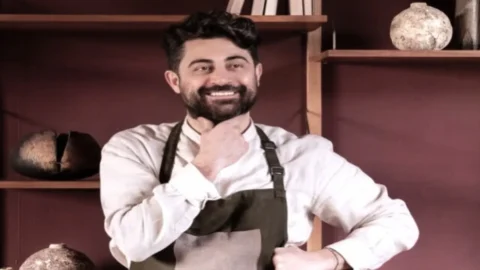
The news causes a sensation: the very true Rana family, after a profound restyling of the Oppeano restaurant in Valais, reopens its doors by entrusting its kitchen to Francesco Sodano, the chef of Somma Vesuviana who has linked his name to the legendary Capo d'Orso lighthouse of Maiori on the Amalfi coast where he landed in March 2019, winning the very prestigious Michelin star. “I am happy to have met Francesco Sodano – comments Gian Luca Rana – and to start a new path together, sharing ideas and projects. We work as a team, very close-knit, whose leadership I chose Francesco for his passionate, sensual and technical gastronomic note at the same time. The team is made up of many passionate, enthusiastic, talented young people, in love with the world of catering and interested in its evolution. Because this is my dream: to continue to create places and conditions to allow young people to flourish and express their full potential. The spirit of our restaurant, in fact, has never changed: to tell the poetic place in which we live and the extraordinary people who are its soul".
“I immediately recognized in Gian Luca Rana a great passion for the world of food and wine, combined with determination, curiosity and attention to detail. I perceived in him the spirit of great patrons, who give trust and the possibility of realizing dreams, voices and hands to share the fruit with the entire community – says chef Francesco Sodano – I received a warm welcome from him and the Rana family extraordinary and a unique freedom of expression. Together we will bring forward a new idea of cuisine in a special place."
The vision: to tell the story of the Veronese area with creativity, taste and technological research, combining it with the Campanian component of the chef
Francesco Sodano, born in 1988, belongs to what was the new wave of chefs of the New Mediterranean Cuisine, who have been able to shape a culinary philosophy between territorial/traditional roots and contamination made of which never aims to amaze but on the contrary to penetrate into the deepest of the gastronomic essence. Skills and techniques perfected in a long but profitable "wandering" in the kitchens of the big names of Italian and international catering starting from the collaboration with Oliver Glowig at the Aldrovandi Villa Borghese in Rome, then from the experience at the Oracle in Los Angeles, continued in the Londoners Galvin at Windows at the London Hilton Park Lane, Annabel's club in Mayfair, and Enoteca Turi (as well as an internship at Heston Blumenthal's Fat Duck), to return to Italy at Quattro Passi in Nerano with Antonio Melillo, today the only three Michelin star in the Southern Italy. Even if he then declares that the most important formative period was with the person he considers his true master, Anthony Genovese, of Il Pagliaccio in Rome.
The vision of the new Rana Family Restaurant led by Sodano is to tell the story of the territory, creativity, taste and technological research. A dimension that implies a new concept of hospitality, based on sensitivity, sharing and love for art in all its expressions, from the culinary to the visual. a place dedicated to storytelling, in which the stories of the people who gave life to the project are shared through a narrative that starts from the dish and the territory, which crosses countries and cultures, suggestions and travels, but which then focuses on the virtuous farm of Rana family, on an increasingly strong bond with the land, in an alternation of dishes which, if on the one hand look at the strong Neapolitan component of the chef, on the other involve the territory in an important way, including not only raw materials and suppliers , but also local culture.
A modern farm in the Feniletto Valley with an organic vegetable garden, farmyard animals and free-roaming horses
Surrounded by the countryside of the lower Veronese area, within the uncontaminated oasis of the Feniletto Valley, among hectares of forest and greenery, the restaurant is part of a vast property, a modern farm, which includes a tree-lined garden, a farmyard dedicated to courtyard animals, stables with horses that roam freely, an organic vegetable garden and an orchard where trees of ancient varieties forgotten by conventional agriculture have been planted. A deliberate choice developed to make the restaurant as sustainable and self-sufficient as possible.