The exhibition, open to the public from May 7, 2026 to March 22, 2027, was born from the encounter between the foundation's social mission and the participatory artistic practice that has characterized Senatore's work for years. The project focuses on themes such as inclusion, resilience, and the transformation of vulnerability into a collective resource, translating personal experiences into a shared narrative. The artist developed the work through a participatory process that involved families at risk of social exclusion, supported by The Human Safety Net and some NGOs active partners in Warsaw, Mestre, and Palermo. Writing, body movement, listening, and sharing have become tools for building a shared space for expression and imagination. The project engages directly with A world of potential, the permanent interactive exhibition curated by Orna Cohen and designed by Studio Migliore+Servetto. While the permanent exhibition guides visitors through the discovery of their strengths through multimedia installations, We Rise by Lifting Others It represents an artistic and profoundly human translation, made of shared stories, words and imagery.
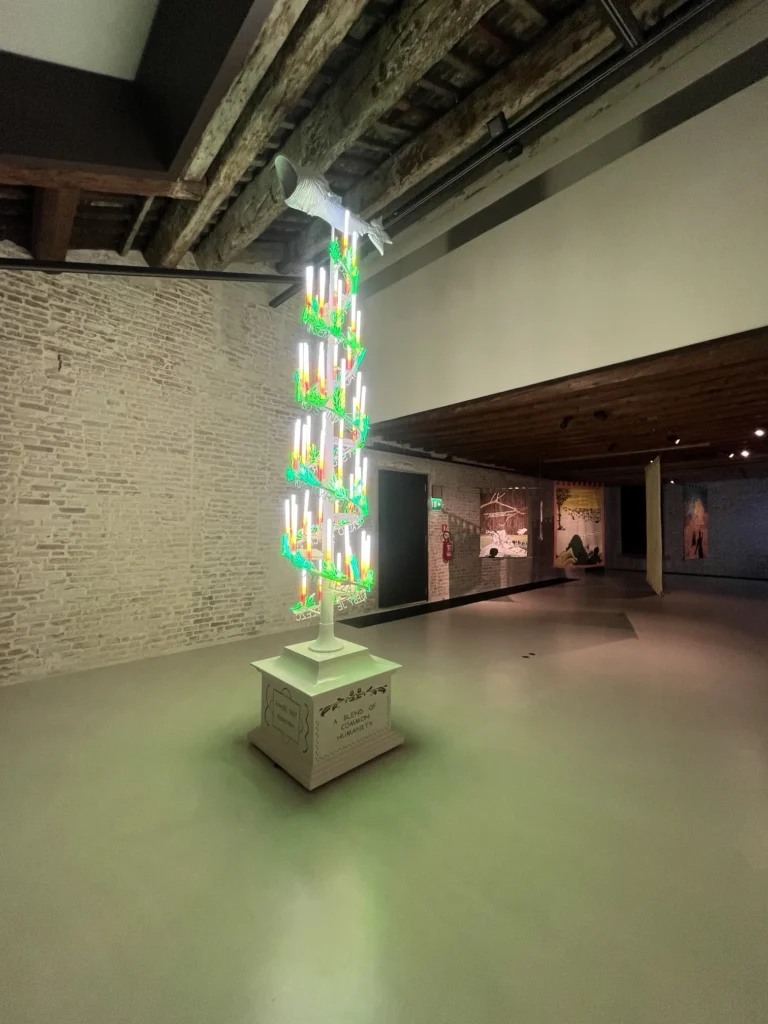
The heart of the exhibition is a monumental light about four meters high.
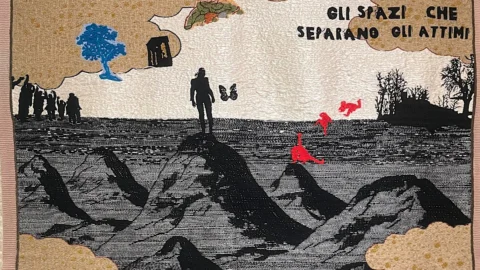
This is a contemporary reinterpretation of the traditional festive illuminations of Southern Italy. The essential and symbolic work takes the form of a relational architecture of light, interwoven with phrases, words, and plant elements that emerged during workshops with the participating families. A fish appears at the top, a metaphor for transformation, transition, and continuity. Alongside the illumination are six tapestries inspired by Baroque engravings, medieval miniatures, and Japanese illustrations. The textiles, populated with stylized figures and embroidered texts, narrate desires, memories, and reflections on individual and collective potential. The works were created by the Chanakya School of Craft in Mumbai, an organization committed to promoting women's emancipation through artisanal training.
«This new chapter confirms once again the extraordinary transformative power of art, a tool for participation, inclusion and awareness.", said Emma Ursich, CEO of The Human Safety Net, emphasizing how the project has given voice and visibility to people who rarely find space in public discourse. For Marinella Senatore, however, the installation represents "a constellation of voices," a shared space in which different stories, desires, and memories find common ground through relationships. The project is rounded out with a series of workshops that the artist will lead throughout the exhibition's duration. The meetings, hosted at La Casa di The Human Safety Net, will focus on somatic movement and Body Sound, a practice that uses voice, breath and movement to create collective sound compositions. With We Rise by Lifting Others, The Human Safety Net thus renews its commitment to promoting the narrative power of contemporary art as a tool for social participation, awareness and inclusion.
The Human Safety Net
The Human Safety Net is a global movement of people-helping people whose mission is to unlock the potential of people living in vulnerable situations so they can transform the lives of their families and communities. The Human Safety Net's programs support vulnerable families with young children (ages 0-6) and contribute to the inclusion of refugees in society through employment and entrepreneurship. To do this, we join forces with non-governmental organizations and
of the private sector in Europe, Asia, and South America. The driving force behind The Human Safety Net is a foundation established by Generali in 2017 and active in 25 countries with a network of 98 partners, including social enterprises. Its programs contribute to five of the United Nations Sustainable Development Goals (SDGs). The For Families program supports indicators related to early childhood (SDGs 3 and 4); the For Refugees program contributes to creating sustainable jobs and communities (SDGs 8 and 11); both programs are based on the principle that significant impact can only be achieved through collaborations between different countries and stakeholders (SDG 17). The Human Safety Net's home is located in the heart of Venice, in Piazza San Marco, near the Procuratie.
Marinella Senatore
Marinella Senatore (Cava de' Tirreni, 1977) develops a multidisciplinary artistic practice that investigates the aesthetic and political potential of collective processes, shared rituals, and participatory forms of cultural production. Her research includes installations, tapestries, collages, films, and collective performances, and is developed through community-based projects and participatory processes in which text, craft practices and vernacular traditions, choreography, sound, architecture, and light become tools to activate public space and generate forms of shared creation. In 2012, she founded The School of Narrative Dance (SOND), a free, nomadic, and non-hierarchical educational platform founded on empowerment, self-training, and collective storytelling. To date, the project has involved over 8 million participants in more than 23 countries, bringing together local communities, students, activists, artisans, musicians, and amateur performers in collaborative artistic processes. His work is regularly presented at leading international museums, including the Centre Pompidou, Palais de Tokyo, Kunsthaus Zürich, Museum of Contemporary Art Chicago, Berlinische Galerie, Castello di Rivoli, MAXXI, and Moderna Museet, and is represented in important public and private collections worldwide. He has participated in numerous international biennials, including the Venice Biennale, the São Paulo Biennale, and the Chengdu Biennale in China. Throughout his career, he has held numerous residencies, including at ISCP (New York), Künstlerhaus Bethanien (Berlin), and the American Academy in Rome. Alongside his artistic practice, Senatore is actively involved in teaching and research, collaborating with universities, art academies, and international cultural institutions on experimental pedagogical methodologies, participatory artistic practices, and collective processes of cultural production.